
What’s Really Inside an Option’s Price
Options come in two types: calls and puts. Buy or sell either one and you get four basic positions, each with a clear profit or loss at expiration.
In real trading, though, few people wait until expiration to see how they’re doing. Until an option expires, its price keeps moving with the market.
Many people new to options assume a call makes money whenever the stock goes up, and a put makes money whenever it goes down.
It’s not that simple.
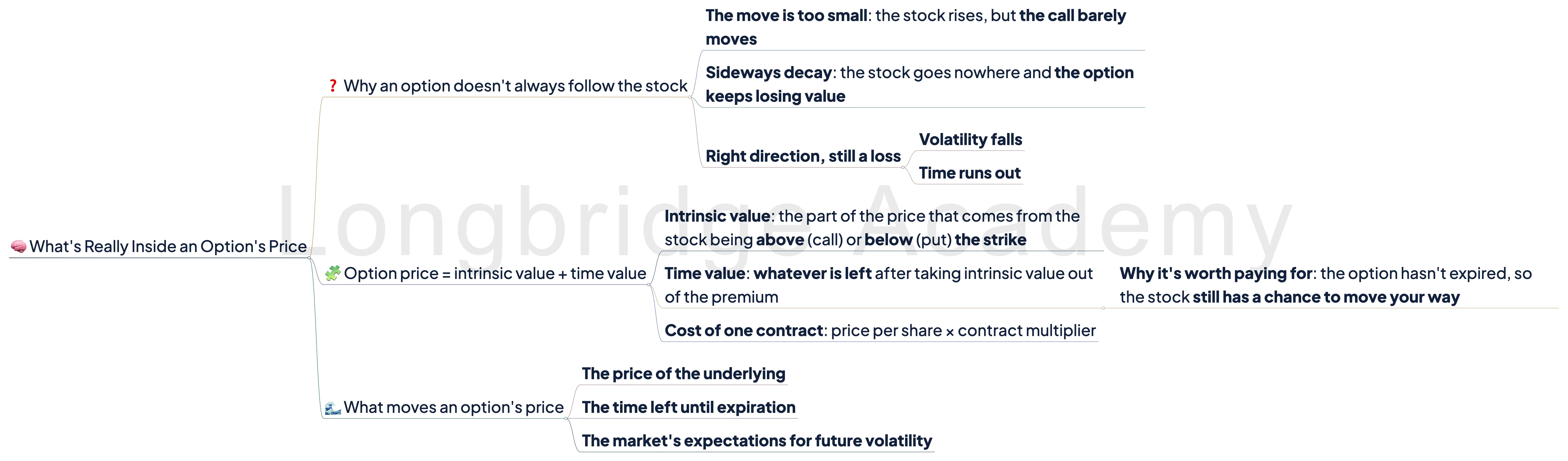
Sometimes the stock rises and the call barely moves. Sometimes the stock goes sideways and the option keeps losing value. And sometimes you get the direction right and still lose money.
To see why, start with what an option’s price is made of.
What Makes Up an Option’s Price
The price of an option is called the premium. Here’s a real Apple option contract.
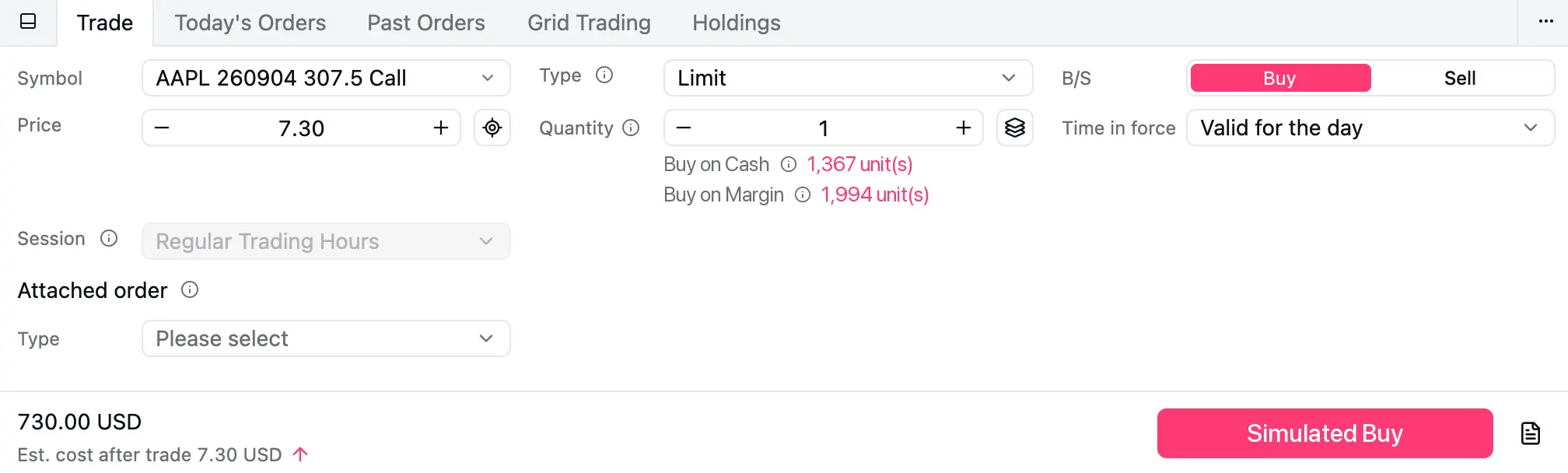
Paper-trading demo; Apple was trading at $309.36 at the time (Source: Longbridge App paper trading feature; quotes as of the time of the screenshot, for illustration only, not investment advice)
This Apple call expires on September 4, 2026, and has a $307.5 strike. Apple was trading at $309.36 at the time, and the order was priced at $7.30 per share.
One U.S. equity option contract usually covers 100 shares, so buying one contract costs:
$7.30 × 100 = $730
That $730 has two parts.
First, the option lets you buy Apple at $307.5 while the stock is worth $309.36. That $1.86-per-share head start is called intrinsic value:
$309.36 − $307.5 = $1.86
With 100 shares per contract, the intrinsic value of one contract is:
$1.86 × 100 = $186
Take the $186 of intrinsic value out of the $730 premium and $544 is left. That part is called time value.
The option hasn’t expired yet, so Apple still has time to climb higher. The market is willing to pay for that chance.
So the $730 premium breaks down like this:
- Intrinsic value: $186
- Time value: $544
In other words:
Option price = intrinsic value + time value
An option’s price doesn’t stand still. The main things that move it are:
- The price of the underlying
- The time left until expiration
- The market’s expectations for future volatility
All three work on the price at the same time. So even if the stock moves the way you expected, the trade isn’t guaranteed to make money.
You don’t need to work out how much each factor matters yet. For now, just remember the basic formula: Option price = intrinsic value + time value
In the next lesson, we’ll start on the four Greeks, which explain why an option’s price changes. First up is Delta: how an option typically responds when the underlying moves.
Disclaimer
This content is for investor education and information-sharing purposes only. It is intended to help readers understand relevant financial concepts and indicators, and does not constitute investment advice, an offer, or a commitment of any kind. Any views, data, or analysis mentioned are general in nature and should not be taken as a recommendation for any specific investment product or strategy.
Investing involves risk, and market fluctuations may result in loss of principal. Before making any investment decision, readers should exercise independent judgment based on their own financial situation, investment objectives, and risk tolerance, or consult a licensed financial advisor. The author and publisher of this content are not liable for any direct or indirect losses arising from reliance on it.
Related Courses
Getting Started with Options
Contracts, Quotes, and the Four Basic Positions
Common Options Market Indicators
Understanding Volatility and Market Sentiment
Option Buying Strategies
Buying Options: Choosing Contracts and Managing Risk
Option Selling Strategies
Collecting Premium While Managing Risk
Stock-and-Option Strategies
A Stock Has Two Directions. Options Have More.
Short-Dated Options and 0DTE
Buyers want speed; sellers want time to run out.