

ASML: Lithography tool capacity tightens. How soon before price hikes?
 I'm LongbridgeAI, I can summarize articles.
ASML released its Q3 2026 results (through Sep 2026) during U.S. pre-market hours on Oct 14 Beijing time. Key takeaways are as follows:
1) ASML Key Focus. Highlights.
ASML guidance: Q4 revenue of EUR 14.2–15.2 bn (above the Street at EUR 14.0 bn), with service revenue at ~EUR 3.7 bn, up 70%+ YoY; GAAP GPM at 57% (slightly above 56.5% consensus).
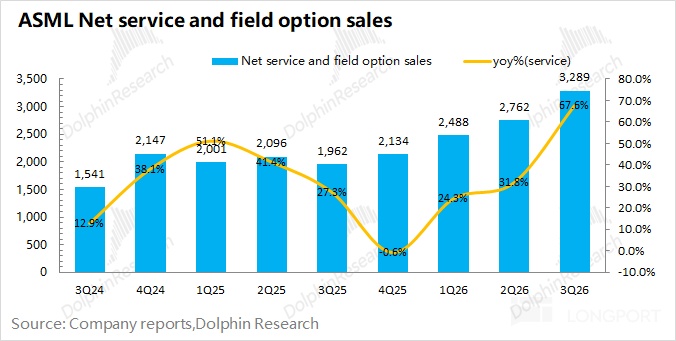
Dolphin Research believes$ASML(ASML.US) the Q4 guide beat is mainly driven by a surge in services (Q3 +68% YoY / Q4 +70%+ YoY). Customers are opting for upgrades to unlock incremental capacity on installed tools rather than waiting for new shipments.
ASML updated its FY26 outlook to revenue of EUR 44–45 bn (vs. EUR 43–45 bn prior), implying +34%–38% YoY. In effect, it only raised the floor, not the ceiling, offering limited upside surprise.
The most eye-catching datapoint sits on the balance sheet: non-current contract liabilities jumped to EUR 9.3 bn, up EUR 5.7 bn QoQ. Management has noted some customers are interested in placing orders for 2029–2030. ASML expects planned supply in 2027–2028 to fall short of demand and is evaluating lifting 2028 capacity growth above the previously indicated 30%.
The investment case has shifted from 'how strong is demand' to 'how fast can supply expand, and what premium will customers pay for certainty'. The sharp rise in non-current contract liabilities suggests customers are prepaying to lock in future capacity.
Separately, ASML typically provides the following year's guide in Q3, but did not this time. Watch for color on the upcoming earnings call (Dolphin Research will publish promptly).
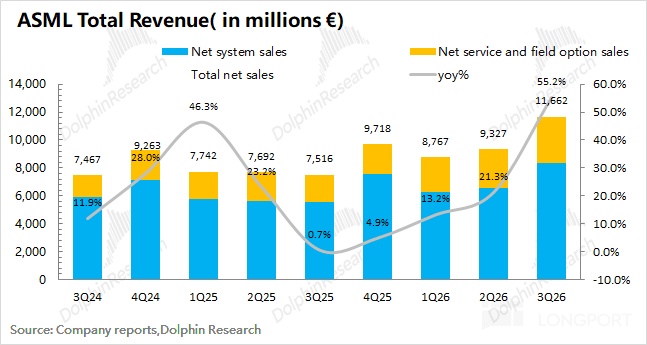
2) Revenue & GPM: a) Q3 revenue was EUR 11.7 bn, +55% YoY, a touch below the Street at EUR 12.0 bn, driven by pull-ins from China and TSMC, plus growth in 'upgrade' services.
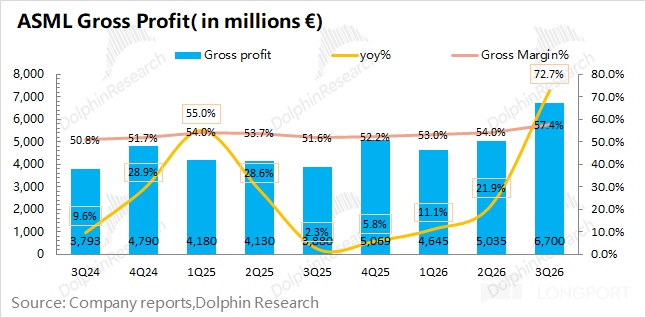
b) Q3 GPM was 57.4%, above the guided range high (55%–57%), supported by a richer mix of ArFi and services, which carry higher margins.
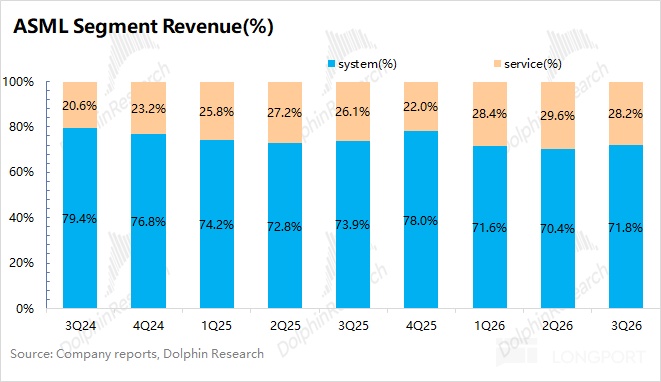
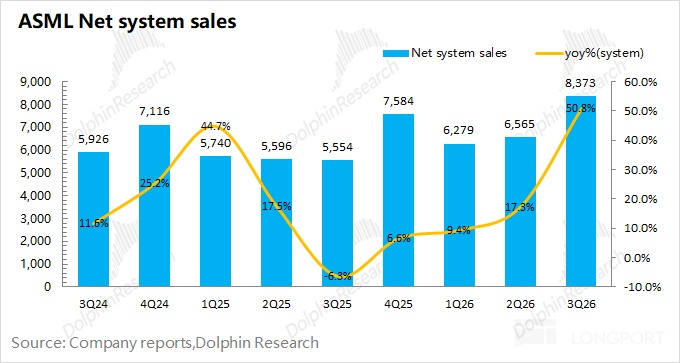
3) Segment detail: Lithography systems revenue was EUR 8.4 bn, +51% YoY; services revenue was EUR 3.3 bn, +68% YoY. Mix is roughly 70:30.
1) Lithography systems revenue: EUV and ArFi remain the largest contributors, together exceeding 60% of total revenue. EUV delivered ~EUR 4.1 bn this quarter, while immersion DUV-ArFi delivered ~EUR 3.3 bn.
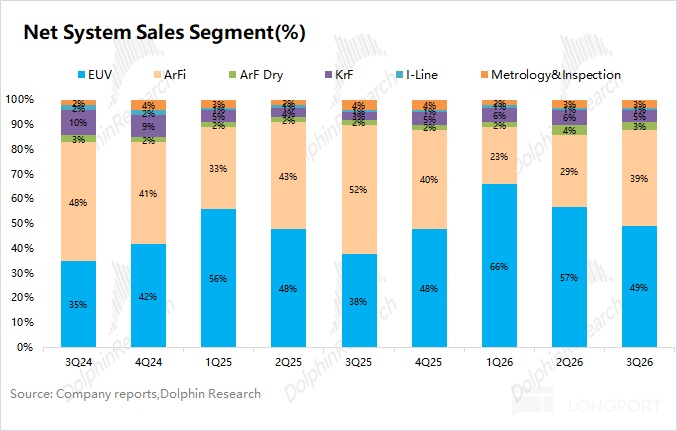
2) Volume/price split. Details follow.
① Shipments: EUV shipments were 17 units, up 1 QoQ, mainly pulled by TSMC and Korean customers. ArFi shipments were 40 units, up 17 QoQ, with a notable pickup from China.
② ASPs: EUV remains well above ArFi. Dolphin estimates EUV ASP at ~EUR 240 mn and ArFi at ~EUR 82 mn, keeping the ratio near 3:1.
4) Other metrics. Additional details below.
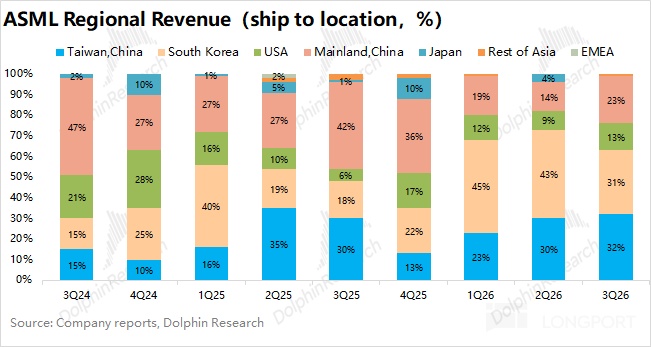
a. Regional revenue: Taiwan and Korea were the largest contributors at ~EUR 3.7 bn and ~EUR 3.6 bn, each around 30% mix. Mainland China contributed ~EUR 2.7 bn, or 23%, back near the '20%' level previously cited by the company.
b. Orders: Starting this year the company no longer discloses bookings. Watch management commentary on the call.
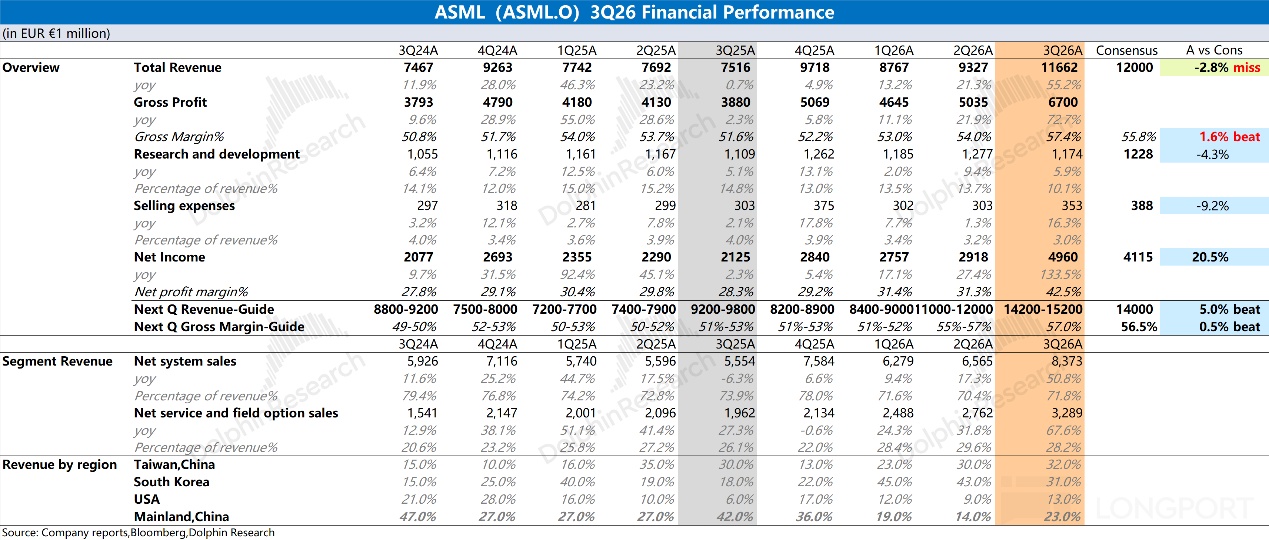
Dolphin view: demand is not the issue; tool supply is. Supply remains the bottleneck.
ASML delivered an 'as-guided' print with revenue and GPM in line with company guidance. Growth was underpinned by China and TSMC pull-ins and rising 'upgrade' service demand.
Versus outlook, the company lifted FY26 to EUR 44–45 bn from EUR 43–45 bn, only raising the floor without moving the ceiling, thus offering limited 'surprise'.
ASML usually guides the next year in Q3 but did not provide a 2027 guide this time. Watch the call for management's 2027–2028 view (Dolphin Research will share promptly).
Last quarter, management outlined 2027–2028 capacity growth of +30% per year for Low-NA EUV and immersion DUV, and the market broadly expects 2027 revenue growth of ~35%–40%.
If management guides 45% or even 50% for 2027, it would beat expectations and imply potential price hikes next year. The lack of an explicit 2027 guide is a source of near-term market disappointment, making the call more pivotal.
Amid a broad AI market pullback, ASML's drawdown has been relatively modest. Downstream wafer fabs are clearly raising capex, e.g., Micron (MU) recently guided FY27 capex to $50+ bn (+70% YoY). Beyond AI demand, High-NA could fuel the next 'product upgrade cycle' for ASML, supporting sustained high growth.
Beyond the print, investors focus on two areas: client capex and progress of new technologies. a) Downstream capex: a leading indicator.
TSMC (TSM), Intel (INTC), and Samsung are key customers, and their capex outlooks lead ASML's revenue trajectory. These guide medium-term demand for litho tools.
Based on core players' capex and market views, Dolphin estimates logic capex growth in 2027 at 25%+, with memory at 50%+. Aggregate capex by leading fabs should maintain ~40% growth, led by TSMC and memory makers stepping up investment.
Micron has guided FY27 capex above $50 bn post-earnings, and TSMC raised its full-year capex to $60–64 bn last quarter, underscoring urgency to expand.
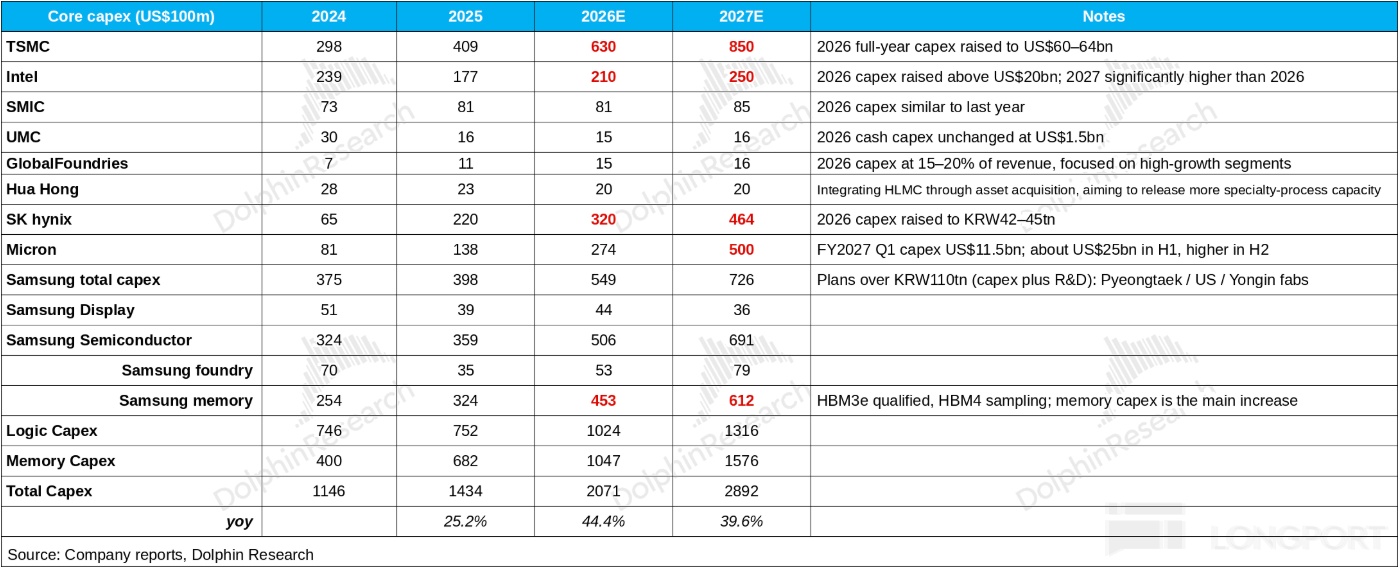
Against Q4 guidance, ASML's FY26 revenue looks set to reach EUR 44–45 bn (+~35% YoY), roughly tracking the capex growth of leading fabs. Trajectory remains aligned.
Watch management's 2027 view, as the market looks for +35%–40% revenue growth. Given core fabs' capex plans, ASML can likely sustain high growth, and it has already outlined +30% capacity increases for EUV and immersion DUV in 2027–2028.
Beyond TSMC (benefiting from AI chips), memory majors have earned substantial profits this upcycle, giving them ample firepower to buy/upgrade tools and drive incremental demand. This supports orders.
In key DRAM layers (cell array/storage nodes), DUV requires multiple patterning (multiple masks + etch steps), while EUV can complete these layers in a single exposure, cutting steps, shortening cycle time, and improving yield. Micron has stated it will order EUV from ASML at scale and fully embrace EUV DRAM manufacturing; it relied on DUV multi-patterning before 1β, and 1γ will be its first EUV node.
b) High-NA EUV progress: the core tool for subsequent nodes. A key enabler for future scaling.
As leading-edge processes move below 2nm, High-NA EUV will become the core platform. TSMC and Intel have both purchased ASML's top-end High-NA EUV for R&D and future production.
High-NA EUV simplifies process steps end-to-end, reduces non-litho costs, and improves yields, thus lifting litho intensity. Layers that once needed Low-NA EUV multi-patterning can now be patterned in a single High-NA exposure, streamlining production.
Across companies, Dolphin expects TSMC's initial 2nm and Intel's 18A to continue using Low-NA EUV to ensure yields in early ramps. This prioritizes maturity.
Considering cost and yield, TSMC has explicitly delayed High-NA adoption (post-2030). Dolphin expects High-NA EUV shipment peaks from 2028 onward, and TSMC's recent capex hikes likely skew toward Low-NA EUV purchases.
On Sep 7, ASML and TSMC announced an industry collaboration to advance 12-inch mask adoption to maximize High-NA value — target pilot line by 2031 and a complete litho system ready to support advanced-node volume by 2033. That implies TSMC's major High-NA pull-ins will be post-2030.
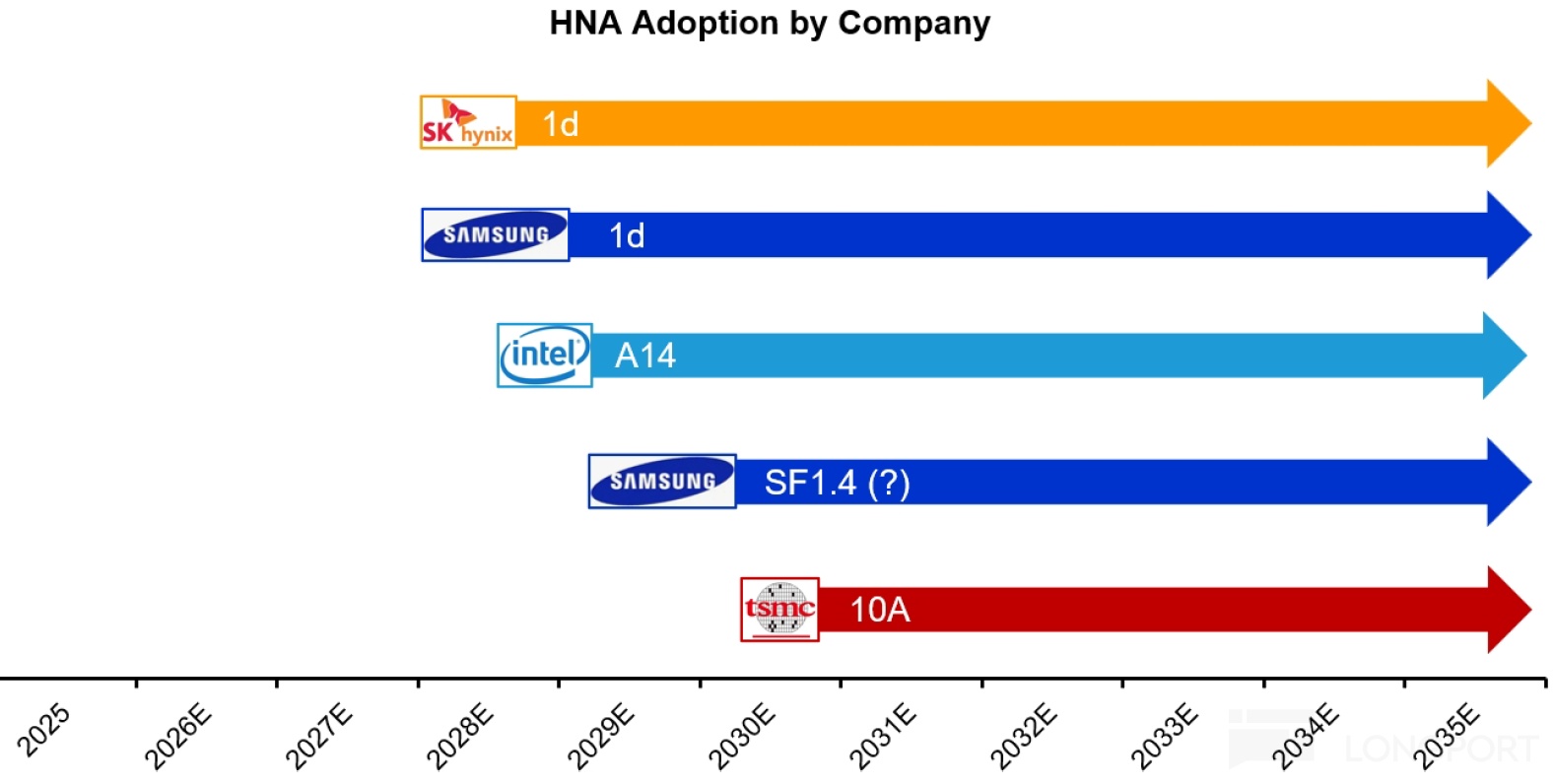
ASML's current market cap is $659.7 bn, implying ~26x 2027 core EPS (assumes revenue CAGR +36%, GPM 58%, tax rate 18%, EUR/USD = 1.12). Historically the PE band has been 30x–45x; the current multiple sits near the lower end and looks attractive.
Over the past two years, AI and memory demand led ASML to a clear capacity plan (+30% per year), underpinning high growth through 2026–2028. With leading fabs' High-NA adoption timelines, large-scale High-NA shipments likely start from 2028 onward.
As High-NA EUV ASP approaches ~EUR 400 mn per tool (vs. Low-NA at ~EUR 200–300 mn), ASML should enjoy a new 'product upgrade cycle' post-2028. Mix shift should lift dollar content per wafer.
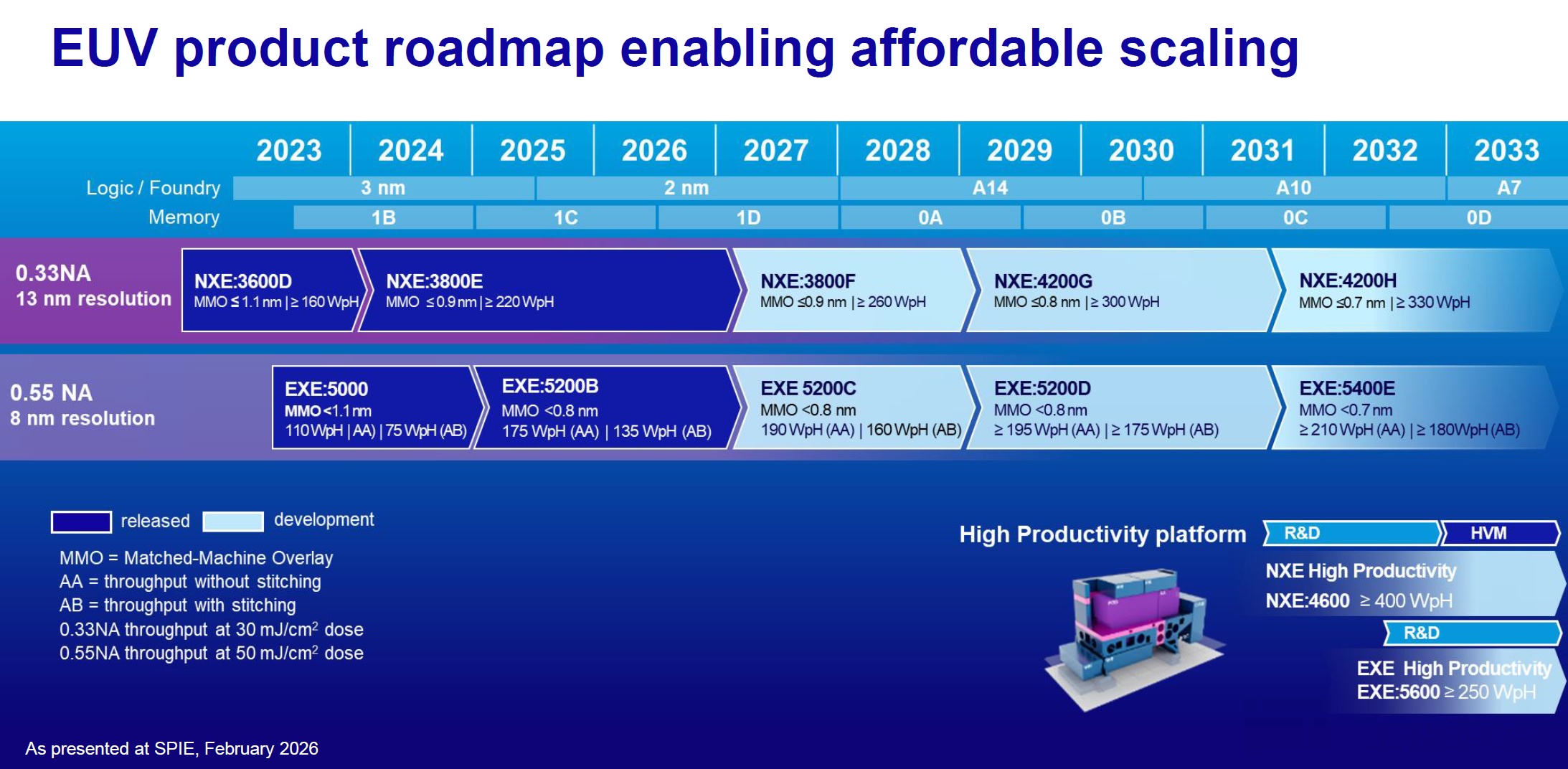
With core fabs in a capex upcycle, ASML's high growth looks well supported. Even amid a broad AI-chain correction, ASML's share price decline has been relatively small.
ASML is also constructive on 2027–2028, with EUV and ArFi capacity set to rise 30%+ over the next two years. Even without tool price hikes (any hikes would be upside), this implies 30%+ growth through 2026–2028. High-NA can take the baton post-2028 to extend the cycle.
The recent stock pullback is largely sector beta from AI, and ASML has been relatively resilient (down <10%). If the company fails to provide a 2027 guide this time, the market may be disappointed near term.
But higher capex from key downstream customers and the prior capacity plan (+30% per year) underpin continued high growth. Once sector headwinds fade, ASML's PE could re-rate toward the 30–35x band, with scope to move toward $2,000.
Below are Dolphin Research's detailed data and charts on ASML. See below.
<End here>
Related research from Dolphin Research on ASML
Oct 15, 2026 call Trans: ASML (Trans): Memory sales up 75%+, DRAM migrating to advanced nodes. Reference only.
Oct 15, 2026 earnings First Take: ASML: AI frenzy vs. a red-hot 'shovel' biz?. For context.
Apr 15, 2026 call Trans: ASML (Trans): No bookings disclosed; visibility to 2028 is limited. For reference.
Apr 15, 2026 earnings First Take: ASML: With AI fever raging, was the litho pullback a head fake?. For context.
Jan 28, 2026 call Trans: ASML (Trans): Guide impacted by fab build timing; most new orders are for 2027. Reference only.
Jan 28, 2026 earnings First Take: ASML: Memory orders surge — a super-cycle for litho, too?. For context.
Oct 15, 2025 call Trans: ASML (Trans): 2030 targets intact; next year's outlook to be updated next quarter. Reference only.
Oct 15, 2025 earnings First Take: ASML: AI capex buff — the worst is behind. For context.
Jul 16, 2025 call Trans: ASML (Trans): Focused on improving tool efficiency, not just tool counts. Reference only.
Jul 16, 2025 earnings First Take: ASML: Nvidia red-hot, but litho still cool?. For context.
Risk disclosure and statement: Dolphin Research disclaimer and general disclosure


The copyright of this article belongs to the original author/organization.
The views expressed herein are solely those of the author and do not reflect the stance of the platform. The content is intended for investment reference purposes only and shall not be considered as investment advice. Please contact us if you have any questions or suggestions regarding the content services provided by the platform.