

Cerebras: Demand and supply look ample—data-center capacity the binding constraint?
 I'm LongbridgeAI, I can summarize articles.
Cerebras (CBRS.O) released Q3 2026 results (through Sep 2026) before market open on Nov 13 Beijing time, with the key takeaways below.
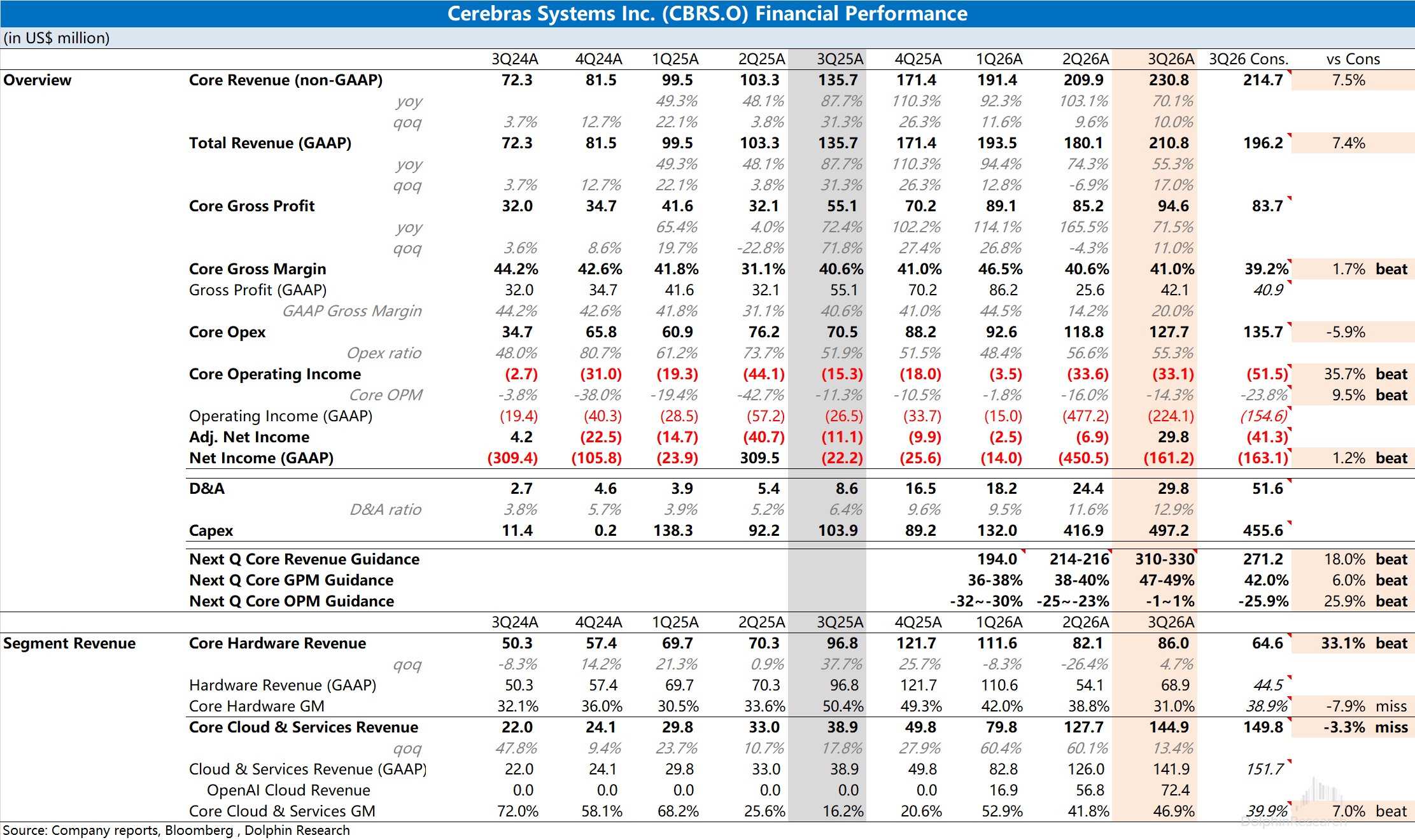
1) Guidance: Cerebras guides Q4 2026 Core revenue to $310–330 mn, implying ~39% QoQ at the midpoint and well ahead of Street ($271 mn). Core GPM is guided at 47–49% (Street 42.0%), with the midpoint up 700 bps QoQ.
Core OPM guidance is -1% to +1%. Management expects Core operating breakeven in Q4.
For 2027, management reiterated$Cerebras(CBRS.US) revenue will more than triple vs. 2026 (implying ~$2.85 bn based on the 2026 guidance midpoint of ~$950 mn, vs. Street $2.98 bn), with GPM progressing toward the 60% long-term target and OPM moving toward the 40% long-term goal.
2) Core metrics: Q3 Core revenue was $231 mn, +70% YoY, above the high end of guidance ($214–216 mn), marking a third straight beat.
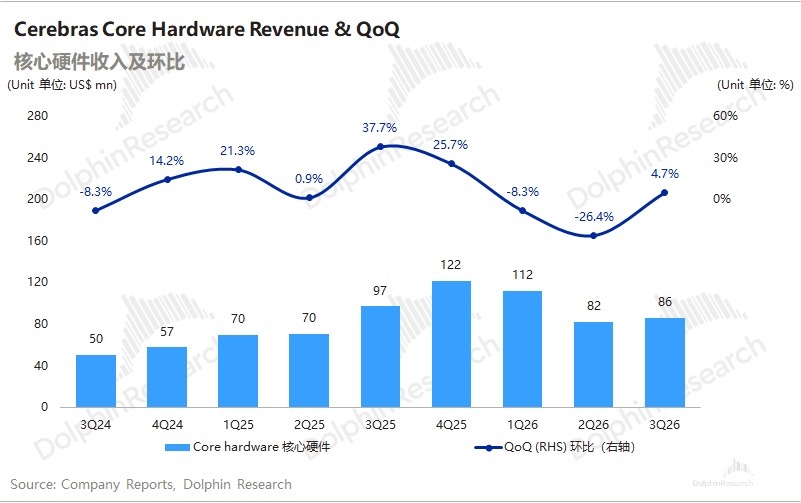
By mix, Cloud revenue rose 13% QoQ, while Hardware grew 5% QoQ. The beat was primarily driven by Hardware, as Core Hardware halted its prior declines.
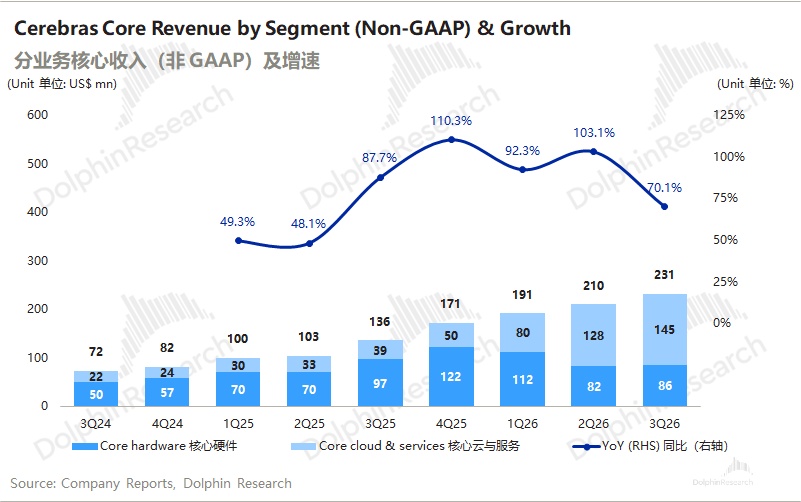
On a GAAP basis, revenue was $211 mn, +55% YoY, topping Street ($196 mn). The delta vs. Core revenue mainly reflects customer warrant amortization (-$36 mn to revenue) and OpenAI data center pass-through revenue ($16 mn).
Note: Core revenue = GAAP revenue + warrant amortization − pass-through revenue.
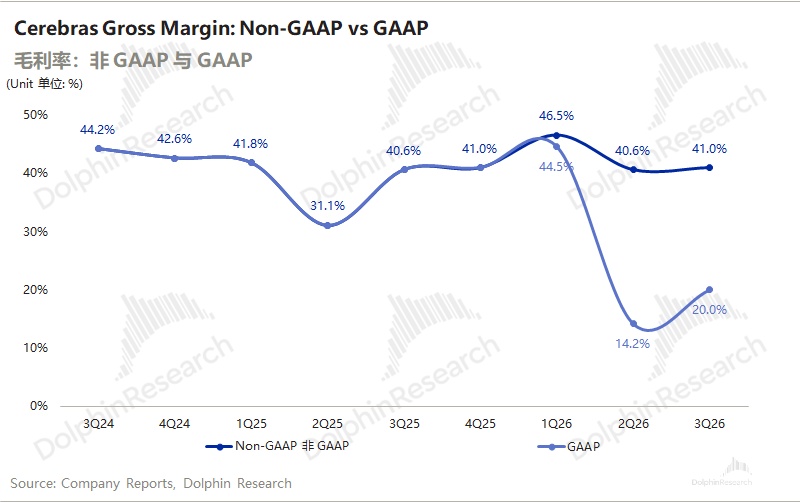
Q3 Core GPM was 41.0%, up 40 bps QoQ and above the guided range (38–40%). Management had expected Q3 to be the trough GPM due to back-leasing owned systems from customers to accelerate inference capacity, which carries higher costs. Actuals came in better, suggesting the trough shifted to Q2.
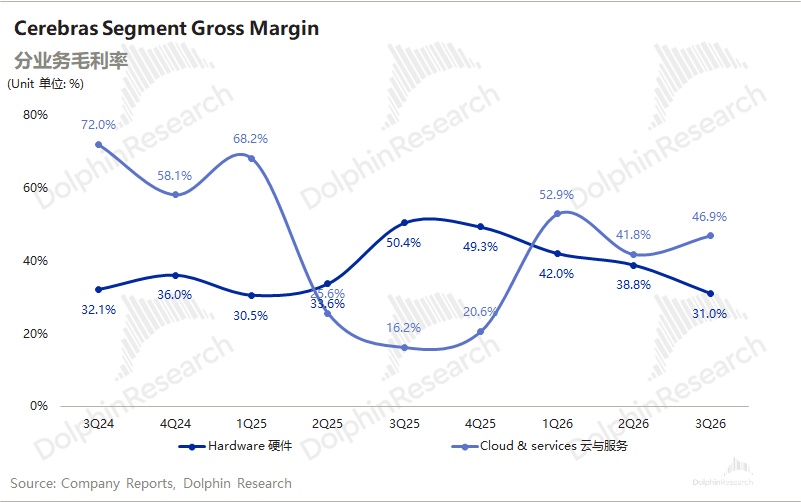
By segment, Cloud Core GPM was 46.9%, up 510 bps QoQ, driven by higher pricing and margins on new contracts. Hardware Core GPM fell to 31.0% due to final deliveries under a discounted 2025 agreement with a major customer (MBZUAI or G42), plus higher input costs and inventory write-downs.
3) Business detail: Cerebras operates Cloud (Cerebras Cloud) and Hardware (CS-series systems); Cloud is now the largest revenue stream, accounting for 63% of Core revenue this quarter.
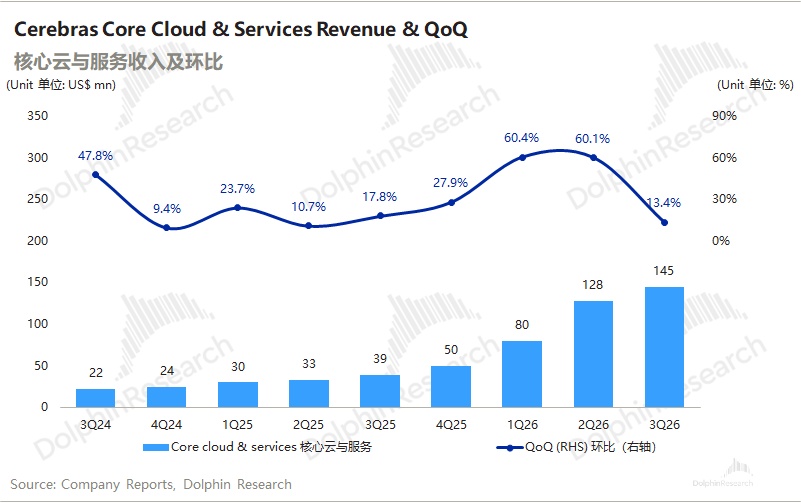
Q3 Core Cloud revenue was $145 mn, +13% QoQ, largely driven by incremental OpenAI demand. Management said Cloud growth is fully constrained by data center build timelines, not by pricing or demand, with demand far outstripping supply. New DC capacity will only ramp from Dec, contributing little to Q4, so Cloud revenue is guided to be flat QoQ next quarter.
Core Hardware revenue was $86 mn, +5% QoQ and ahead of Street ($65 mn). Shipments under new hardware wins with multiple customers (including Oracle) will start in Q4 and run at least through H1 2027. Hardware is expected to account for ~50% of revenue in Q4 and Q1 next year.
Customer mix: OpenAI contributed $72 mn this quarter (incl. DC pass-through), up $16 mn QoQ, while related parties MBZUAI and G42 combined for 45% (38% and 7%). The top three customers accounted for ~79%, indicating continued concentration.
On backlog, remaining performance obligations (RPO) stood at $26.1 bn, up $0.7 bn QoQ, with the bulk still from OpenAI’s 750 MW take-or-pay contract ($20 bn+).
Note: (i) New orders signed after quarter-end, including a large Oracle order, are not yet included. (ii) Within the next 24 months (through Sep 2028), the expected recognition ratio rose to 33% from 22% in Q2 ($5.6 bn → $8.6 bn), with months 25–48 at 44% ($10.9 bn → ~ $11.5 bn), pulling more revenue forward.
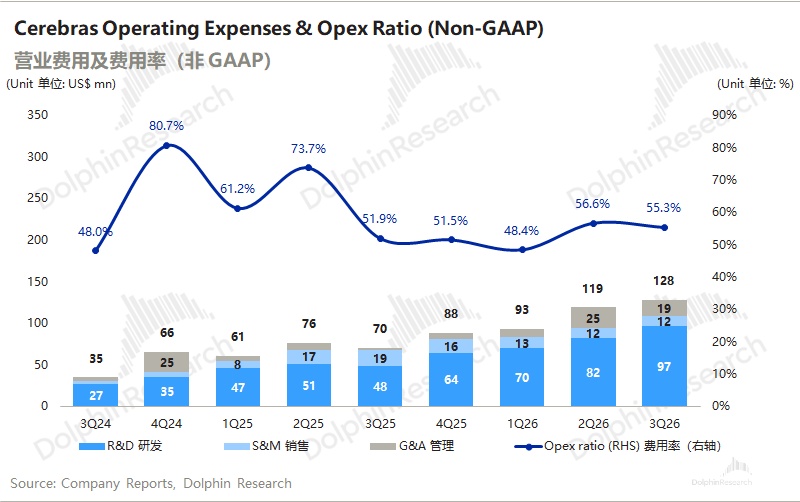
4) Opex and profit: Q3 Core opex was $128 mn, +81% YoY, including R&D of $97 mn, roughly doubling YoY. Core opex ratio was 55.3%, stable.
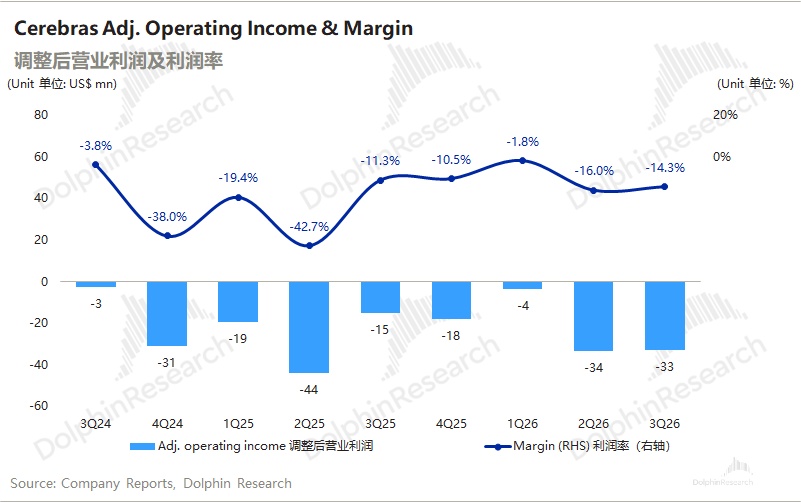
Q3 Core operating loss was $33 mn, with OPM of -14.3%, an improvement of 170 bps QoQ and better than Street (-23.8%).
Supported by interest income from $7.8 bn of cash and equivalents (Q3 interest and dividends of $82 mn), Core net income turned positive to $30 mn, marking the first Core profit since listing.
GAAP net loss was $161 mn, broadly in line with Street (-$163 mn), mainly due to SBC and warrant amortization.
For the transcript, click here.
Dolphin Research view: Results are solid; the bottleneck is data centers
Cerebras delivered strong Q3 results and Q4 guidance, with Core profitability turning positive, and the upside largely from Hardware. Cloud is constrained by DC capacity build delays, so next quarter is guided to be flat QoQ.
GPM trajectory: Q1 (46.5%) → Q2 (40.6%) → Q3 (41.0%) → Q4 (guide 47–49%). The previously guided GPM trough in Q3 has already been pulled forward. Q4 GPM uplift is driven by new hardware shipping at higher current prices (Q3 Hardware GPM was only 31.0% due to the last batch of legacy discounted orders), and by higher-priced new Cloud contracts. Management expects Core GPM to top 50% in the near term and keep progressing toward the 60% LT target.
Addressing the concern that low Hardware GPM implies poor yields, management clarified that TSMC’s wafer and parametric yields are high. Lower Hardware GPM reflects manufacturing ramp dynamics and early customer discounts, and margins should improve meaningfully over the next few quarters.
The market’s focus this quarter is less on Q3 prints and more on the following:
a) OpenAI relationship and orders: OpenAI is the largest single customer and main RPO source, with a 750 MW take-or-pay and 1.25 GW of optional capacity.
On OpenAI, management responded directly:
(i) The relationship is unchanged, but Cerebras capacity is insufficient for broader rollout.
(ii) The issue is delivery cadence, as DC capacity stood up later than expected post signing, and initial tranches are behind schedule. Delays stem from land, power, and facilities; chips and systems are not the bottleneck, and worst-case offsets are already reflected in RPO. Cancellable capacity this year is expected to be under 5% of the total, with no cancellations to date, and the company expects to be back on schedule in H2 2027.
(iii) Per the contract, OpenAI can switch from Cloud services to direct Hardware purchases, but its own DCs are also behind. The 1.25 GW option (online from 2029) has not been discussed yet.
Management acknowledged OpenAI will use multiple hardware stacks, and OpenAI has announced an in-house inference chip in early testing aimed at low-latency inference. On chatter that Cerebras systems cannot run frontier models, management explicitly denied it, noting CS-3, CS-4, and CS-5 support frontier-scale and larger models.
b) New customers and hardware orders: Over the past six months the company signed three hyperscalers, with hardware demand spreading from OpenAI to hyperscale CSPs and neoclouds.
(i) Microsoft (new): announced a cloud services partnership (Cerebras to provide cloud inference), with details in H1 2027 and revenue starting then, and with pre-service milestones in the contract.
(ii) Oracle: procuring Cerebras hardware for U.S. DCs to power OCI fast inference, expected online by summer 2027.
(iii) Amazon AWS: partnership signed in Jun, starting with leasing Cerebras systems in AWS DCs and including purchase options, minimum manufacturing capacity protection, and exclusivity. A Trainium + CS-3 disaggregated inference solution is slated to launch on Bedrock in Q1 2027.
(iv) Neoclouds: Gimlet Labs plans 100 MW (first shipments in 2026, CS-4 from 2027), and General Compute signed a multi-year hardware purchase agreement.
The disclosed $26.1 bn RPO still skews to OpenAI’s mega deal, and the sizes and recognition profiles for Oracle and Microsoft were not disclosed and are not in current RPO. Hardware revenue will be lumpy and tied to delivery schedules, so whether new wins translate into sustained growth in 2027 depends on forthcoming guidance.
c) Capacity and DC resources: As noted earlier, demand is not the constraint, supply is not the constraint; data centers are the constraint, which was even more evident this quarter.
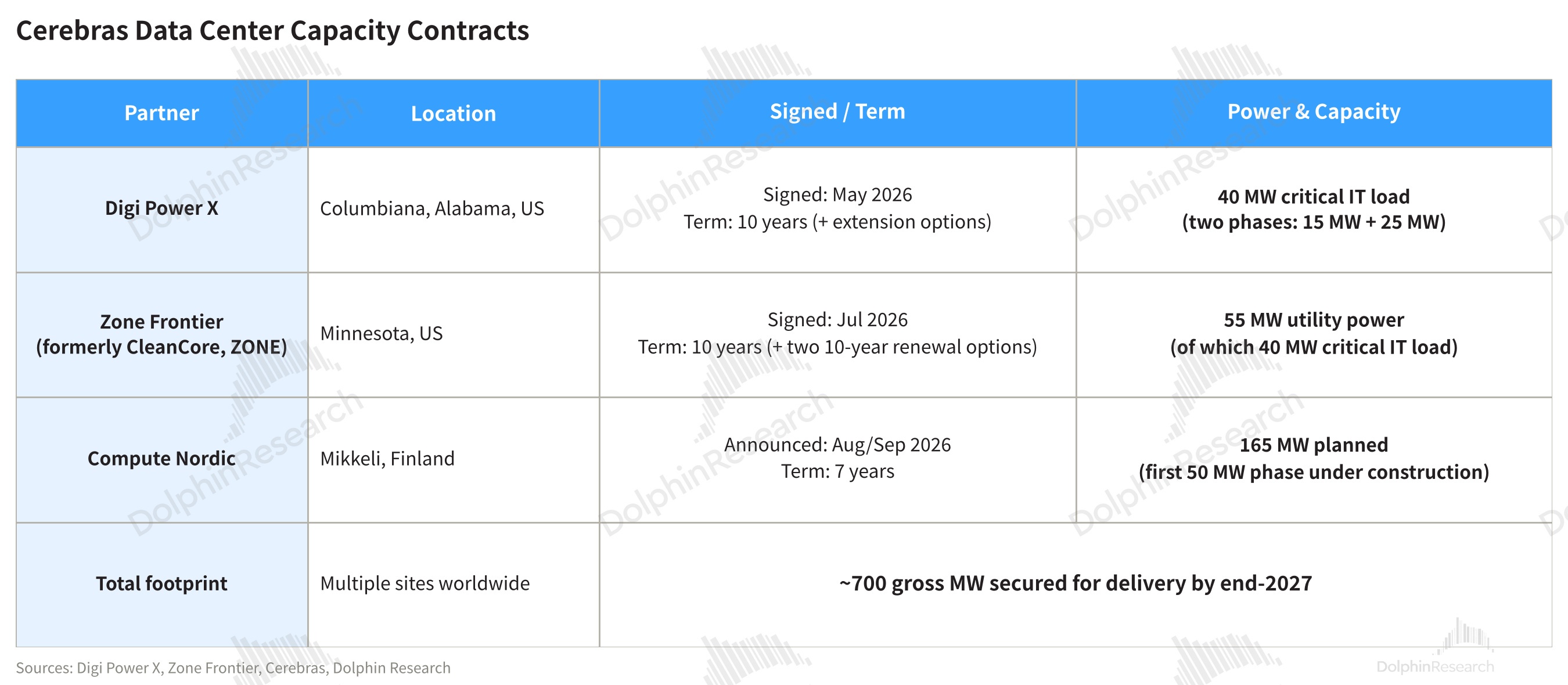
Q4 Cloud flat QoQ guidance reflects DC build delays, and the company has now secured ~700 MW (gross) of DC capacity for delivery through end-2027 (vs. prior ‘600 MW+’).
Given a potentially tightening U.S. policy environment for DC builds, over 75% of the 2027 online capacity will be outside the U.S. New facilities in Canada, France, and Norway will go live in the coming months. The company also signed new capacity in Norway and Finland this quarter, and a Sao Paulo, Brazil DC is nearing final signing.
With in-house chips, the company avoids sharing ~70% GPM with third parties and does not pay for high-priced HBM, resulting in lower capex per MW.
Given the 750 MW OpenAI order slated for completion by end-2028, we anchor valuation to 2028. Dolphin Research estimates 2028 Core revenue of $8.5 bn, split into $2.3 bn Hardware and $6.2 bn Cloud.
We assign Core OPMs of 35% for Hardware and 28% for Cloud, with a 14% tax rate. Hardware contributes $700 mn after-tax OP, and Cloud contributes $1.5 bn after-tax OP.
Applying 25x PE to 2028 Hardware and 20x PE to Cloud, and factoring in $7.0 bn additional borrowing through end-2028, netting the $7 bn and discounting back at 15%, the midpoint valuation is roughly $30 bn.
On shares, the IPO lock-up was released in 11 tranches, most before end-Sep. Management confirmed on the call the lock-up fully expired on Nov 9. The staggered unlock pressure has been largely reflected in the stock, and the overhang is basically cleared.
Overall, this is a beat-and-raise quarter, with the GPM inflection arriving a quarter early and Core operating breakeven in sight. With Microsoft and Oracle added, demand is broadening to hyperscalers, easing concerns about reliance on OpenAI.
There are blemishes: near-term upside is driven by lumpy Hardware deliveries, Cloud is capacity-constrained, and OpenAI deliveries have slipped. The market would prefer to see Cloud scale, which is more sustainable.
Dolphin Research views the post-market rally as a reset on beats and guidance plus the float overhang clearing, which should lift Street estimates and guide valuation toward ~$30 bn (our neutral case).
The strategic focus has shifted to Cloud, which could command a higher multiple. For now, OpenAI remains the only at-scale Cloud customer, and landing more large CSP deals would drive both earnings and multiple expansion.
<End>
Dolphin Research archive on Cerebras:
Oct 9, 2026 deep dive: Cerebras: A wafer-scale ‘monster’ without cutting wafers. Can it challenge Nvidia?
Risk disclosure and statement: Dolphin Research disclaimer and general disclosure
The copyright of this article belongs to the original author/organization.
The views expressed herein are solely those of the author and do not reflect the stance of the platform. The content is intended for investment reference purposes only and shall not be considered as investment advice. Please contact us if you have any questions or suggestions regarding the content services provided by the platform.