I'm LongbridgeAI, I can summarize articles.
In the face of Trump's fluctuating tariffs, Mercedes, Stellantis, and General Motors have withdrawn their 2025 performance guidance, while Porsche and Volvo have also lowered their expectations or cut costs. High tariffs have disrupted the supply chain and driven up global car prices, forcing many automakers to adjust their production layouts and shift towards domestic manufacturing in the United States to avoid policy risks
Under the impact of tariffs, several major car manufacturers in Europe have withdrawn their performance guidance for 2025.
On Wednesday, Germany's Mercedes-Benz Group and Stellantis withdrew their performance guidance for this year, citing that tariffs have disrupted supply chains and driven up global car prices.
Mercedes stated that the uncertainty brought by tariffs is too high to reliably assess this year's business development. If the current trade barriers persist, the company's operating profit, cash flow, and profit margins will be impacted. Volkswagen maintained its performance expectations largely unchanged but warned that it has not yet accounted for the impact of tariffs.
Additionally, American automaker General Motors, despite exceeding expectations in the first quarter, announced on Tuesday the cancellation of its annual guidance and suspended its stock repurchase plan, even delaying the timing of its earnings call.
Trump's Tariff Policy Fluctuates, Making It Difficult to See the Industry's Future
According to CCTV News, Trump's 25% tariff on imported cars officially took effect on April 3. However, opposition to the government's tariff policy continues to grow, putting increasing pressure on the government. On April 29, Trump signed a notice allowing for some compensation to be provided to auto manufacturers that assemble cars in the U.S. for the tariffs on parts imported for those vehicles.
Trump's tariff policy fluctuates repeatedly, coupled with a weak local market in Europe and intensified competition... European car manufacturers are under significant pressure this year, and they have been working hard to assess the impact of tariffs:
High-end sports car manufacturer Aston Martin has export business to the U.S., with many models manufactured locally in Europe before being exported to the North American market. The company announced on Wednesday: "We will postpone shipments to the U.S. to first deplete the inventory held by U.S. dealers to mitigate the impact of tariffs."
Volkswagen Group's CFO stated on Wednesday that they are prepared to work with U.S. policymakers to expand production in the U.S. to avoid tariff risks. Currently, Volkswagen has factories in Tennessee and Mexico, and there is a possibility of increasing investment to produce more models domestically in the U.S.
Mercedes-Benz is also making plans, considering shifting one of its models to its factory in Tuscaloosa, Alabama, to reduce the tariff impact on vehicles exported from European factories. Mercedes' CFO stated that if tariffs remain unchanged, the company's automotive manufacturing profit margin will decline by 35%. Data estimates that the company's profit margin is expected to drop from the previous 6% to 8% directly to below 3%
Earlier this week, Porsche lowered its profit forecast and warned that it could not estimate the impact of tariffs on the company after June. The company, which has no factories in the United States, is one of the automakers most affected by tariffs.
Volvo simply withdrew its annual performance guidance and announced plans to cut nearly $2 billion in costs.
Additionally, S&P Global Mobility significantly lowered its forecast for global light vehicle annual production earlier this month, now estimating that automakers' vehicle production this year will be approximately 87.91 million units, a decrease of 1.56 million units from last month.
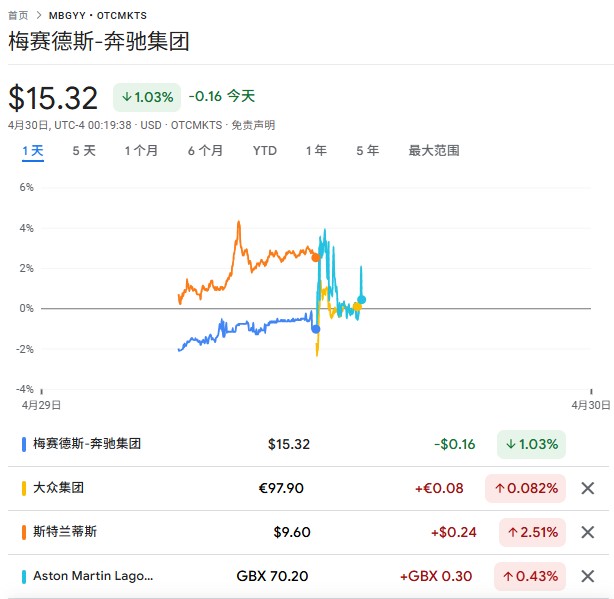
In terms of stock prices, on Wednesday, Mercedes and Volkswagen saw their stock prices decline, while Aston Martin recovered early losses, and Stellantis's stock price rose by as much as 4.6%.
Analysts pointed out that the reason for Stellantis's stock price increase is the company's improved performance in the North American market and pricing that exceeded expectations. As a manufacturer whose vehicles sold in the U.S. are mostly produced locally, Stellantis will benefit from Trump's latest tariff exemptions.