
 I'm LongbridgeAI, I can summarize articles.
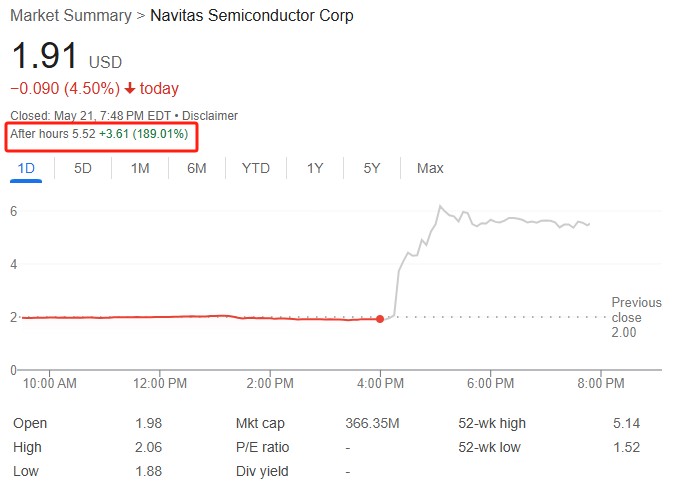
On May 21st local time, Navitas Semiconductor announced a collaboration with NVIDIA to develop the next generation 800V high-voltage direct current (HVDC) architecture to power the "Kyber" rack-level system supporting GPUs, including Rubin Ultra. Navitas's gallium nitride and silicon carbide technologies will play a key role in this collaboration. After the U.S. stock market closed on Wednesday, Navitas's stock price surged by 200%
NVIDIA is collaborating with Navitas Semiconductor to jointly develop an 800V power architecture, which is expected to revolutionize the power supply system for AI data centers.
On May 21 local time, Navitas Semiconductor announced its partnership with NVIDIA to develop the next-generation 800V high-voltage direct current (HVDC) architecture, which will support GPU-powered "Kyber" rack-level systems, including the Rubin Ultra. Navitas's gallium nitride and silicon carbide technologies will play a key role in this collaboration.
Media reports indicate that this represents a significant technological leap in the field of data center infrastructure, particularly in supporting gigawatt-level AI computing loads. Navitas's technology is expected to significantly enhance energy efficiency and reduce copper usage to some extent. After hours trading on Wednesday, Navitas's stock price surged by 200% at one point.
Power Demand in the AI Era Drives Revolutionary Solutions
Modern AI data centers require gigawatt (GW) level power to meet the growing demands of AI computing.
According to media reports, current data center architectures use traditional 54V rack power distribution systems, with power limited to several hundred kilowatts (kW). This architecture requires bulky copper busbars to transmit low-voltage power from the power racks installed in the racks to the computing trays. When power increases to over 200kW, this architecture reaches its physical limits due to issues such as power density, copper demand, and reduced system efficiency.
NVIDIA's solution is to directly convert 13.8kV AC grid power to 800V high-voltage direct current at the periphery of the data center, using solid-state transformers (SST) and industrial-grade rectifiers, eliminating multiple AC/DC and DC/DC conversion steps to maximize efficiency and reliability.
Due to the higher voltage level of 800V HVDC, the thickness of copper wires can be reduced by up to 45%.
According to the I²R loss principle, the same power can be transmitted by increasing voltage and reducing current. Using the traditional 54V DC system, powering a 1MW rack requires over 200kg of copper, which is unsustainable for the next generation of AI data centers that require gigawatt-level power