
GGII: Structural insufficiency in lithium iron phosphate material production capacity, a new round of expansion is being initiated
 I'm LongbridgeAI, I can summarize articles.
GGII released a report stating that although the lithium iron phosphate cathode material industry is facing overcapacity and a slowdown in construction, it is expected that from the second half of 2024 to the first half of 2025, the industry will initiate a new round of expansion due to the high growth in demand for energy storage lithium batteries. The shipment volume of lithium iron phosphate cathode materials in China is expected to reach 1.61 million tons in 2025, a year-on-year increase of 68%. The effective capacity utilization rate is expected to exceed 70% in 2025 and surpass 75% by 2027
According to the Zhitong Finance APP, on August 20, GGII released a report stating that from 2023 to 2024, due to the overcapacity in the lithium iron phosphate cathode material industry, the construction of new capacity is slowing down, leading the lithium iron phosphate material equipment industry into a downturn. However, with the high growth in demand for energy storage lithium batteries in H2 2024 to H1 2025 and the mass production of next-generation materials, the lithium iron phosphate cathode material industry is about to initiate a new round of capacity expansion.
According to GGII data, in H1 2025, China's lithium iron phosphate cathode material shipment volume is expected to reach 1.61 million tons, a year-on-year increase of 68%. The capacity utilization rate of lithium iron phosphate materials is expected to increase significantly, with shipments projected to reach 3.5 million tons in 2025, and the effective capacity utilization rate is expected to exceed 70%. By 2027, the effective capacity utilization rate is expected to exceed 75%.
Forecast of China's lithium iron phosphate cathode material capacity and utilization rate from 2023 to 2027 (10,000 tons, %)
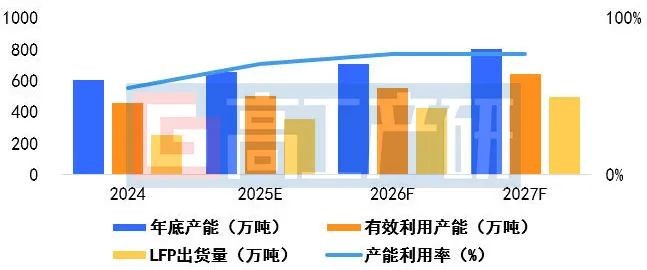
Data source: GGII Lithium Battery Research Institute, August 2025
In simple terms, the effective capacity utilization rate of the lithium iron phosphate cathode material industry is still not very high, but the industry has the following characteristics that lead to structural capacity shortages, necessitating expansion to address these structural issues.
First, there is a structural capacity shortage among enterprises in the lithium iron phosphate material industry. Some companies with good product performance and customer resources, such as Yuneng New Energy, FuLin Precision, Dangsheng Technology, Bangpu Recycling, and Dynanonic, have already exceeded a 90% capacity utilization rate. If these companies need to increase their shipment volume, they must expand production or seek outsourcing. Many other lithium iron phosphate material companies have low capacity utilization rates due to their product quality not meeting the requirements of first and second-tier lithium battery companies.
Second, the upgrade of lithium iron phosphate material products, with significant increases in shipments of third-generation and even fourth-generation lithium iron phosphate cathode materials, is driving the widespread application of the two-milling and two-sintering process. Some existing single-sintering capacity needs to be discounted by 60-70% to produce two-sintering products.
Third, some lithium iron phosphate material capacities will be eliminated or cleared out, and the elimination of this capacity will lead to structural tension in the lithium iron phosphate cathode material capacity.
The following types of lithium iron phosphate cathode material capacities are expected to be eliminated:
-
The green electricity direct connection policy will accelerate the transfer of lithium iron phosphate material capacity to areas rich in green electricity, with some high-cost capacities, especially in eastern regions, gradually being abandoned due to high costs;
-
The upgrade of lithium iron phosphate cathode material products is significant, and some companies will be eliminated for failing to keep up with the pace of product upgrades;
-
The lithium iron phosphate cathode material industry has experienced a 2-3 year downturn, and some capacities will be cleared out due to company bankruptcies or cash flow exhaustion
-
Some lithium iron phosphate cathode material production lines are poorly designed, with kilns being too short, insufficient layers, and small sand mills, leading to excessive energy consumption or the inability to upgrade technology, resulting in new products failing to meet the latest requirements for lithium iron phosphate cathode materials, and facing the risk of elimination.
Fourth, the lithium iron phosphate cathode material industry experiences seasonal fluctuations, with the industry in a seasonal low in the first half of the year and a seasonal peak in the second half. In the past three years, the shipment volume of lithium iron phosphate cathode materials in the second half of the year has been about 151% of that in the first half, making the industry prone to seasonal capacity tightness in the second half.
2022-2025 H1 Semi-annual Shipment Volume of Lithium Iron Phosphate Cathode Materials (10,000 tons)
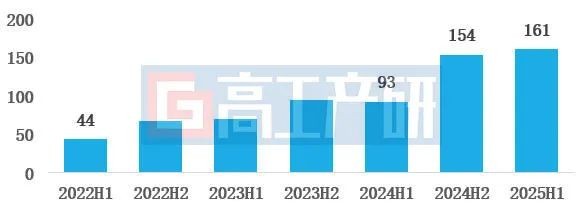
Data source: GGII (Gaogong Industry Research Institute Lithium Battery Research Institute), August 2025
Fifth, as South Korean lithium iron phosphate batteries gradually ramp up production, overseas lithium iron phosphate cathode material capacity is insufficient due to trade barriers. Chinese lithium iron phosphate cathode material companies are actively building overseas capacity. According to statistics from GGII, as of H1 2025, the overseas capacity of Chinese lithium iron phosphate cathode material companies is only 30,000 tons, while the planned overseas capacity for Chinese lithium iron phosphate cathode materials is expected to reach 580,000 tons.
GGII predicts that the next round of expansion in lithium iron phosphate cathode materials will have the following characteristics:
-
Expansion will mainly be led by lithium iron phosphate cathode material companies with product advantages;
-
Expansion locations will primarily be in the western regions, with overseas locations as a supplement, while expansion in the eastern regions will be relatively limited;
-
Focus will be on high-end products, primarily high-end lithium iron phosphate cathode material production lines with two grinding and two firing processes;
-
During expansion, equipment will rapidly scale up, with roller kilns primarily exceeding 90 meters.
The next round of expansion in lithium iron phosphate cathode materials may impact lithium iron phosphate cathode material equipment companies as follows:
-
Leading lithium iron phosphate cathode material equipment companies will see an increase in market share, helping them emerge from a low period, while many lithium iron phosphate material equipment companies will struggle to secure orders;
-
Lithium iron phosphate cathode material equipment companies with product advantages, quality advantages, scaling advantages, overseas advantages, and leading customer advantages are expected to continue winning orders in the competitive landscape