
 I'm LongbridgeAI, I can summarize articles.
FedEx will release its financial report on Thursday, which may provide clues for the current record-high U.S. stock market and reveal whether the bull market can continue. Dow Theory states that the industrial and transportation indices must confirm each other to validate market trends, but this year the two have not aligned, suggesting that the market may face resistance. The express delivery industry has seen demand affected by tariff policies, and Wall Street's attitude towards express delivery stocks has cooled, with FedEx's stock price dropping 20% since 2025
According to the "Dow Theory" stock market analysis framework, the financial report released by FedEx (FDX.US) on Thursday may provide clues for the current stock market, which has been hitting new highs, revealing how long this rally can continue.
The Dow Theory was proposed by Charles Dow in the early 20th century, who also invented the Dow Jones Industrial Average and the Dow Jones Transportation Average. The core view of this theory is that only when the movements of the industrial index and the transportation index confirm each other (i.e., when one rises/falls, the other follows suit) can a true market trend be confirmed. However, this "confirmation" has been absent this year: the Dow Jones Industrial Average continues to set records, while the transportation index remains sluggish.
From the perspective of the Dow Theory, the current stock market situation has shown ominous signs. Since 2005, the gap between the Dow and the transportation index has only reached the current level during four periods: during the global financial crisis of 2008-2009, the market crash triggered by the COVID-19 pandemic in 2020, and the tariff panic in April of this year.
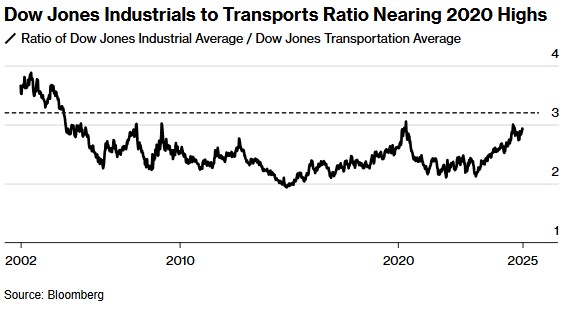
There is a broader logical support behind this theory: freight and passenger transport companies are usually the main beneficiaries of strong economic growth, so when these companies encounter difficulties, it is often seen as a signal that the market is about to face obstacles. As the second-largest component stock in the transportation index, the release of FedEx's financial report naturally draws close attention from Wall Street.
"FedEx, United Parcel Service (UPS.US), Delta Air Lines (DAL.US), and other airlines are all significant companies and can be regarded as a 'barometer' of economic health," said Tyler Rich, editor and technical analyst at Sevens Report.
Express Delivery Sector Cools Down
Affected by the Trump administration's tariff policies that suppressed freight demand, Wall Street's attitude towards express delivery stocks has continued to cool this year.
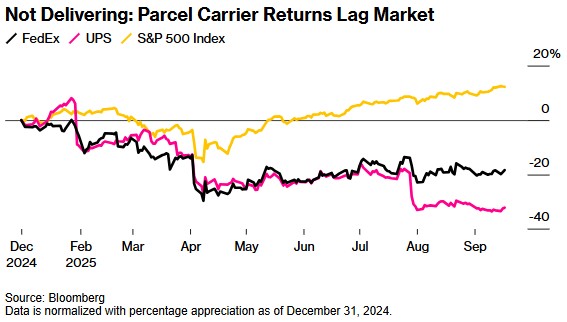
Since 2025, FedEx's stock price has fallen by 20%, ranking among the 50 worst-performing stocks in the S&P 500 index. Meanwhile, United Parcel Service's stock price has plummeted by 33%, reaching a near low since 2013, becoming the worst-performing component stock in the Dow Jones Transportation Index—its strategy to reduce cooperation with Amazon has further exacerbated market pessimism towards the stock.
In stark contrast, the S&P 500 index has risen by 12% this year, the Dow has increased by 8%, while the Dow Jones Transportation Index has declined by 2.5%.
Analysts expect FedEx to report slight growth in revenue and adjusted earnings per share in its first-quarter financial report for fiscal year 2025. However, the market's reaction to the stock is likely to depend on whether the company believes its busiest "holiday season" (year-end shopping season) will see a business rebound. Currently, FedEx has only released a performance forecast for this quarter and has not provided longer-term guidance; FedEx has simply abandoned its full-year performance expectations.
"This earnings call will be crucial," said Dirk Malaki, managing director of SLC Management.
Impact of the Cancellation of the De Minimis Exemption Policy
Investors are particularly concerned about how FedEx will respond to the Trump administration's cancellation of the de minimis exemption. This policy previously allowed packages valued at $800 or less to enter the United States tax-free. In May of this year, the U.S. government first closed this "loophole" for packages from mainland China and Hong Kong, impacting both FedEx and United Parcel Service (UPS); on August 29, the policy became ineffective for packages from other regions worldwide, putting even greater pressure on courier companies.
CFRA analyst Devin DeLange pointed out in a report sent to clients last week: "For investors, FedEx management's comments on the cancellation of the de minimis exemption are likely to be the core focus of this earnings report."
However, from another perspective, FedEx's stock price has fallen to a low level, and even if the earnings report does not reach "impressive" levels, it may trigger a rebound.
Citigroup analyst Ali Rosa stated: "I can't recall a time when investor sentiment towards UPS and FedEx was this pessimistic; this sentiment is reflected in the stock price valuations. To achieve significant increases in these stocks, there is no need to make overly aggressive assumptions about their historical performance or valuations."
Meanwhile, the warning signals from Dow Theory continue. However, some strategists believe that in the digital age, this theory, which originated over a century ago, has "lost its value"—for example, it fails to account for large vertically integrated retailers like Amazon and Walmart, which have their own logistics systems, and whose transportation data is not reflected in the Dow Jones Transportation Average.
Joe Mazzola, head of trading and derivatives strategy at Charles Schwab, countered: "Where do most people order their goods from? Amazon's logistics data won't appear in the Dow Jones Transportation Average."
Nevertheless, Rich from "Seven Reports" still believes that Dow Theory should be used in conjunction with other economic indicators to fully assess economic and market trends.
Currently, other indicators are also showing bearish signals: the U.S. Treasury yield curve is steepening, credit spreads are widening slightly, and the gold-to-oil price ratio has risen to its highest level since 2020. Now, FedEx's earnings report has the opportunity to break these negative trends or further confirm them.
Rich stated: "If Charles Dow were still alive and saw the divergence between the Dow and the Transportation Average, along with the performance of the S&P 500, I believe he would conclude: 'This is a huge bull market trap.'"