
Arent (TSE:5254) Is Posting Healthy Earnings, But It Is Not All Good News
 I'm LongbridgeAI, I can summarize articles.
Arent Inc. (TSE:5254) reported strong earnings but faced concerns over its high accrual ratio of 0.45, indicating insufficient free cash flow relative to profits. The company generated JP¥333m in free cash flow against a reported profit of JP¥1.33b, raising worries about future earnings. Additionally, Arent's share count increased by 12%, diluting earnings per share (EPS) growth. Despite a 61% profit boost last year, EPS only rose by 54%, suggesting dilution impacts. Unusual items contributed JP¥220m to profits, leading to caution about sustainability in future earnings.
Despite posting strong earnings, Arent Inc.'s (TSE:5254) stock didn't move much over the last week. We looked deeper into the numbers and found that shareholders might be concerned with some underlying weaknesses.
This technology could replace computers: discover the 20 stocks are working to make quantum computing a reality.
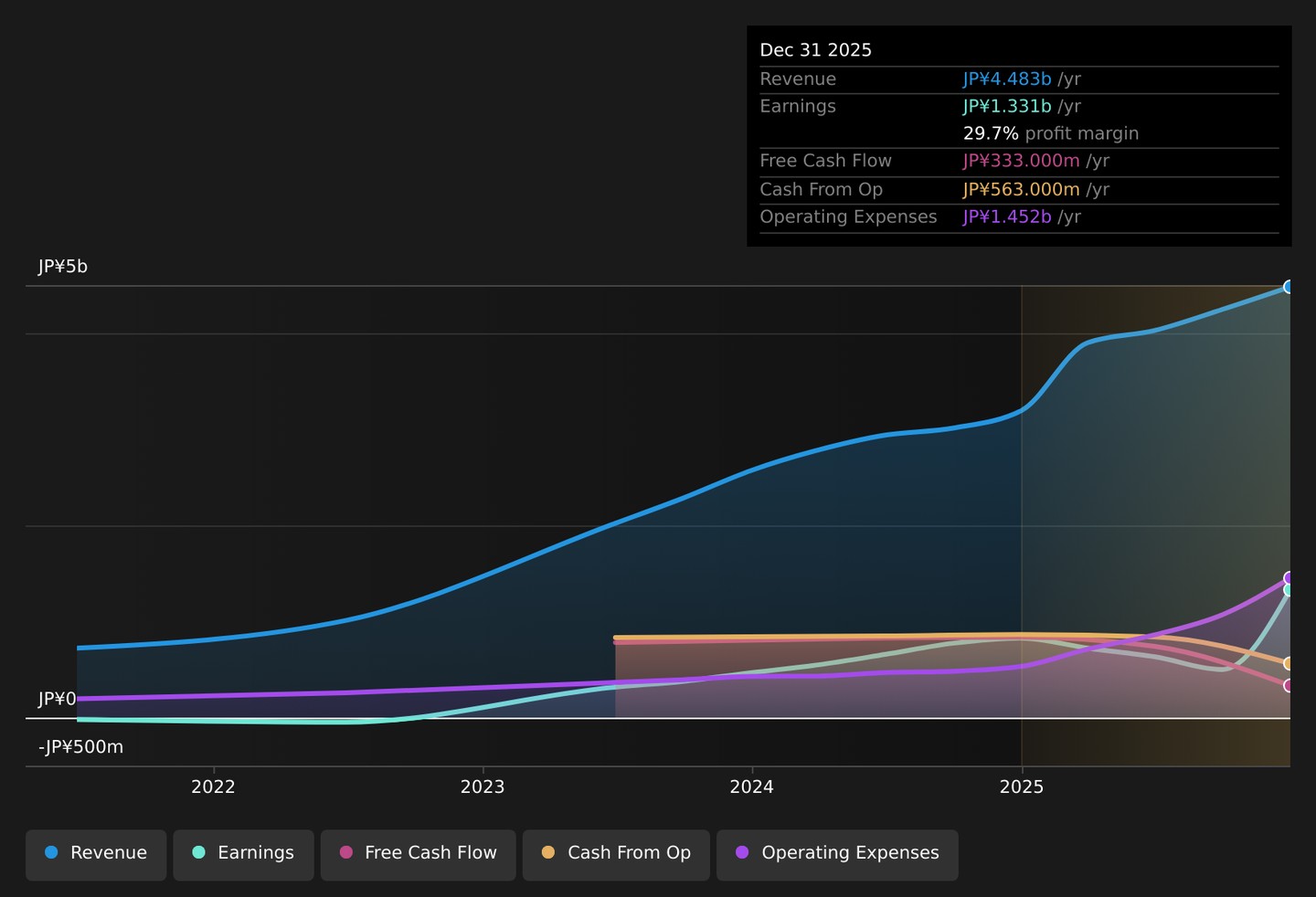
A Closer Look At Arent's Earnings
In high finance, the key ratio used to measure how well a company converts reported profits into free cash flow (FCF) is the accrual ratio (from cashflow). The accrual ratio subtracts the FCF from the profit for a given period, and divides the result by the average operating assets of the company over that time. You could think of the accrual ratio from cashflow as the 'non-FCF profit ratio'.
As a result, a negative accrual ratio is a positive for the company, and a positive accrual ratio is a negative. While it's not a problem to have a positive accrual ratio, indicating a certain level of non-cash profits, a high accrual ratio is arguably a bad thing, because it indicates paper profits are not matched by cash flow. That's because some academic studies have suggested that high accruals ratios tend to lead to lower profit or less profit growth.
Over the twelve months to December 2025, Arent recorded an accrual ratio of 0.45. That means it didn't generate anywhere near enough free cash flow to match its profit. Statistically speaking, that's a real negative for future earnings. To wit, it produced free cash flow of JP¥333m during the period, falling well short of its reported profit of JP¥1.33b. Arent shareholders will no doubt be hoping that its free cash flow bounces back next year, since it was down over the last twelve months. However, that's not the end of the story. We can look at how unusual items in the profit and loss statement impacted its accrual ratio, as well as explore how dilution is impacting shareholders negatively. The good news for shareholders is that Arent's accrual ratio was much better last year, so this year's poor reading might simply be a case of a short term mismatch between profit and FCF. As a result, some shareholders may be looking for stronger cash conversion in the current year.
See our latest analysis for Arent
That might leave you wondering what analysts are forecasting in terms of future profitability. Luckily, you can click here to see an interactive graph depicting future profitability, based on their estimates.
One essential aspect of assessing earnings quality is to look at how much a company is diluting shareholders. Arent expanded the number of shares on issue by 12% over the last year. Therefore, each share now receives a smaller portion of profit. To celebrate net income while ignoring dilution is like rejoicing because you have a single slice of a larger pizza, but ignoring the fact that the pizza is now cut into many more slices. Check out Arent's historical EPS growth by clicking on this link.
A Look At The Impact Of Arent's Dilution On Its Earnings Per Share (EPS)
Arent has improved its profit over the last three years, with an annualized gain of 879% in that time. In comparison, earnings per share only gained 751% over the same period. And the 61% profit boost in the last year certainly seems impressive at first glance. But in comparison, EPS only increased by 54% over the same period. And so, you can see quite clearly that dilution is influencing shareholder earnings.
Changes in the share price do tend to reflect changes in earnings per share, in the long run. So Arent shareholders will want to see that EPS figure continue to increase. However, if its profit increases while its earnings per share stay flat (or even fall) then shareholders might not see much benefit. For the ordinary retail shareholder, EPS is a great measure to check your hypothetical "share" of the company's profit.
The Impact Of Unusual Items On Profit
Given the accrual ratio, it's not overly surprising that Arent's profit was boosted by unusual items worth JP¥220m in the last twelve months. While we like to see profit increases, we tend to be a little more cautious when unusual items have made a big contribution. We ran the numbers on most publicly listed companies worldwide, and it's very common for unusual items to be once-off in nature. And that's as you'd expect, given these boosts are described as 'unusual'. Assuming those unusual items don't show up again in the current year, we'd thus expect profit to be weaker next year (in the absence of business growth, that is).
Our Take On Arent's Profit Performance
In conclusion, Arent's weak accrual ratio suggested its statutory earnings have been inflated by the unusual items. Meanwhile, the new shares issued mean that shareholders now own less of the company, unless they tipped in more cash themselves. For all the reasons mentioned above, we think that, at a glance, Arent's statutory profits could be considered to be low quality, because they are likely to give investors an overly positive impression of the company. So while earnings quality is important, it's equally important to consider the risks facing Arent at this point in time. Case in point: We've spotted 2 warning signs for Arent you should be mindful of and 1 of them is concerning.
Our examination of Arent has focussed on certain factors that can make its earnings look better than they are. And, on that basis, we are somewhat skeptical. But there are plenty of other ways to inform your opinion of a company. Some people consider a high return on equity to be a good sign of a quality business. So you may wish to see this free collection of companies boasting high return on equity, or this list of stocks with high insider ownership.
New: Manage All Your Stock Portfolios in One Place
We've created the ultimate portfolio companion for stock investors, and it's free.
• Connect an unlimited number of Portfolios and see your total in one currency
• Be alerted to new Warning Signs or Risks via email or mobile
• Track the Fair Value of your stocks
Try a Demo Portfolio for Free