
 I'm LongbridgeAI, I can summarize articles.
The US-Iran conflict has carved out a deep pit, but history tells us that the best entry points for gold are often hidden in moments of despair. Western Securities explicitly stated in its latest report that regardless of the US choice in the final outcome of the Iran conflict, it will almost certainly lead to further cracks in the dollar's credibility, ushering in gold's fourth major "upward wave" in the second half of the year
In the spring of 2026, gold is undergoing a crisis of faith.
Following the outbreak of the US-Iran conflict, this asset known in textbooks as the "ultimate safe haven" did not surge as expected. Instead, it plummeted sharply from its historical high in January. In a world filled with 战火 and blocked energy corridors, holders of gold watched their positions evaporate, inevitably starting to wonder: could something be wrong this time?
Voices in the market began to split: on one side were pessimists claiming the "long-term bull logic has collapsed," and on the other, bulls who believe this is a once-in-a-century buying opportunity.
But if you stretch your timeline and look back at history, you'll find this debate itself is somewhat strange—because gold falling first and then rising at the onset of geopolitical crises is almost a fixed historical script. Western Securities explicitly stated in its latest report that regardless of the US choice in the final outcome of the Iran conflict, it will almost certainly lead to further cracks in the dollar's credibility, ushering in gold's fourth major "upward wave" in the second half of the year.
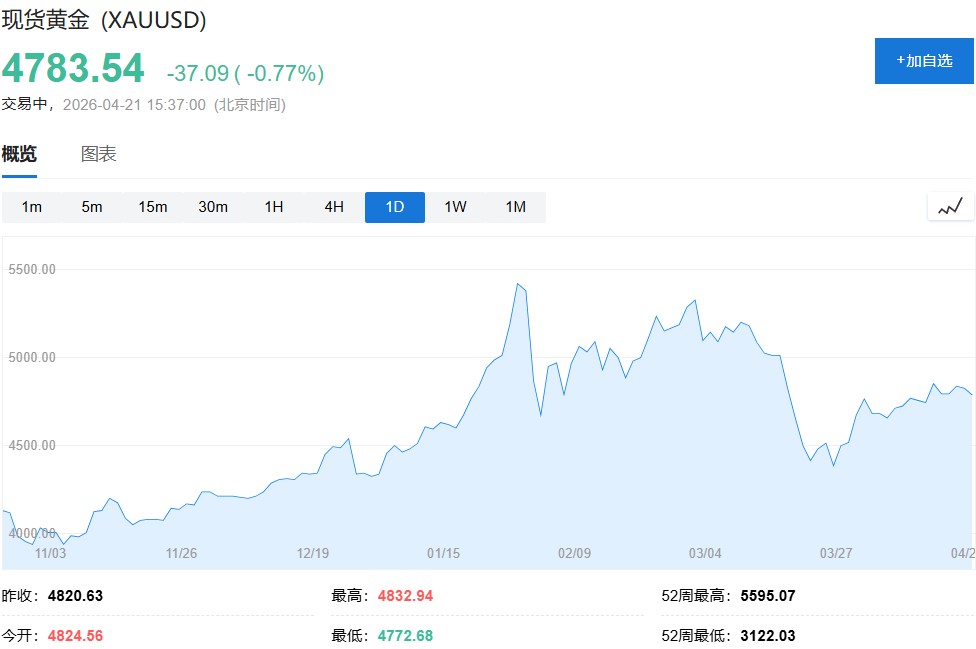
As of the afternoon of the 21st, spot gold was quoted at $4,783 per ounce. After Trump hinted at an end to the hostilities, gold prices began a rebound, yet they have still retreated approximately 14% from their historical high in January.
It's Not Gold That's Broken; Liquidity Has Hijacked Prices
To understand this decline, we must first grasp a question that confuses many: why did gold fall instead of rise when war broke out?
The answer lies not in gold itself, but in the market's "forced liquidation" logic.
When oil prices skyrocket and inflation expectations rise, bond yields are repriced. Simultaneously, global stock markets corrected sharply, triggering margin calls for a vast amount of derivative positions. Fund managers faced a dilemma: sell the most liquid assets to cover margins or face forced liquidation.
Gold, an asset with exceptional liquidity, became the "fire bucket" used to put out the flames.
Data firm Vanda estimates that since the start of the war, global gold ETFs have seen cumulative outflows of approximately $10.8 billion. This does not mean investors lack confidence in gold; rather, they had no choice. Meanwhile, the war drove up inflation expectations and lowered rate cut expectations, temporarily boosting the relative attractiveness of bonds and further suppressing gold prices from a sentiment perspective.
This is not the collapse of gold's pricing logic; it is a forced sale under a liquidity crisis.
The Historical Script: Under Oil Crises, Gold Always Falls First Then Soars
If the liquidity shock explains "why it fell," historical experience provides the answer to "what happens after the fall."
Yangtze Strategy dug up the historical ledger of two oil crises in the 20th century.
The first oil crisis occurred in 1973. OPEC launched an oil embargo, blocking energy corridors and causing global inflation to soar sharply. At the onset of the crisis, market liquidity tightened and risk appetite plummeted. Gold similarly underwent a period of temporary adjustment amidst tightening liquidity. However, as the inflation center continued to rise and economic growth began to slow down, stagflation characteristics gradually shifted from expectation to reality. Gold's anti-inflation attributes were reactivated, prices broke through previous highs, and it ultimately embarked on a stunning trend-driven rally.
The second oil crisis occurred in 1979, ignited by the Iranian Revolution. The same script was almost repeated word for word: pressure at the onset of the crisis, a brief adjustment caused by tightening liquidity, but the stagflation logic eventually dominated the latter half. After a brief rest, gold hit new highs repeatedly.
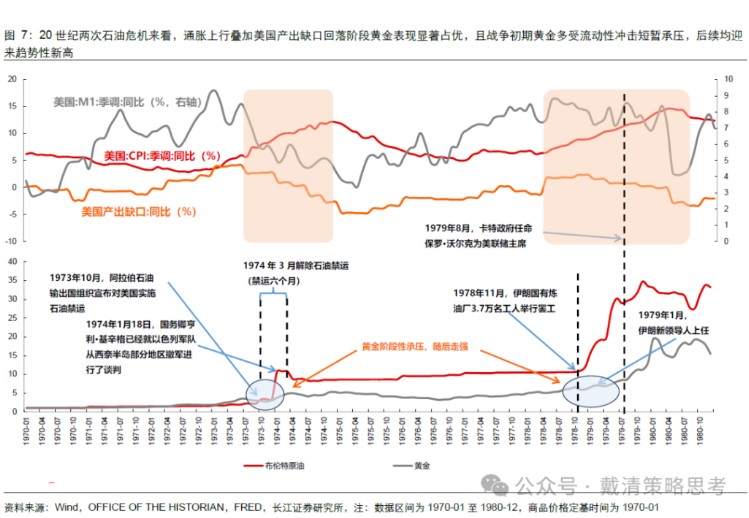
These two experiences reveal a pattern: the impact of an oil crisis on gold follows a curve that falls first and rises later, rather than a straight line in one direction.
Yangtze Strategy also added a crucial clue: the expectation of "higher rates held for longer" that suppresses gold prices is being fully priced in. The probability of the market expecting the Federal Reserve to raise rates by March 2027 is approaching 30%. With rate hike expectations largely fully priced and rate cut expectations significantly declining, this means short-term negative factors are nearing exhaustion on the margin, not just beginning.
More importantly, inflation expectations have been revised upward. Comparing Bloomberg consensus data from the end of 2025 and April 2026, the central point of inflation-related forecasts has clearly risen. Under the combination of "rising inflation center + weak economic recovery," real interest rates tend to be easier to fall than to rise—this is the main thread for gold.
Thus, Yangtze Strategy defines the current situation as: the allocation window is gradually opening. The "pit" of the "golden pit" is not a depth to fear, but the shape formed after concentrating the release of short-term risks.
A Bigger Story: Gold Pricing Power Has Quietly Shifted
If Yangtze Strategy answers "why we don't need to change our judgment on gold this time," Western Securities attempts to answer a bigger question: why might the trend be larger than imagined?
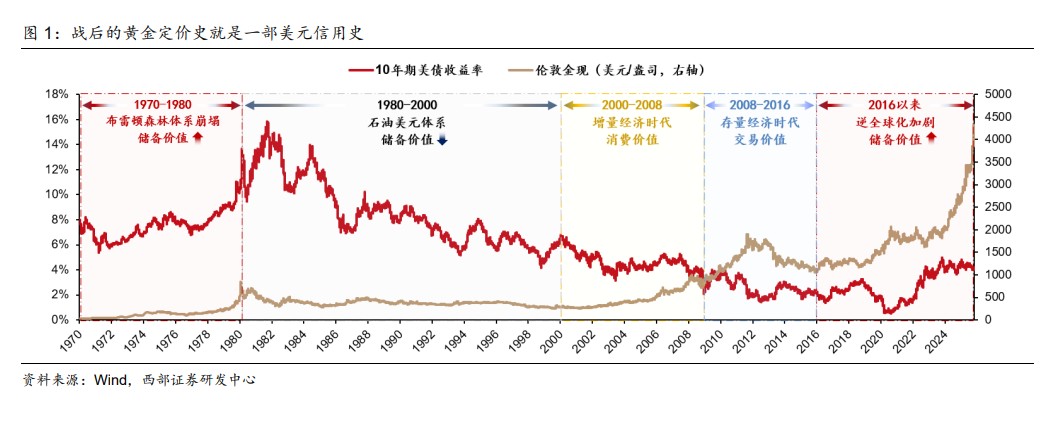
Cao Liulong, Chief Strategy Analyst at Western Securities, proposed a subversive observation in his latest report: over the past decade, the correlation between gold and US Treasury yields and the US Dollar Index has weakened significantly.
If gold no longer follows interest rates or the dollar, what is it pricing?
Cao Liulong's answer is: reserve value. Or more bluntly, gold is pricing the global level of trust in the dollar system.
This judgment traces back to 2016.
That year, China had become the world's largest goods trading nation. RMB settlement accelerated penetration in foreign trade, and the share of USD settlement began to decline. Systematic de-allocation of sovereign funds away from dollar assets quietly began, launching the first major upward wave of gold.
The second wave followed the Russia-Ukraine conflict in 2022, when the US kicked Russia out of SWIFT and froze its foreign exchange reserves. This move shattered the implicit consensus that "foreign exchange reserves are inviolable." Global central banks suddenly realized: holding dollar assets could be directly deprived in extreme scenarios. IMF data shows that since then, global central bank gold purchases have reached historic highs, exhibiting a characteristic of "buying more as prices rise."
The third wave occurred in 2025. The Trump administration returned to the White House. The "Big and Beautiful Bill" significantly expanded fiscal deficits, forcing long-term rates to rise rapidly and compelling the Federal Reserve to cut rates early. When monetary policy begins to serve fiscal needs, the Fed's independence comes into question, and the credibility of the dollar as a "rule anchor" begins to loosen.
Three major upward waves, three instances of damage to dollar credibility. The logic remains consistent.
Now, the 矛头 points to the core pillar of the dollar—the "petrodollar" system.
Fourth Wave Trigger Logic: The Strait of Hormuz Is Becoming a Historic Fork
The petrodollar is a more fragile existence than most imagine.
Global oil is priced and settled in dollars. Oil-producing nations invest oil export revenues into dollar assets, while the US guarantees stability in the Gulf region and free flow of oil trade through military power. This is a triangular closed loop of military-currency-energy that has sustained dollar hegemony for half a century.
Western Securities' analysis points out that at the initial stage of the US-Iran conflict, rising oil prices and expanding oil trade scales objectively strengthened the demand for dollar settlement in the short term, acting as a constraint on gold prices—explaining why gold did not surge immediately after the war started.
But this reinforcement is fragile. The real risk lies in the fact that whatever choice the US makes could tear apart this closed loop:
If the US chooses to withdraw troops or end the conflict early, it will send a dangerous signal to Gulf allies: the US military protection commitment is unreliable. Once the security guarantee of the petrodollar collapses, the entire system loses its foundation.
If peace talks succeed but Iran gains toll rights for the Strait of Hormuz, the US's geopolitical dominance in the Middle East will be substantially weakened—and the root of dollar credibility lies precisely in the ability to maintain the global free trade order.
If a prolonged war ensues, defense expenditures will soar, fiscal deficits will continue to deteriorate, and ultimately, the Federal Reserve will have to step in with the printing press to bail them out. QE restarts, credit dilutes, and the purchasing power of the dollar will be repriced by the market again.
This is a three-way fork, where every path leads to the same destination: further widening of cracks in dollar credibility. "Unless the US can quickly defeat Iran and restore free passage through the strait, this conflict is likely to become the last straw that breaks the camel's back for petrodollar confidence."
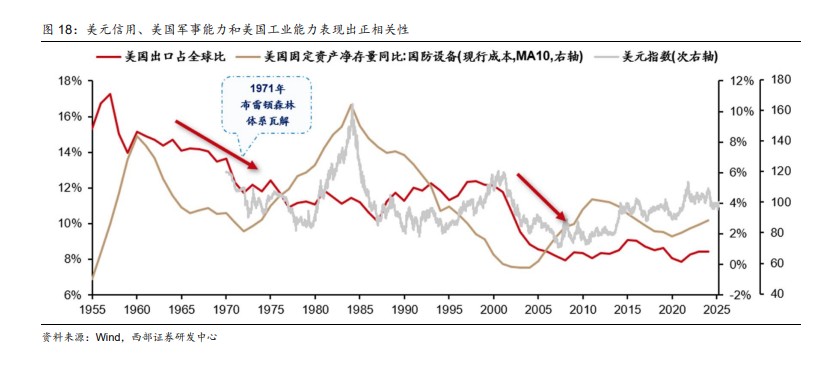
Gold's "fourth wave" is not a distant prospect but a near-term proposition dependent on the trajectory of the conflict and policy choices.
Two Sets of Signals to Verify: "Golden Pit" or End of Trend?
Of course, making a judgment and verifying it are two different things. Synthesizing the analytical frameworks of both institutions, future market pricing of gold will revolve around two sets of signals:
First set: Will liquidity and position pressures ease? The core focus is whether gold ETF fund flows stabilize and whether the intensity of passive deleveraging weakens. When net inflows into ETFs turn positive again, it means the "fall first" phase is nearing its end, and the heaviest short-term selling pressure has been released.
Second set: Can the stagflation and dollar credibility narrative take over? The core lies in whether inflation expectations continue to be revised upward and whether confidence in the "petrodollar" system is reassessed due to the situation in the Strait of Hormuz and policy responses. Once global central banks accelerate gold accumulation again, or once rising oil prices force the Fed to abandon rate hike expectations, the main driver of gold will resume dominating prices.
Under this framework, the current deep correction looks more like a cleansing event that concentrates the release of short-term risks—a classic "golden pit." Short-term liquidity panic created a drop, but medium-to-long-term pricing power is slowly returning to the stagflation logic and dollar credibility reassessment.
The Deepest Pits Are Often the Best Starting Points
History possesses a cruel humor: the best buying opportunities always appear at the moment you least want to buy.
During the 1973 oil crisis, holding gold required perseverance amidst tightening liquidity and market panic. In the 1979 Iranian Revolution, entrants had to endure initial adjustments and skeptical glances. But the answer from history is clear: those who recognized the logic in the darkest moments and completed their positioning during the "fall first" phase ultimately reaped the richest returns of that era.
This time, the US-Iran conflict has created a deep pit. ETF outflows, margin calls, and suppressed rate expectations—all these factors are real and stacking short-term selling pressure to its peak. Yet, the $10.8 billion in ETF outflows has not changed a single fact: global central banks are still buying gold, inflation is being revised upward, and cracks in the petrodollar's credibility continue to widen.
Whether the "fourth wave" arrives will be answered by the sustainability of stagflation trades and the speed of expansion of dollar credibility cracks.