
 I'm LongbridgeAI, I can summarize articles.
Digital banks face profitability challenges, with 76% unprofitable and low per-user revenue compared to traditional banks. The core issue is reliance on transaction fees rather than lending, which is the primary profit driver for traditional banks. Successful models like Nubank and Revolut achieved profitability by leveraging credit products and loans, while Chime recently turned a profit after focusing on credit advances. Digital banks must return to the essence of banking—lending—to sustain growth.
Author: Thejaswini M A Translator: Shan Ouba, Jinse Finance
There's an old joke about planned economies: A planner walks into a store, finds the shelves empty, and says, "See, this is what happens when there's no demand." This is a long-circulated anecdote among economists, used to satirize the Soviet era.
The digital banking industry is now trapped in the exact same vicious cycle. More than 500 startups worldwide have launched debit card current accounts, attracting a total of 1.4 billion users, yet making money is incredibly difficult.
76% of digital banks have yet to achieve profitability; the average digital bank generates $45 per user annually, compared to $350 for traditional banks.
The root cause lies in the product segment initially chosen by the startups, and whether that segment actually has real profit potential.
To understand the choices these companies made initially, we must see the ills of the old industries they wanted to escape. In the past, traditional banks exploited customers at every level, even charging fees for withdrawing their own salaries from ATMs. If you came from an ordinary background and had meager savings, the experience was even worse. When the first batch of digital banks launched zero-fee accounts with no minimum deposit requirement, users naturally voted with their feet. In just a few years, hundreds of millions of users flocked to the platform. Today, Nubank covers over 60% of Brazil's adult population. Traditional banks have always treated ordinary customers with indifference, making the explosive growth of digital banks almost inevitable. However, this business model ultimately proved unsustainable. If you spend $40 at a coffee shop using your debit card, the merchant has to pay a transaction fee. According to the Federal Reserve's Regulation II, this transaction fee is capped at approximately 22 cents, with the revenue shared among the card organization, the issuing bank, and the payment clearing institution. The profit received by digital banks is negligible. Millions of users treat it only as a daily consumption account, keeping their mortgage payments and wealth management accounts elsewhere; the meager fees are simply insufficient to support a business. Traditional banks don't profit from credit card spending; transaction fees are only a small supplement. The core profit pillar of the banking industry is always lending: interest generated from mortgages, car loans, and other types of loans. Payment services are merely a daily channel for banks to reach users; lending is the core source of revenue. This is also the crux of the long-term losses of digital banks: without a banking license, they cannot lend on a large scale and collect interest. Most digital banks initially emerged as technology platforms built on top of traditional banking licenses, facing legal constraints in their lending operations. In 2013, Novo Nordisk started in Brazil, primarily offering free credit cards. At that time, traditional banks in Brazil had exorbitant loan interest rates, and this product quickly gained popularity, reaching over 131 million users and a company valuation of $60 billion by 2026. The free account was merely a customer acquisition tool; the real profits came entirely from the lending business. Last year, Novo Nordisk's total revenue was $15.8 billion, with the vast majority coming from credit cards, personal loans, and interest income. Personal loans saw the fastest growth, becoming its largest profit segment. Novo Nordisk's survival wasn't due to cutting-edge technology, but rather its lending practices; the smooth and visually appealing app was simply bait to attract users. Revolut has forged a different path to profitability. In 2025, the company's net profit reached £1.3 billion, with revenue increasing by 46% year-on-year to £4.5 billion, achieving profitability for five consecutive years. Profits primarily came from foreign exchange fees, membership subscriptions, cryptocurrency business, and credit assets. Credit volume increased by 120% year-on-year, reaching a total of $2.9 billion. Relying on the stable cash flow from its early foreign exchange and membership businesses, Revolut had ample time to quietly develop its credit sector. Chime, on the other hand, took the longest to understand this logic. Previously, it relied almost entirely on credit card transaction fees for survival. Customer acquisition costs in the US are extremely high, and profit margins on single-card transactions are very thin; once a user stops spending, revenue drops to zero. In 2025, Chime's revenue exceeded $2 billion, but it still suffered a $1 billion loss, primarily due to the massive equity incentives following its IPO. The company's IPO valuation was $11 billion, but its stock price plummeted within months of listing. A turning point came in the first quarter of 2026, when the company achieved its first profit in 12 years, earning $53 million. The core driver was the explosive growth of its credit products: the advance payroll business was expected to exceed $400 million in revenue for the year, and the instant microloan business experienced explosive growth. In June 2026, a developer at Noor Bank accidentally triggered a liquidation process during a routine software update. The system sent push notifications and emails to a large number of users, falsely claiming that the Central Bank of Brazil had liquidated the bank and informing users how to claim funds through the deposit insurance fund. Co-founder Christina Junkel was forced to issue a public apology on Instagram, stating it was merely a bizarre operational error and that both the bank and user funds were safe. Within minutes, a basic blunder led users to believe the company was on the verge of collapse. Objectively speaking, traditional banks also frequently make similar gaffes, such as input errors leading to the misdirection of billions of dollars. However, established banks like Citibank, founded in 1812, have deep roots; even if their systems malfunction, users simply consider it a normal corporate mistake. But for startup digital banks, once a risk is reported, users immediately panic and run on the bank. In April 2024, intermediary service provider Synapse declared bankruptcy, completely exposing the fatal flaws of its unlicensed model. Digital banks are essentially software companies; to launch current accounts, they must connect to an entire supply chain of partners. Synapse acted as an intermediary, connecting hundreds of digital banks with traditional banks handling escrow funds, responsible for bookkeeping, compliance audits, and asset verification. After Synapse collapsed, customer fund records were lost, and approximately $265 million in user funds were frozen. Partner banks were unable to distinguish the ownership of the funds, and subsequent investigations revealed that $95 million was missing. The entire system completely lacked an accountability mechanism. Major digital banks like Yotta and Juno were shut down for months, and some users were even unable to make mortgage payments. If your digital bank lacks its own banking entity and relies on third-party intermediaries, this seemingly perfect system is actually extremely fragile and could collapse at any time. Ultimately, the only trump card against this type of systemic risk is a banking license. In the past, digital banks always claimed that they didn't need a license at all. Last October, I wrote an article analyzing the real potential of crypto digital banks: the regulatory framework was gradually becoming clearer, users held on-chain assets, and they hoped to use them directly for consumption. This judgment remains valid, but I severely underestimated the chain of risks brought about by "relying on the underlying architecture of third-party banks." The crypto industry's solution is to completely abandon the white-label partnership model and independently apply for compliance qualifications. From December 2025 to May 2026, the U.S. Office of the Comptroller of the Currency (OCC) conditionally approved ten national trust licenses for crypto and fintech, exceeding the total number issued in the past decade. Paxos, BitGo, Fidelity Digital Assets, Ripple, Circle, and Bridge (acquired by Stripe for $1.1 billion) all applied for the U.S. national trust license, which digital banks initially scoffed at. A national trust license is the ultimate way to escape the intermediary trap: companies directly obtain federal official qualifications, enabling them to independently manage user assets and handle payment clearing, with unified compliance standards across all fifty states. They no longer need to rely on traditional partner banks, nor will they bet their entire business on invisible intermediary service providers like Synapse. Crypto companies are finally recognizing reality: to move billions of dollars without being hampered by the underlying infrastructure of traditional banks, they must integrate into the federal formal financial system and obtain a compliance license. Payment giant Payward (Kraken's parent company) has now acquired three types of US compliance qualifications: a Wyoming banking license, approval for a Federal Reserve master account in March 2026, and an application for an OCC national trust license submitted in May 2026. SoFi acquired Golden Pacific Bank in 2022, obtaining an OCC banking license; in December 2025, it issued a US dollar stablecoin, becoming the first nationally licensed bank in the US to issue a stablecoin based on a permissionless public blockchain. By May 2026, 14.7 million platform users could hold, spend, and exchange the stablecoin within the app, with MasterCard as its clearing partner. Coinbase, relying on the Morpho protocol of the Base public chain, conducts Bitcoin-collateralized lending, with the scale of collateralized BTC exceeding $1.4 billion by early 2026. SoFi's development path is highly representative: student loan service provider → digital bank → licensed regulated bank → stablecoin issuer, completing the entire industry chain. Currently, the total scale of centralized and decentralized crypto collateralized lending is $67.42 billion, while the scale of uncollateralized DeFi lending is only $24 million. Protocols that once entered the uncollateralized lending market (Goldfinch, early Maple, TrueFi) have either fully transitioned to a fully collateralized model or are on the verge of shutting down.
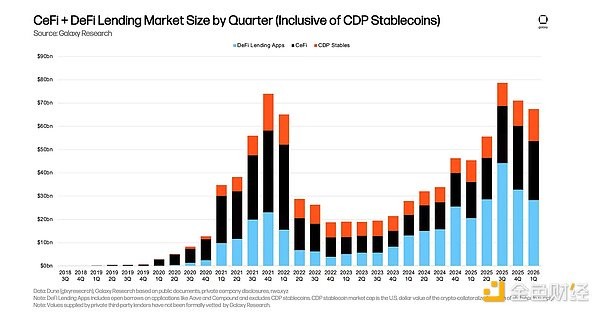
Currently, Maple, a leading DeFi lending protocol, boasts a collateralization ratio as high as 160%.
In the anonymous public blockchain environment, uncollateralized lending lacks an effective default recovery mechanism. In reality, when users default on loans, banks can report to credit bureaus and file lawsuits; DeFi lacks credit bureaus and asset collection channels, and borrowers can simply abandon their wallet addresses, making it impossible to recover lent funds permanently. Many protocols have attempted to build reputation scoring systems, but ultimately still encountered large-scale bad debts—lacking real-world legal constraints, anonymous users have no incentive to repay.
... Nubank lends to 131 million users with no credit history, relying on user transaction behavior for risk control and approval. This model has real commercial value, but its operating costs are extremely high and its implementation is extremely difficult. If a company wants to scale up similar lending businesses on the blockchain, it will almost certainly need a banking license. The application queue for licenses from the U.S. Office of the Comptroller of the Currency will only grow longer in the future. Last October, I wrote that crypto banks are replicating the path the banking industry took a century ago: technological iteration never stops, but the underlying logic of humans dealing with money has never changed. I originally thought this pattern carried a sense of industry destiny, but now it reveals a more stark reality: traditional banks always charge high fees for lending. Early digital banks that broke through promised to end this chaos; and the surviving companies all eventually embarked on the path of lending—only with more friendly interest rates and smoother product interfaces, the underlying business logic remains unchanged. The essence remains the same despite all the changes.