
 I'm LongbridgeAI, I can summarize articles.
Despite June inflation cooling to 3.5%, Wall Street saw a tech selloff, with the sector falling 5.9% for the week. IBM plunged 25.2% on weak earnings as clients shifted spending from software to AI hardware. Semiconductor stocks suffered their worst month since 2008, triggered by lower-than-expected SK Hynix estimates for HBM4 shipments. Meanwhile, US consumer sentiment rose, though concerns remain regarding potential energy price impacts from geopolitical tensions.
The best inflation report of 2026 landed on Wall Street this week, and the market sold anyway, abandoning the semiconductor trade that has carried the entire rally for three years.
By Friday afternoon, the technology sector had slumped 5.2% for the week, marking one of the worst weeks of the year.
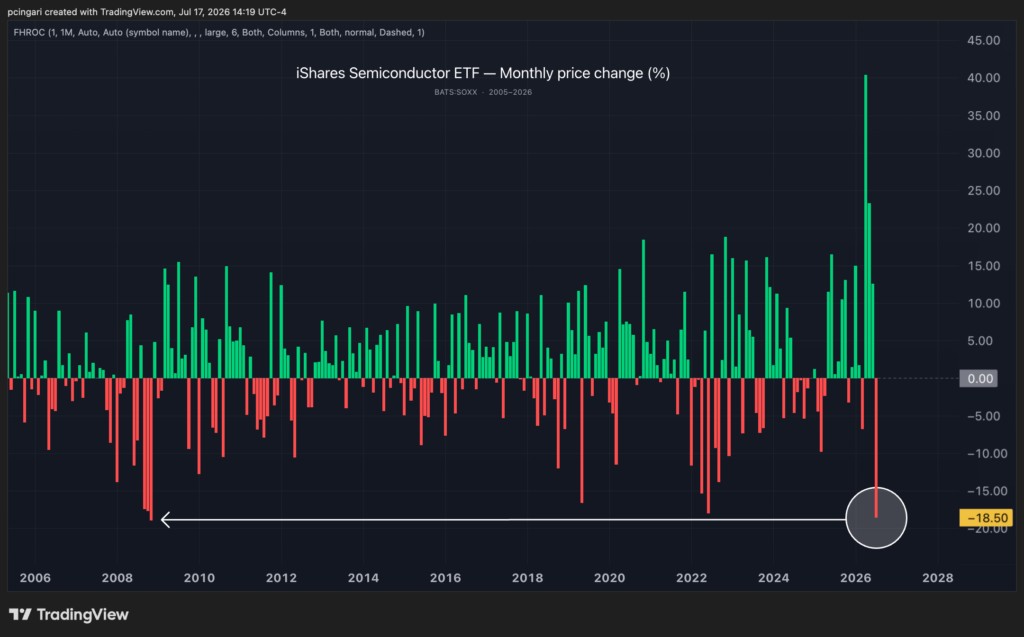
The iShares Semiconductor ETF (NASDAQ:SMH) — the fund investors use as shorthand for the AI trade itself — was down nearly 18.5% month to date, tracking toward its worst month since November 2008.
Two cooler-than-expected inflation reports eased the Fed worry that has hung over the tape in recent months.
Neither did anything to stop the tech wreckage.
Consumer prices cooled in June to 3.5% year-over-year from 4.2%, the first decline of 2026. On a monthly basis, inflation fell 0.4%, the sharpest drop since April 2020.
Producer inflation fell too, with the headline Producer Price Index down 0.3%.
Traders are now heavily positioned for the Federal Reserve to leave interest rates unchanged at 3.75% at its July meeting.
Chart Of The Week: Chip Stocks Are On Pace For Worst Month Since 2008
Read Also: Chip Stocks Are Having Their Worst Month Since 2008: This Analyst Says Buy the Reset
IBM’s Worst Day Ever Was A Story About Where The Money Went
The week’s defining collapse belonged to International Business Machines Corp. (NYSE:IBM).
Shares plunged 25.2% on Tuesday, the worst single-session decline in the company’s history — deeper than Black Monday in October 1987 — after the company preannounced its second-quarter results ahead of the scheduled reporting date.
Revenue came in at $17.2 billion, roughly $700 million short of what Wall Street analysts had collectively forecast. Adjusted earnings landed at $2.93 per share against a $3.02 estimate.
CEO Arvind Krishna highlighted a budget shift in the final weeks of the quarter. Clients pulled spending out of software and infrastructure and redirected it into AI hardware, such as memory chips, servers, and storage.
Read that sentence again, and the week’s logic falls into place. IBM didn’t lose the money. It lost it to the memory names.
The Selloff That Started In Seoul
SanDisk Corp. (NASDAQ:SNDK) and Western Digital Corp. (NASDAQ:WDC), two of the year’s most crowded memory trades, both fell more than 20% on the week.
The trigger came from South Korea. Local brokerage KIS published a second-quarter estimate for SK Hynix Inc. (NASDAQ:SKHY) that sat 8% below consensus, citing slower-than-expected shipments of HBM4 — the high-bandwidth memory stacked directly alongside AI processors, and the single component the entire industry has been unable to make fast enough.
If the bottleneck is easing, the pricing power that justified the rally eases with it.
The Korean giant fell 15% in Asia on Monday, its worst day ever. Its newly launched U.S. depositary receipt closed its first week of trading deep in the red.
Consumers Feel Better, But The Timing Of The Survey Matters
University of Michigan Consumer Sentiment jumped 10% for a second consecutive month, hitting its highest reading since February on falling gas prices. Year-ahead inflation expectations eased to 4.2% from 4.6%.
Long-run expectations held at 3.3%.
Survey director Joanne Hsu cautioned that the rebound may be fragile.
More than 70% of the interviews were completed before U.S. strikes on Iran resumed on July 7 and pump prices turned higher again.
Read Also: Trump Declared The Iran Ceasefire 'Over': These 7 Energy Stocks Have Been Cashing In Ever Since
Photo: rblfmr/Shutterstock