
AI data center business becomes a new growth engine, Nokia's Q2 profit greatly exceeds expectations
 I'm LongbridgeAI, I can summarize articles.
Nokia's Q2 net profit exceeded expectations, with AI data center business becoming a growth engine. Net sales reached €4.8 billion, and adjusted operating profit was €434 million. The network infrastructure division saw a 12% year-on-year sales increase driven by AI demand, with sales to AI and cloud customers surging by 105%. CEO Pekka Lundmark stated that AI and cloud orders reached €2.8 billion, with half expected to convert into revenue in the next 12 months, but supply chain shortages remain a challenge for the industry
According to Zhitong Finance APP, Nokia (NOK.US) reported a significant profit in the second quarter that exceeded market expectations. The Finnish telecommunications equipment manufacturer has been focusing on expanding its data center hardware business, which has driven sales growth. Nokia announced on Thursday that its net sales in the second quarter increased by 8% year-on-year, reaching €4.8 billion, in line with analyst expectations; adjusted operating profit rose by 18% year-on-year to €434 million (approximately $496 million), while the average analyst expectation was €372.3 million.
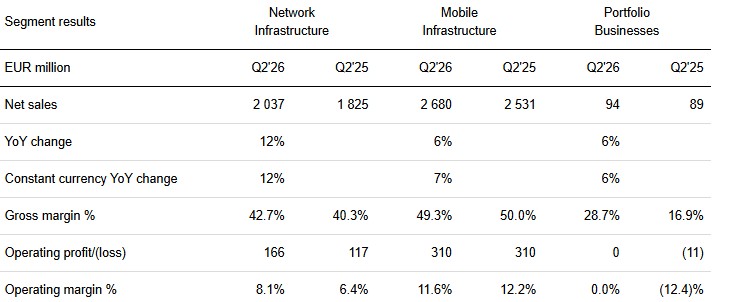
Data shows that, at constant exchange rates, the sales of the network infrastructure sector covering AI data center connectivity business grew by 12% year-on-year in the second quarter, reaching €2.037 billion. Among them, sales in the optical network business increased by 20%, and sales in the IP network business grew by 16%. Net sales to AI and cloud customers surged by 105%.
Sales in the mobile infrastructure sector, which includes traditional mobile device business, increased by 7% year-on-year to €2.68 billion.
The AI Infrastructure Wave is Coming: Nokia Continues to Advance Strategic Transformation
Nokia CEO Justin Hotard is driving business diversification to reduce reliance on traditional telecom network equipment and seize the opportunities presented by the large-scale construction of data centers amid the artificial intelligence (AI) wave. He announced this transformation plan last year, along with a reorganization plan, divesting loss-making business segments, and committing to achieving double-digit operating profit growth in the coming years. The company's stock price has risen by 66% so far this year.
In the second quarter earnings report, Hotard stated, "In the second quarter, our AI and cloud business orders amounted to €2.8 billion, with sales growing more than double year-on-year. The company's growth momentum has been fully released, with long-term orders secured in both optical network and IP network businesses. We expect that about half of these orders will convert into actual revenue in the next 12 months. Market demand remains strong, but supply chain shortages continue to be a core constraint across the industry, prompting customers to increase long-term orders."
While the AI boom has opened up new growth opportunities, the rush of global companies to build new data centers and expand computing power reserves has led to shortages of core components such as storage chips and rising raw material costs. Competitor Ericsson warned last week that rising costs would hurt profit margins, making it more expensive to fulfill new customer orders.
Nokia has agreed to acquire a chip manufacturing facility in Chandler, Arizona, from NXP Semiconductors, but the deal still requires regulatory approval. Nokia will begin leasing part of the capacity starting in early 2027 and will subsequently retrofit the production line to specifically manufacture optical communication components for AI data center chips.
In recent years, this Finnish company has been continuously expanding its manufacturing capacity in the United States, focusing on high-value-added telecommunications components and semiconductor products. This strategy has helped the company secure federal funding support under the U.S. CHIPS Act while also enhancing the resilience of its supply chain As part of a large-scale cost-cutting restructuring plan, Nokia is laying off employees in Europe to save up to €1.2 billion in costs this year. The company disclosed that the layoffs in Europe will incur €200 million in restructuring expenses.
Nokia is also leveraging AI technology to enhance equipment efficiency. Last week, the company jointly launched a new technology with chip giant Nvidia, which is expected to double the data transmission capacity for wireless operators on the same radio frequency band. The platform is scheduled to be launched next year and will be compatible with existing 4G and 5G networks; once the next-generation 6G standard is established, the equipment can be upgraded to adapt to the new standard through software.
This means that cost-sensitive telecom companies can upgrade their networks virtually without the need to replace expensive hardware. Hottad stated that he hopes the software subscription model will become a major driver for the company's wireless access network business in the future. Last year, Nvidia invested $1 billion in Nokia