
 I'm LongbridgeAI, I can summarize articles.
Calculations show that supply disruptions triggered by the war with Iran have driven cumulative oil price increases of $49, becoming the main driver of this year's oil price surge and pushing global inflation to 4.5% by the fourth quarter of 2026. Market expectations for the Federal Reserve have shifted from rate cuts to rate hikes, as geopolitical conflicts are reshaping the path of global inflation and monetary policy
Geopolitics is pushing oil prices to new highs, and this energy shock triggered by the war with Iran is systematically reshaping global inflation and monetary policy expectations.
According to Ziad Daoud, Bloomberg's chief emerging markets economist, geopolitical supply disruptions since the beginning of the year have raised oil prices by $49, equivalent to about half of the current oil price.
Bloomberg expects that the surge in oil prices will push global inflation to 4.5% in the fourth quarter of 2026, significantly higher than the 3.1% recorded in the fourth quarter of 2025. Meanwhile, market expectations for the Federal Reserve have shifted from interest rate cuts to rate hikes—current market pricing indicates that the Fed may not only refrain from cutting rates but could even raise them nearly twice.
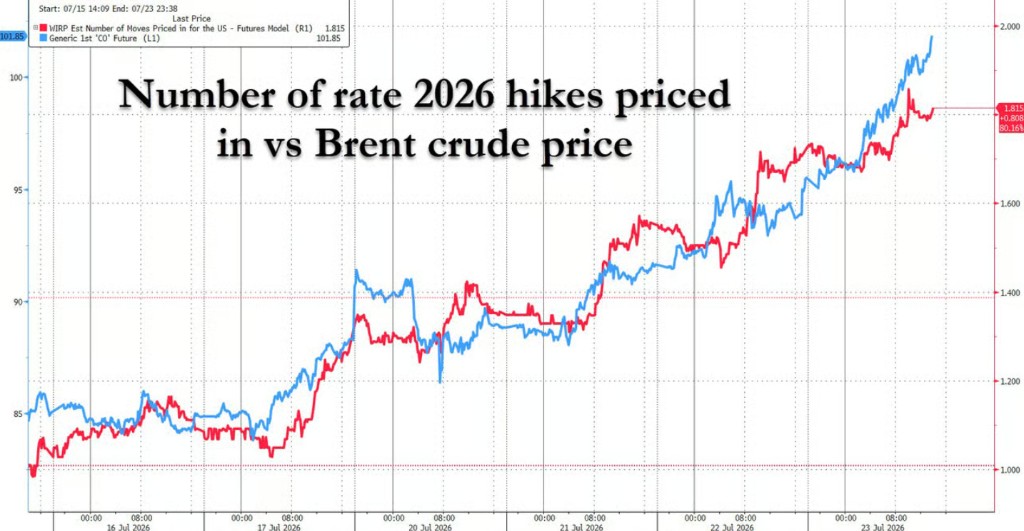
This shift poses a direct impact on both consumers and investors: the dual pressure of rising living costs and higher borrowing costs is mounting, while the Trump administration's initial governing logic, which relied on cheap energy and loose monetary policy, has been completely disrupted by this war.
Blockade of the Strait of Hormuz, Supply Shock Contributes $49 Increase
The United States and Iran have been launching strikes against each other for 12 consecutive days.
Tehran is attempting to formalize its control over the Strait of Hormuz, while Washington is working to break this blockade. The result of this confrontation is that this most important energy shipping channel in the world is nearly closed.
According to Bloomberg data, shipping traffic through the Strait of Hormuz plummeted again after a brief rebound in late June, currently causing interruptions to approximately 10% of global oil supply. Meanwhile, the conflict has spread to the Red Sea, where Houthi forces have begun attacking Saudi oil tankers, threatening another alternative shipping route that carries about 5% of global crude oil flow.
With two key shipping routes under pressure simultaneously, global oil supply faces an unprecedented double bottleneck. Bloomberg estimates that the aforementioned supply disruptions have collectively contributed a $49 increase to oil prices this year.
Weakening Demand Partially Offsets, But Buffer Space Is Limited
Weakness on the demand side has acted to some extent as a "shock absorber" for wartime supply shortages. Bloomberg estimates that declining demand has put downward pressure of about $10 on Brent crude oil prices in 2026.
Consumer responses are mainly reflected in two aspects: first, fuel substitution, shifting to alternative energy sources; second, overall compression of energy consumption, with demand adjustments in Asia being particularly noticeable. In addition, inventory releases have also helped fill supply gaps to some extent, replacing missing spot supplies with reserve oil.
However, natural contraction on the demand side and inventory buffers are ultimately difficult to fully offset structural losses on the supply side. Against the backdrop of continuing expansion of supply shocks, the marginal effect of this buffering mechanism is diminishing.
Reassessment of Inflation Expectations, Window for Interest Rate Cuts Closes
This war has caused significant shock to the global economy and fundamentally changed market judgments on the path of monetary policy.
Before the outbreak of the war, the market generally expected the Federal Reserve to start a rate-cutting cycle. However, as continuously rising oil prices pushed up inflation expectations, market pricing has shifted towards rate hikes—currently implying nearly two rate hikes. Consumers will face the dual pressure of rising living costs and higher borrowing rates.
From a policy perspective, after returning to the White House, Trump explicitly sought a policy combination of cheap energy and low interest rates. At the end of 2025, falling oil prices and expectations of rate cuts were both within reach. However, the outbreak of the war with Iran caused both goals to fall through—this war, initiated under his leadership, ultimately failed to deliver any of the economic benefits he had hoped for.