
Fu Peng: Why is Q2 a Critical Tipping Point?
 Complete. Here is the key summary
Fu Peng points out that Q2 this year marks a key turning point for the free cash flow of major US internet companies, with most expected to see their free cash flow drop to zero. As massive capital expenditures (CAPEX) increase, market focus has shifted from revenue and profits to free cash flow status and the authenticity of valuation growth within profits. The market reaction following Google's earnings report confirms this concern, as investors increasingly prioritize free cash flow that genuinely rewards shareholders without the need for borrowing, viewing it as a core indicator for risk resistance
The second quarter of this year represents a significant turning point for the free cash flow of major US internet companies—those footing the bill for this round of artificial intelligence capital expenditure. Most of their free cash flow will drop to zero. Why?
01 The Tipping Point Has Arrived—Why Q2 Cannot Be Ignored
Throughout Q2, in my discussions with various parties, I have treated this as a significant event because it requires an understanding of the importance of free cash flow, especially during this period of massive CAPEX. Free Cash Flow actually points to a critical time node, which is Q2 of this year.
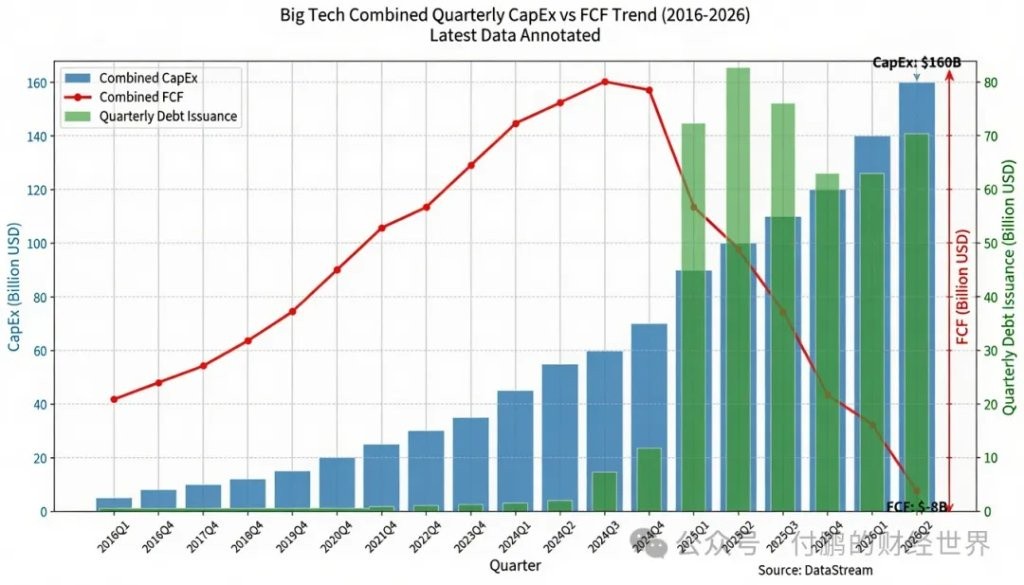
Therefore, after Google's financial statements were released a couple of days ago, you could see the market's reaction (remember, the market reacts in advance, and its reaction is always correct). This reaction indicates a major shift in market focus: First, everyone is closely watching free cash flow turn negative; second, they are concerned that a large portion of the profits in financial statements comes from valuation increases driven by internal circular investments. Isolating these two factors reflects the market's current primary concerns.
For many trading US stocks, while you may seem to focus on revenue, profits, and valuations, the most crucial aspect to understand the essence is actually Free Cash Flow.
As a shareholder or investor in a company, free cash flow is vital. Simply put, it is the money the company truly earns and saves, available for discretionary use. For shareholders, this is most important because only this money can genuinely reward shareholders and resist risks.
With this money, the company does not need to borrow from others for future development. Think of it like personal finance: money you truly earn and save allows you to spend at will, cover unexpected medical expenses, or start a small business without borrowing from relatives or friends. Thus, this money is extremely important.
Moreover, free cash flow is relatively authentic in financial reports and less prone to manipulation. In contrast, profits can be adjusted and require detailed breakdowns to assess accurately.
For a company, free cash flow is the cash generated from daily operations after deducting necessary expenses to maintain the business. In the early stages, this includes purchasing equipment, building factories, and upgrading servers; in later stages, it includes utilities, labor, and other maintenance costs. What remains after these deductions is free cash flow.
In personal terms, it is the money left from your monthly salary after deducting essential expenses like food, housing, and utilities, which you can spend freely. This is your free cash flow.
02 Free Cash Flow: Key to Risk Resistance for Individuals and Companies
Many years ago, I used data on savings rates and savings growth. The savings rate, in particular, refers to an individual's free cash flow—the amount remaining after essential living expenses, available for savings.
These savings can be used to defend against risks, reward oneself (e.g., enjoying better food), or invest in future development. For individuals, this disposable amount is called the savings rate.
Japan's resident savings rate was zero, or even negative, for about 21 years from 1990 to around 2011. This means that after deducting essentials like food, housing, and utilities, individuals had virtually no money for discretionary spending, risk defense, or future development.
This situation, where individual free cash flow hits zero, is quite alarming. You can extend this logic to observe many young people today who, after deducting essentials, may even need to borrow via consumer credit platforms, resulting in negative free cash flow.
Thus, for individuals, free cash flow is paramount as it truly measures one's financial foundation, capabilities, and risk resistance.
For investors, free cash flow is even more critical because it determines a company's strategic flexibility. Dividends, stock buybacks, debt repayment, and opportunistic investments without borrowing all depend on this financial foundation.
Therefore, at the start of a new major cycle, companies with strong free cash flow have significant strategic space and can undertake various initiatives.
After the 2008 financial crisis, many US companies saw their stock prices quickly "V-shape" recover by 2015–2016. This recovery was not necessarily driven by performance or profit growth but relied on strong free cash flow to continuously pay dividends and repurchase stocks, thereby stabilizing share prices.
After 2016, as the economy stabilized, free cash flow accumulated further, leading to highly profitable business models. What defines such a good business? It requires minimal large-scale investment. Normal operations incur low costs, yet the company maintains monopoly power and high profitability, leading to continuous accumulation of free cash flow. Such businesses offer flexibility and are ideal.
If a company has strong pricing power, loyal customers, high barriers to competition, and low maintenance costs after amortizing early CAPEX, most of its earnings remain as free cash flow, which grows continuously.
Imagine how beneficial this is for shareholders. Post-2008 crisis, companies could defend value by repurchasing stocks and increasing dividends, returning the value generated by free cash flow to shareholders.
Conversely, as an investor, when new opportunities arise, such as the emergence of ChatGPT in 2021, the company can quickly deploy its own funds for offensive strategies. Using internal funds requires no financing, roadshows, or extensive explanations, allowing for rapid investment in R&D. Speed is key. Even with no external support, having substantial cash on hand makes the company a standard "cash cow." This state constitutes a complete moat.
A complete moat implies the ability to accumulate free cash flow, underpinned by competitive advantages. This moat is not just about pricing power on the revenue side but also cost advantages, making it harder to break than mere technical or brand advantages in competition.
03 Cash-Burning Models and Free Cash Flow: The Evolution Path of Internet Giants
Conversely, poor business models require continuous cash injections to maintain market share, constantly burning cash. In such highly competitive markets, stopping the cash burn leads to a decline in competitive position.
Such businesses are undesirable. If massive cash burning only maintains market share without generating positive free cash flow or profits, it becomes problematic.
Why is "free cash flow turning negative" a critical node? As an investor, you cannot ignore this key data point in June (Q2). Because CAPEX spending has peaked for three consecutive years (2023, 2024, 2025), this figure cannot be overlooked.
You may observe that many still analyze the market using the logic of the previous three years, but in reality, the tipping point has arrived.
Currently, the main spenders are internet giants. Since they are the ones spending now, and also those who previously accumulated free cash flow, let us briefly recall how they built their free cash flow:
The Dotcom Bubble burst around 2000, wiping out many cash-burning internet companies. Survivors took over a decade (2000–2012) to digest that massive capital expenditure. They truly built their moats using soft powers like scale, network effects, data, and ecosystems.
Only after the financial crisis did they generate substantial free cash flow for buybacks, forming monopolies and moats. Without the 2000 bubble, they would not have controlled costs so strictly.
What is a "bubble"? As mentioned earlier, it is essentially storytelling. What does "post-bubble maturity" mean? It means transforming storytelling into verifiable economic models—models that generate profits and free cash flow. At this stage, user base, data, and ecosystem barriers become increasingly high.
As network effects expand, marginal costs drop sharply. Scale effects mean larger scale leads to lower marginal costs. Consequently, incremental revenue incurs lower costs and higher yields, leading to rapid accumulation of free cash flow.
Thus, internet giants' advertising, cloud services, and app stores naturally possess free cash flow conversion capabilities. Companies become flexible: repurchasing stocks or investing as desired; acquiring competitors during industry downturns; or using cash buffers and buybacks during the 2008 crisis.
Therefore, it took over a decade after the financial crisis to complete the loop of "burning cash for growth, growth for cash, and cash building moats."
Now, in recent years, specifically early 2023, with the release of GPT-3.5 and the operation of general large models, it was proven that infrastructure investment was viable, paving the way for a new generation of AI infrastructure.
04 AI Capital Expenditure Initiates a New Infrastructure Cycle
This enters a cycle of infrastructure capital expenditure—data centers, GPU clusters—with CAPEX expanding massively.
Investing in a promising new frontier requires spending. AI, fundamentally, is an infrastructure layer requiring massive construction. "To get rich, build roads first"; you must invest in building this road.
Governments can fund roads through fiscal budgets or bonds. For companies, investment first consumes existing free cash flow reserves. As this is an early infrastructure phase, capital expenditure ramps up quickly.
The market logic here is interesting. The logic is that whoever invests in CAPEX gains first-mover advantage, leadership, and a new moat. Thus, expectations drive frantic spending.
Capital markets exhibit optimism during this phase. Optimism means believing that spenders will form future moats. Hence, it becomes an arms race where spending leads to future profits, driving market valuations higher.
In this phase, free cash flow is consumed, yet market valuations expand. Thus, the first node of the early arms race is spending, reflecting confidence in future profitability and the belief that "AI will definitely have traffic," supporting a positive feedback narrative, even though free cash flow is being depleted.
05 Impact of Negative Free Cash Flow on Tech Company Valuations
But why is it a tipping point? The tipping point is that once free cash flow turns negative, outcomes depend on whether the spending yields results.
The issue is not just negative free cash flow but also the lack of visible results. For instance, if a business invests for three years, stabilizes profits and free cash flow, and convinces stakeholders of future stability or growth, sentiment remains positive. This is because ultimate value comes from end-user applications.
If a highway is built and cars gradually start using it, with expectations of increasing traffic, confidence remains high. However, if free cash flow turns negative and it becomes clear that traffic (applications) may take an uncertain amount of time to arrive, sentiment shifts abruptly.
Previously, as a profit-generating machine, the company enjoyed superior metrics, with investors willing to pay valuation premiums for future growth. But once free cash flow turns negative and sentiment shifts, if application layers require a long time to materialize, the narrative shifts to a cash-burning logic, causing a drastic change in shareholder and investor mindset.
Previously, shareholders trusted long-term plans presented at annual meetings. Now, they may reconsider. When management claims to invest in the future, but reserves are depleted and AI applications seem distant, why should anyone believe in a short-term turnaround?
Thus, risk sensitivity rises sharply. Without the financial cushion of free cash flow, sensitive shareholders become increasingly anxious.
If continued investment is needed, the company must seek external financing, either by issuing stock (diluting shareholder equity) or borrowing (increasing debt burden and sensitivity to economic fluctuations). External investors' mindset becomes sensitive, differing significantly from using internal free cash flow.
Consequently, the entire valuation framework changes—from "growth plus discounted cash flow" to "growth consuming cash flow but supported by confidence and valuation," and potentially to "questionable growth valuation."
With negative free cash flow, the question mark deepens. Focus shifts to when profitability will return, how much more needs to be spent, and the significant dilution of shareholder equity. This becomes a vicious cycle.
Therefore, negative free cash flow does not inevitably lead to disaster. A critical node is whether certainty exists after three years of spending. With certainty and a clear path, negative free cash flow is manageable.
The major trouble in Q2 this year lies in the simultaneity of two factors: free cash flow turning negative while large-scale AI application breakthroughs remain elusive. Some argue cloud service revenues are rising, but comparing this revenue growth to current CAPEX reveals a rapidly widening gap.
In other words, it costs increasingly more to earn each dollar. Although revenue may grow from one to two dollars, the cost increases even more, creating a "bottomless pit" concept that weakens market confidence. When these two factors resonate, the investment is no longer seen as rolling but as a drain on shareholders.
Thus, understand that this critical node has appeared. Massive CAPEX has consumed free cash flow. Will it ultimately prove to be a benign long-term investment maintaining moat leadership, or will it become a consuming bottomless pit?
Some say this is merely a matter of confidence in the future AI era.
Know that human confidence fluctuates; it is not brainwashing. Reaching the endpoint involves intermediate fluctuations that must be assessed at each node.
Finally, I hope this sharing helps explain why we are highly sensitive to the step-by-step turn to negative free cash flow among spending tech giants entering Q2.
Risk Warning and Disclaimer
Market investments carry risks; proceed with caution. This article does not constitute personal investment advice and does not consider individual users' specific investment goals, financial situations, or needs. Users should consider whether any opinions, views, or conclusions in this article align with their specific circumstances. Investment decisions based on this content are the sole responsibility of the user.