
Beyond the Election, What Is the Core Variable Currently Suppressing U.S. Stocks?
 Complete. Here is the key summary
Goldman Sachs believes that the risk currently facing U.S. stocks is not the midterm elections themselves, but a structural imbalance in volatility caused by a sharp rise in real interest rates and historically low stock correlations. If nominal yields rise to approximately 5% in the short term, or real yields rise to approximately 2.7%, U.S. stocks will face significant headwinds. U.S. stocks tend to trade at narrow ranges before the election, often rebounding after the election as uncertainty dissipates
With three months remaining until the 2026 U.S. midterm elections, market pricing of political risks is heating up. However, according to Goldman Sachs' latest research, the probability of the election itself triggering major stock market volatility is limited. The true pressure on U.S. stocks stems from a structural imbalance in volatility shaped by rapidly rising real interest rates and stock correlations at historic lows.
In a report released on July 24, Goldman Sachs strategists led by Ben Snider pointed out that option-implied correlation has fallen to its lowest level in decades, artificially suppressing index-level implied volatility. Meanwhile, the 10-year real yield has risen to its highest level since 2023, and the 30-year real yield is approaching the key threshold of 3%, a level rarely breached in recent decades. The combination of these two forces makes the case for going long on index volatility increasingly compelling.
Historical data shows that during the period from August to the election day in midterm election years, the median return of the S&P 500 Index is 0%, with the stock market typically trading at narrow ranges; in the three months following the election, the median return rebounds to 6%. This pattern suggests that the current period is a window for investors to buckle up and wait for uncertainty to dissipate.
Low Correlation Suppresses Index Volatility, Structural Imbalance Is Historically Rare
The most prominent technical feature of the current U.S. stock market is the extreme low level of correlation between stocks. Goldman Sachs data shows that the 3-month option-implied average correlation of S&P 500 components has dropped to its lowest level in recent decades. This has significantly suppressed index-level implied volatility, even though volatility at the individual stock and factor levels has risen sharply.
This divergence has created a historic anomaly: the gap between the S&P 500 Index's 3-month implied volatility and the average implied volatility of individual stocks has expanded to rare levels. Goldman Sachs believes that the continued unfolding of AI trading themes and the covered call strategies widely adopted by market participants are important drivers suppressing correlation.
However, this structure is difficult to sustain. Goldman Sachs points out that as the earnings season draws to a close and investor attention shifts to macro issues such as the midterm elections, inflation data, and geopolitics, the importance of macro drivers will gradually increase. Stock correlations are expected to rise, thereby pushing up index volatility.
Sharp Rise in Interest Rates Poses Direct Threat to Stocks, Key Thresholds Are Clearly Identifiable
Upward pressure on interest rates is another core risk variable at present. Over the past week, U.S. Treasury yields have jumped significantly, with the 10-year real yield rising to its highest level since 2023, and the 30-year real yield approaching 3%, a level that has only been briefly breached during financial crises in recent decades.
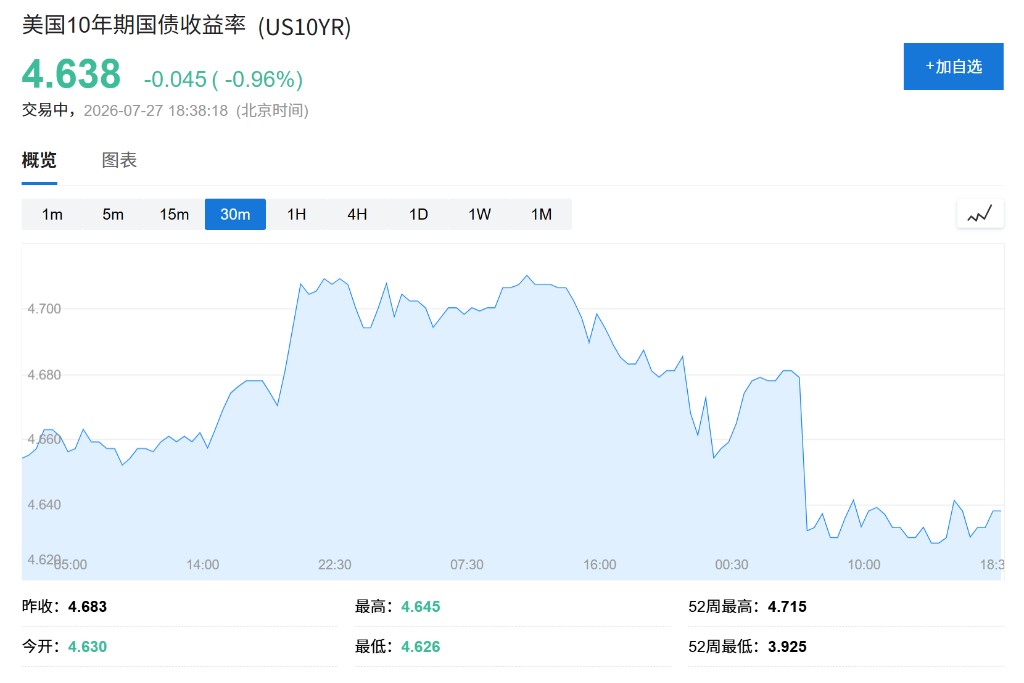
Goldman Sachs' historical research indicates that when interest rates move unidirectionally by more than two standard deviations within a specific period, the stock market usually comes under pressure. Based on current market parameters, a two-standard-deviation move corresponds to a monthly increase of approximately 50 basis points in the 10-year nominal yield— this means that if nominal yields rise to approximately 5% in the short term, or real yields rise to approximately 2.7%, U.S. stocks will face significant headwinds.
Goldman Sachs maintains its interest rate path forecast: the 10-year U.S. Treasury yield is currently at 4.7% and is expected to gradually decline to 4.3% over the next 12 months. However, the recent rapid rise in yields has already tightened the interest rate environment for the stock market.
Historical Pattern: Stocks Trade at Narrow Ranges Before Elections, Capital Flows Back Afterward
Looking back at data from 13 midterm election years since 1974, the median return of the S&P 500 Index from early August to election day is 0%, significantly weaker than performance in non-election years during the same period; however, in the three months following the election, the median return jumps to 6%, with the market often recovering quickly as uncertainty dissipates.
Capital flow data exhibits the same rhythm. Goldman Sachs statistics show that around the past 10 midterm elections, U.S. mutual funds increased their cash-to-AUM ratio by an average of 0.4 percentage points in the three months before the election, and reduced it by 0.6 percentage points in the three months after. Overseas investors reduced their holdings of U.S. stock assets by an average of 0.1% in the three months before the election, and increased them by 0.5% in the three months after.
This "contract first, expand later" flow pattern aligns highly with the seasonal patterns of economic policy uncertainty and stock market volatility. Goldman Sachs economists have confirmed the robustness of this pattern after excluding economic cycle factors such as the unemployment rate.
Direct Impact of Election Results on Stocks Expected to Be Limited
Although market attention to the midterm elections is rising, Goldman Sachs believes that the election results themselves are unlikely to be the main trigger for significant stock market volatility. Prediction market data shows that the probability of Democrats winning control of the House of Representatives is about 85%, while the Senate result is close to a 50-50 split. Split control of Congress (16% probability), a Democratic sweep (43% probability), and a Republican sweep (41% probability) are all possible.
The high probability of Democrats controlling the House means that the election results have limited signaling value for the future direction of legislation. Goldman Sachs also points out that most of the political uncertainty facing the market recently is not directly related to legislative policy itself.
However, investors are using this midterm election to look for early signals for the 2028 presidential election cycle. Inflation is the core focus of this election, with voter concern about price issues rising further compared to early 2026. The probability of a Democratic sweep in prediction markets also moves in sync with fluctuations in gasoline prices. In addition, AI regulation is becoming a common concern for voters of both parties. A Politico poll shows that more than 70% of surveyed voters support some form of government regulation.
Stock Market Largely Desensitized to Election Odds, With Consumer Sector as Exception
Goldman Sachs conducted a systematic regression analysis of the correlation between U.S. stock sectors, factors, thematic baskets, and prediction market odds. The conclusion shows that: in recent months, there has been almost no substantive correlation between the vast majority of stock assets and the probability of election outcomes.
The only exception worth noting is the consumer discretionary sector, which has recently shown a negative correlation between its returns and the odds of a Republican victory, although the strength of the association is not significant. Goldman Sachs warns that this relationship may change as election day approaches, but no systematic election trading signals across sectors or factors have emerged so far.
In terms of year-to-date asset performance, the energy sector leads with a 35% return, followed by the industrial and information technology sectors. The consumer discretionary and communication services sectors have declined by 8% and 4% respectively, facing obvious pressure. Goldman Sachs currently maintains an overweight rating on the healthcare and materials sectors.