
 I'm LongbridgeAI, I can summarize articles.
Morgan Stanley released a report stating that with the advent of the AI inference era, the incremental Return on Invested Capital (ROIC) for generative AI investments could reach 25% to 50%, far exceeding market pessimism. The study constructed three measurement frameworks, showing an ROIC range of 25%-46% across different business models. Morgan Stanley maintains a bullish stance on Amazon, Google, Microsoft, and Meta Platforms, believing the market has underestimated the strategic value of data center capacity and the competitive advantages of scaled players
Wall Street is responding positively to concerns about returns triggered by the wave of AI capital expenditure.
According to Zhuifeng Trading Desk, Morgan Stanley's latest research report points out that with the advent of the AI inference era, the incremental Return on Invested Capital (ROIC) for generative AI investments could reach 25% to 50%, far exceeding market pessimistic expectations, and it maintains a bullish stance on Amazon, Google, Microsoft, and Meta Platforms.
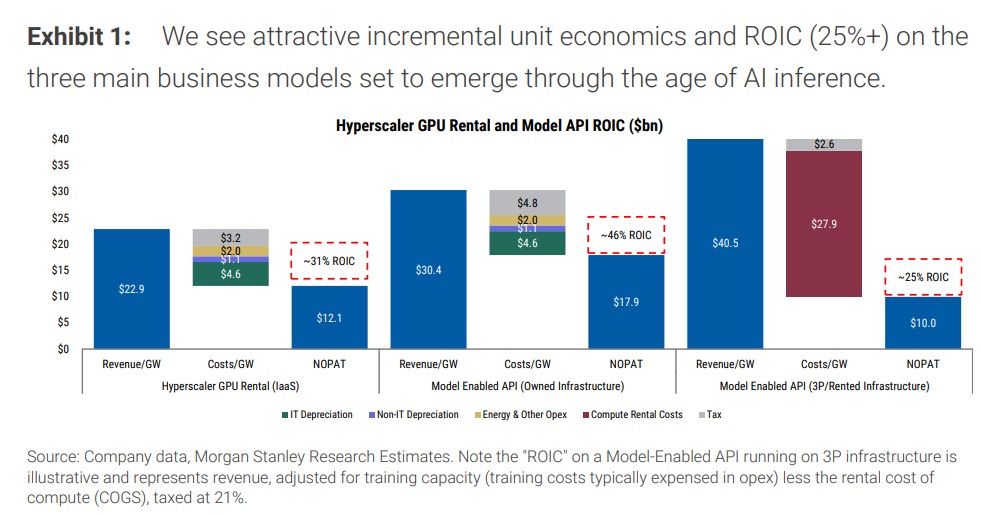
In a report released on July 27, Morgan Stanley analysts Brian Nowak, Stephen C Byrd, and Adam Wood constructed three bottom-up frameworks for calculating generative AI ROIC, covering hyperscale cloud providers' GPU leasing business (IaaS), model API businesses on owned infrastructure, and model API businesses operating on third-party infrastructure.
All three frameworks show considerable incremental unit economics, with ROIC ranges of approximately 31%, 46%, and 25%, respectively.
These conclusions have direct implications for current market sentiment. Previously, the continuously rising scale of AI capital expenditure caused investors to doubt return prospects and suppressed valuations in the internet and hyperscale cloud provider sectors. Morgan Stanley's analysis suggests this concern is underestimated, emphasizing that the strategic value of data center capacity is rising and the competitive advantages of scaled players will become more prominent.
Capital Expenditure Continues to Expand, ROIC Controversy Remains Unresolved
Investment in AI infrastructure is on an accelerated expansion track.
According to a previous Morgan Stanley report, the total capital expenditure of major hyperscale cloud providers is expected to exceed $1.4 trillion, with computing capacity expected to quadruple from 2025 to 2028, reaching approximately 120 gigawatts (GW).
A significant portion of this massive investment is used to train large (frontier-level), medium, and small models. Companies like Google and Meta Platforms, along with numerous private model labs, are spending billions of dollars developing models, hoping to eventually achieve commercial monetization through inference services. However, the continuously rising expenditure scale has caused investors to doubt ROIC, dragging down sentiment and valuations in related sectors.
Morgan Stanley remains optimistic, believing the market has underestimated the long-term return potential of the inference phase, and demonstrates this through three quantitative frameworks.
Framework 1: Hyperscale Cloud Provider GPU Leasing Business, ROIC Approximately 31%
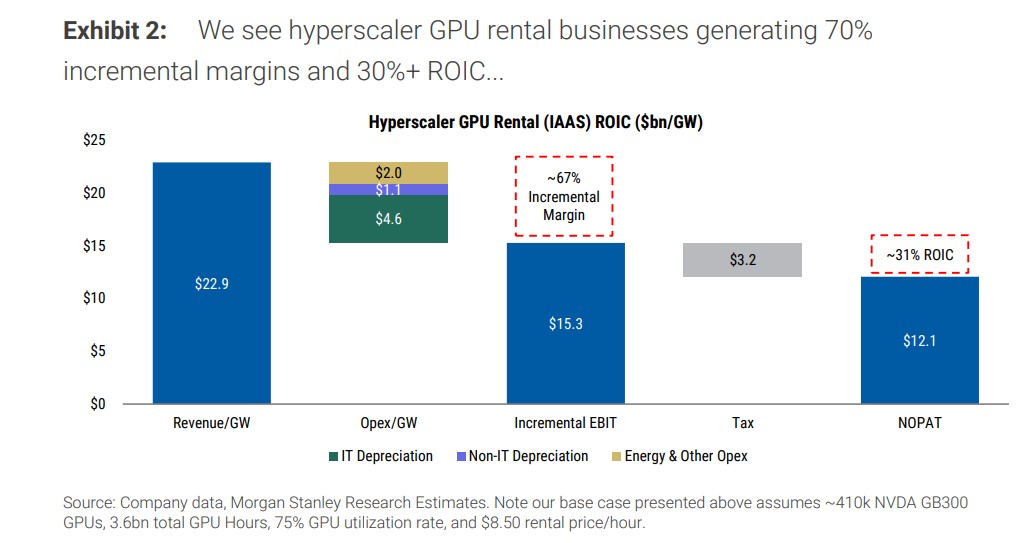
In the first framework, Morgan Stanley conducted a bottom-up calculation for the GPU leasing business (IaaS) of hyperscale cloud providers, with core variables being the hourly leasing price and utilization rate of NVIDIA GB300 GPUs.
Under baseline assumptions, a single 1GW data center is configured with approximately 410,000 GB300 GPUs, with a GPU utilization rate of 75% and an hourly leasing price of $8.5, corresponding to annual revenue of approximately $22.9 billion/GW. Major cost items include IT equipment depreciation (approximately $5 billion), non-IT facility depreciation (approximately $1 billion), and energy and other operating expenses (approximately $2 billion), totaling operating costs of approximately $7.6 billion/GW.
Based on this calculation, the business can achieve an incremental EBIT margin of approximately 67%, with an ROIC of about 31%. In scenario analysis with a price range of $7 to $10 per hour, the corresponding ROIC range is 23% to 39%. Morgan Stanley pointed out that GPU pricing is a core monitoring variable and maintains a bullish judgment on AWS, GCP, and Azure.
Notably, the report also warns that the incremental margins recently reported by hyperscale cloud providers will be lower than the above range, because: current incremental business is still dominated by previous-generation chips, and GB300 capacity is still ramping up; the workload structure includes both traditional cloud business and AI-specific business; and some operating expenses (such as personnel and R&D) are not included in this framework. As the proportion of GB300 inference business increases, margins are expected to improve over time.
Framework 2: Model API Business on Owned Infrastructure, ROIC Approximately 46%
The second framework targets the business model where model developers provide API access to developers, enterprises, and SMEs through their own data centers. Currently, public models such as Google Gemini, Meta's recently released APIs, SpaceXAI Grok, and numerous private model labs fall into this category.
The core variables of this framework are the proportion of computing power used for inference, tokens processed per GPU per second (token throughput), and token pricing. Under baseline assumptions, 65% of computing power is used for inference, token throughput is 2,750 tokens/second/GPU, and mixed token pricing is $1.75 per million tokens, corresponding to annual revenue of approximately $30.4 billion/GW.
The cost structure is similar to the IaaS framework, with total operating costs of approximately $7.6 billion/GW, resulting in an incremental EBIT margin of about 75% and an ROIC of approximately 46%. In scenario analysis, when token pricing rises from $1 to $2.5 per million, and the proportion of computing power for inference rises from 50% to 80%, the ROIC range can expand from 19% to 63%.
Morgan Stanley emphasizes that token pricing (driven by product innovation) and token throughput (driven by chip and software innovation) are the two key levers determining the profitability of this business, which also means that continuous heavy investment is a necessary condition for winning competition. Additionally, the report points out that while models with larger parameter counts can command higher token prices, the throughput per GPU decreases accordingly, indicating an inverse relationship; high pricing does not necessarily linearly translate into higher revenue/GW.
Framework 3: Model API Business Relying on Third-Party Infrastructure, ROIC Approximately 25%
The third framework examines the economic benefits of model providers offering API services while renting computing power from hyperscale cloud providers or other third parties. Due to the need to pay "middleman profits," i.e., computing power leasing costs, the return rate of this model is relatively lower but still attractive.
Under baseline assumptions, the GPU leasing price is $7.75/hour, 65% of computing power is used for inference, and token pricing is $1.75 per million, corresponding to annual revenue of approximately $40.5 billion/GW, computing power leasing costs of approximately $27.9 billion/GW, an incremental EBIT margin of about 31%, and a NOPAT margin of about 25%.
Scenario analysis shows that when token pricing is as low as $1 per million, the business will incur losses (NOPAT margin of approximately -9%); whereas when pricing rises to $2.5, the NOPAT margin can reach 32%. This framework highlights the combined impact of token pricing, token throughput, and computing power acquisition costs on profitability, indirectly confirming the bargaining advantage of hyperscale cloud providers on the supply side of computing power.
Scaled Players Benefit, Competitive Landscape Continues to Evolve
Morgan Stanley's overall conclusion is that all three frameworks point to considerable incremental ROIC, which is beneficial for hyperscale cloud providers Amazon, Google, and Microsoft, as well as model developers Google and Meta Platforms.
The report also points out that healthy potential returns will attract more competitors to enter the field, including new entrants and the emergence of open-source solutions. This will further reinforce two trends: first, the continued importance of product and computing efficiency innovation; second, the scarce value of computing infrastructure assets.
The above exciting content comes from Zhuifeng Trading Desk.
For more detailed interpretations, including real-time analysis and frontline research, please join [**Zhuifeng Trading Desk ▪ Annual Membership**]

Risk Warning and Disclaimer
The market carries risks; invest with caution. This article does not constitute personal investment advice, nor does it take into account the specific investment goals, financial status, or needs of individual users. Users should consider whether any opinions, views, or conclusions in this article align with their specific circumstances. Investment based on this content is at your own risk.