
 I'm LongbridgeAI, I can summarize articles.
Nvidia shares fell despite securing a $50 billion, 15-year AI data center lease in Texas with Hut 8. The stock decline reflects market concerns over Nvidia's shift to heavy capital expenditures and long-term leases, which may erode gross margins. Investors also worry about circular financing risks with clients like OpenAI and potential artificial inflation of AI demand. Broader caution regarding AI hardware spending and a bearish technical structure suggest further downside risk, with targets at $180 or $160.
TradingKey - Nvidia wins major Texas data center deal, but shares slide instead, risking a drop to $180.
On July 28, Eastern Time, Nvidia ( NVDA) shares extended their decline, falling 0.45% in premarket trading to temporarily sit at $195.62. Yesterday, Nvidia shares plummeted nearly 5%, driving its market value down to $4.77 trillion, while Apple continued to rise to new highs, with its market value soaring to $4.95 trillion, making it the world's most valuable listed company.
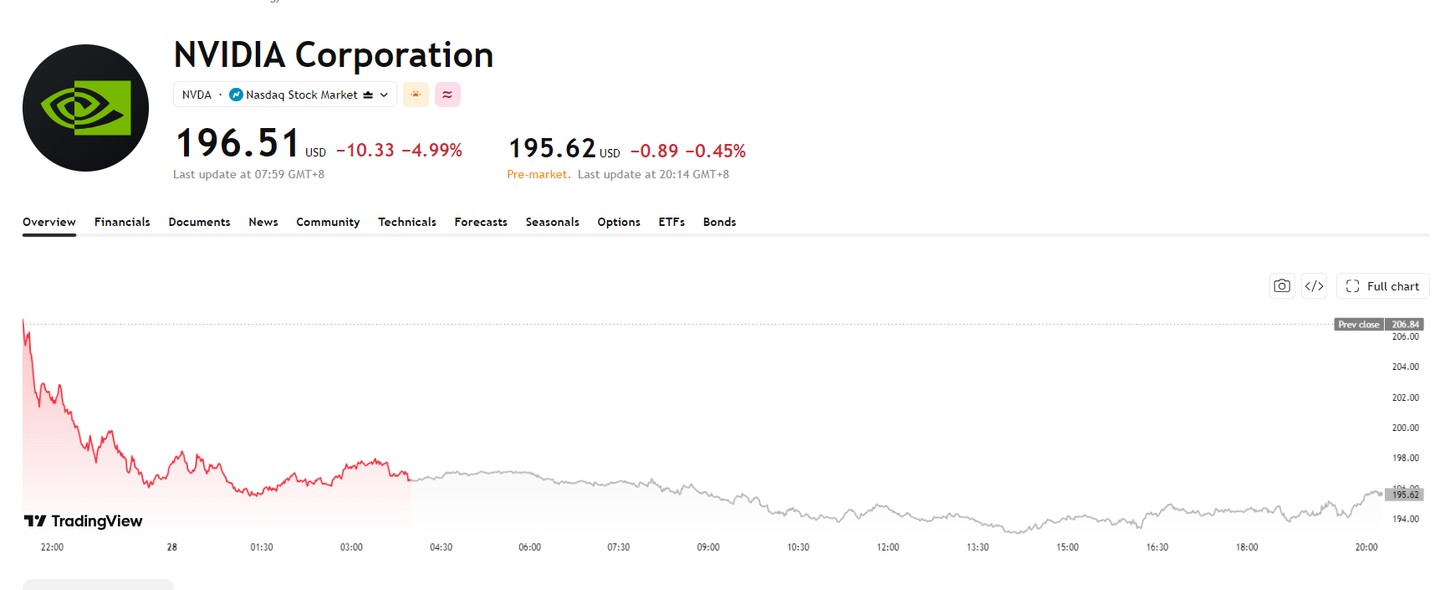 Nvidia stock chart, Source: TradingView
According to a Financial Times report today, Nvidia and Hut 8 ( HUT) have reached a massive $50 billion (15-year lease) gigawatt-scale (1 GW) AI data center lease agreement in Texas. In addition, hundreds of thousands of Nvidia GPUs will be deployed in the server rooms of this data campus. Following the announcement, Nvidia's stock fell instead of rising; why is this the case?
Previously, Nvidia simply sold chips, so it was not bogged down by the heavy capital expenditure burdens facing other tech giants. Now, Nvidia's business model is shifting as it begins to build its own or sign long-term leases for infrastructure, which means taking on extremely high and fixed capital expenditures. Meanwhile, the market is concerned that massive infrastructure operating and leasing costs will erode Nvidia's historical gross margin.
More critically, Nvidia is falling into circular financing risks, providing guarantees, leases, or investments to companies like OpenAI, Hut 8, and Naver to lock in these chip buyers, raising market concerns over whether current AI demand is being artificially inflated. Due to this intertwined relationship, if any of these companies run into issues, especially if the AI bubble bursts, Nvidia could face a cascading impact.
Of course, the recent weakness in Nvidia's stock is also tied to the current macro-market environment, which remains broadly cautious about AI hardware stocks. As tech giants like Google and Tesla spend astronomical amounts on AI infrastructure, investors are increasingly scrutinizing whether this massive capital expenditure can truly translate into corresponding software revenue. The Philadelphia Semiconductor Index and the tech-heavy Nasdaq Composite Index continuing to slide over the past month is a classic reflection of this.
Since setting a record high on May 13, Nvidia's stock has seen its rebound peaks and pullback troughs continuously decline, forming a descending channel. This is a classic bearish technical structure, signaling that the stock is poised for further declines, with a potential drop to $180 this week. If it loses support at that level, it could slide further to test this year's low of $160.
 Nvidia stock chart, Source: TradingView
Find out more