
US Stocks Are Already Feeling the Pressure of Midterm Elections!
 Complete. Here is the key summary
Despite strong corporate earnings, the S&P 500 has largely treaded water since early May. Historical data shows that in the year preceding US midterm elections, the S&P 500 often underperforms, with corrections particularly likely in the summer. However, the market typically regains its upward momentum in the months following the election
The US stock market is quietly entering a sensitive period signaled by historical patterns. Despite robust corporate earnings, the S&P 500 has largely treading water since early May, leading market participants to look toward a potential explanation: the gravitational effect of the midterm elections is manifesting ahead of schedule.
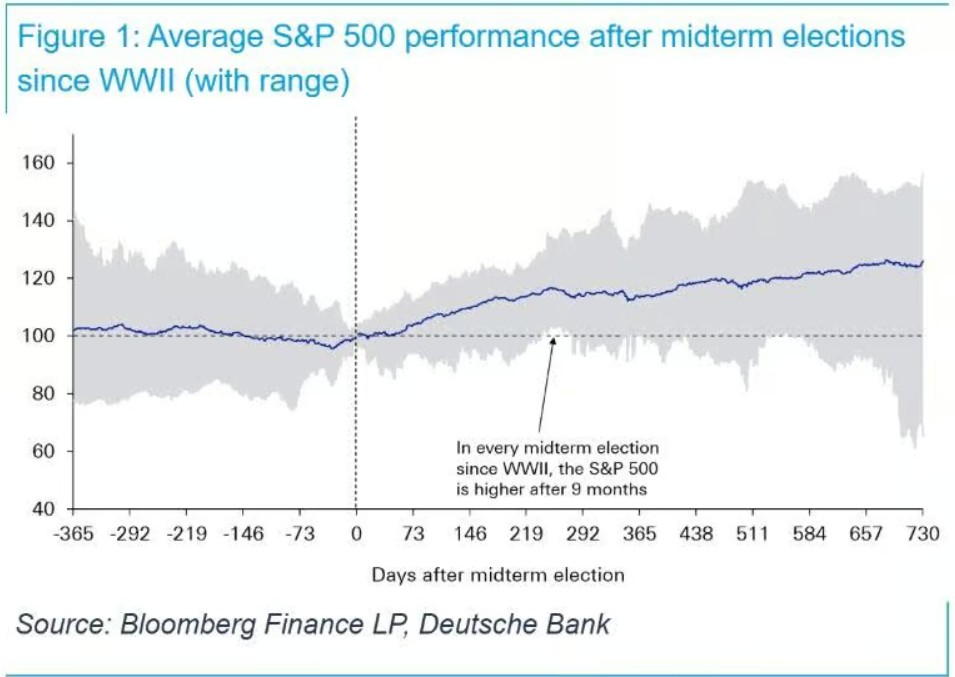
According to research by Deutsche Bank strategist Jim Reid, historical data indicates that in the year before US midterm elections, the S&P 500 often performs poorly, with corrections being particularly common in the summer. However, the market usually regains its upward momentum in the months following the election—across the 20 midterm election cycles since World War II, the S&P 500 has never recorded negative returns in the nine months following an election. This pattern suggests that the current relative weakness in the market may not be due to deteriorating fundamentals, but rather investors actively adopting a wait-and-see stance due to election uncertainty.
The current cycle is further complicated by additional factors. The war in Iran and the resulting surge in oil prices are putting pressure on government approval ratings. As the election approaches, this situation could influence the US government's strategic orientation toward Iran, thereby adding new variables to the market.
Strong Earnings, Yet Unable to Lift the Index
The stagnation of the S&P 500 is not stemming from weak fundamentals.
Deutsche Bank equity analysts pointed out that the second-quarter earnings season has been exceptionally strong so far. About two weeks into the earnings season, with approximately one-third of constituent companies having reported, nearly 90% of companies exceeded expectations, with overall earnings about 10% higher than market consensus estimates.
The S&P 500's second-quarter earnings growth is currently poised to reach 34% year-over-year, significantly surpassing the previously optimistic consensus estimate of 26%. This implies a clear divergence between the stagnation at the index level and the improvement in micro-level earnings, suggesting that the market's "inertia" needs to be explained from other dimensions.
Historical Pattern: Pressure Before Elections, Rebound After
Deutsche Bank's historical data reveals a clear market pattern surrounding midterm elections: In the year preceding an election year, the S&P 500 often enters a sideways or even downward channel, which is particularly evident around the summer; whereas about two months after the election results are finalized, the market typically begins to regain momentum and continues to strengthen thereafter.
Notably, across all 20 midterm election cycles since World War II, the S&P 500 has never posted negative returns in the nine months following an election, a record that remains intact to this day. This pattern provides a reference framework for the current market: if history repeats itself, the current slump may be merely temporary, rather than the beginning of a trend reversal.
The Iran Variable Makes This Cycle More Complex
Unlike previous midterm election cycles, the current situation carries additional uncertainty due to the war in Iran.
Rising oil prices are dragging down support for the ruling party, and as Election Day approaches, the White House's choices on Iran policy will be increasingly influenced by political considerations. This dynamic itself constitutes a potential source of market disruption.
However, Deutsche Bank's analysis also points out that even setting aside the Iran factor, the uncertainty surrounding the election outcome itself may be sufficient to keep investors cautious until the results are clear. In other words, the current wait-and-see sentiment in the market reflects more of a systematic avoidance of political uncertainty rather than a reactive response to a specific risk event.
Tech Stocks Drag, Sector Divergence Intensifies
Structurally, the "Magnificent Seven" (Mag 7) have generally traded sideways since last September and have declined recently, becoming the main drag on the index. Meanwhile, other sectors have performed relatively better, leading to significant divergence within the market.
This landscape echoes the cooling of the AI narrative. The market's tolerance for hyperscale cloud computing vendors continuously increasing AI capital expenditure is waning. Deteriorating free cash flow, increased debt issuance, and interest rate pressures collectively constrain valuations. Against the dual backdrop of pressure on tech stocks and rising election uncertainty, investors' defensive tendency may be difficult to reverse in the short term.