
Excess Financing of $3.5 Billion: Moonshot AI Approaches $50 Billion Valuation
 Complete. Here is the key summary
Moonshot AI has completed a $3.5 billion financing round, reaching a post-money valuation of $35 billion. The company plans to initiate a new round of financing at a pre-IPO valuation of $50 billion and intends to list in Hong Kong within the year. It has previously discussed listing matters with CICC and Goldman Sachs and is currently advancing key IPO steps, such as distributing shareholder resolutions
News on July 29: With the release of the open-source large model Kimi K3 and the widespread discussion it sparked in overseas tech circles, China's leading AI startup Moonshot AI has demonstrated remarkable acceleration in the capital markets.
According to insiders, Moonshot AI successfully raised $3.5 billion in this recently completed financing round, far exceeding the previously expected target of $1 billion to $2 billion. Its post-money valuation reached $35 billion.
Currently, the Beijing-based AI startup has begun contacting potential investors, aiming to launch a new Pre-IPO financing round at a pre-money valuation of $50 billion. It seeks to complete its final round of financing and capital accumulation before listing in Hong Kong later this year.
An insider close to Kimi stated, "Completing at a $35 billion valuation and starting at $50 billion is consistent with the information we have heard."
From a technology-oriented laboratory to a top domestic AI enterprise about to hit a $50 billion valuation, Moonshot AI is redefining the global AI competitive landscape with breakthroughs in extreme open-source models and a surge in capital.
01 In 6 Months, Valuation Soared 12-Fold
In fact, earlier this year, Moonshot AI had already begun considering a listing in Hong Kong and had held discussions with China International Capital Corporation (CICC) and Goldman Sachs Group regarding the promotion of the listing.
The enthusiasm from the capital market is directly reflected in the valuation. In this closed new round of financing, the valuation of this leading Chinese large model company reached $35 billion, and it has begun to charge towards the Pre-IPO valuation target of $50 billion.
This rapidly growing company was co-founded in early 2023 by CEO Yang Zhilin along with Zhou Xinyu, Zhang Yutong, and others. Yang Zhilin, 33, studied at Tsinghua University and Carnegie Mellon University and previously worked at Meta and Google. It took Yang only three years to go from academic achievements in the laboratory to steering a prospective listed company valued at $35 billion.
Driven by both capital and business catalysts, Moonshot AI's IPO preparations have taken a key step forward. The initiation of the substantive action of distributing shareholder resolutions means that its IPO process has officially entered the fast lane. Founder Yang Zhilin is intentionally accelerating the pace, as the window of opportunity following model breakthroughs is closing faster than most people expected.
Supporting the $35 billion valuation and the confidence for a Hong Kong IPO are solid financial figures. In April this year, Moonshot AI's Annualized Recurring Revenue (ARR) was $200 million; by June, it surged to $300 million, achieving 50% growth in two months.
Moonshot AI's commercial monetization path is also very clear: on the consumer side, it relies on tiered subscriptions for the Kimi chatbot, while on the business side, it sells underlying technical interfaces to corporate clients. In early June, the company also launched the general AI agent product Kimi Work to broaden application scenarios.
Going back to December 31, 2025, Yang Zhilin confirmed in an internal letter that the company had completed its Series C financing of $500 million.
He stated in the letter: "Current cash holdings exceed RMB 10 billion. Compared to the secondary market, we judge that we can raise larger amounts of funds from the primary market. In fact, the amount raised in our Series B/C rounds exceeds the fundraising of most IPOs and private placements by listed companies. Therefore, we are not in a hurry to list in the short term."
Data shows that after Moonshot AI completed its Series C, its post-money valuation was $4.3 billion. The Series D financing completed in May this year, at a valuation of $20 billion, was led by Longzhu Capital, a subsidiary of Meituan, with participation from state-backed China Mobile and Tsinghua Capital.
02 Kimi K3 Goes Viral: Ending the Closed-Source Myth
The direct trigger for this round of capital frenzy and Moonshot AI's determination to list was the release of its open-weight model Kimi K3 on July 16. Almost overnight, Moonshot AI's name spread within US AI companies.
With Kimi K3 becoming a hit, some in the US tech circle even began to reflect: Why didn't Yang Zhilin stay in the US to start a business after completing his PhD at Carnegie Mellon? As the strongest open-source model of the year, this open-weight model with 2.8 trillion parameters has directly disrupted Silicon Valley's rhythm.
The last time such market turbulence occurred was when DeepSeek released its R1 model.
In frontier benchmarks by third-party AI analysis agencies, Kimi K3's performance even ranked ahead of Anthropic's top model Claude Opus 4.8, becoming the first Chinese open-weight model to reach this milestone.
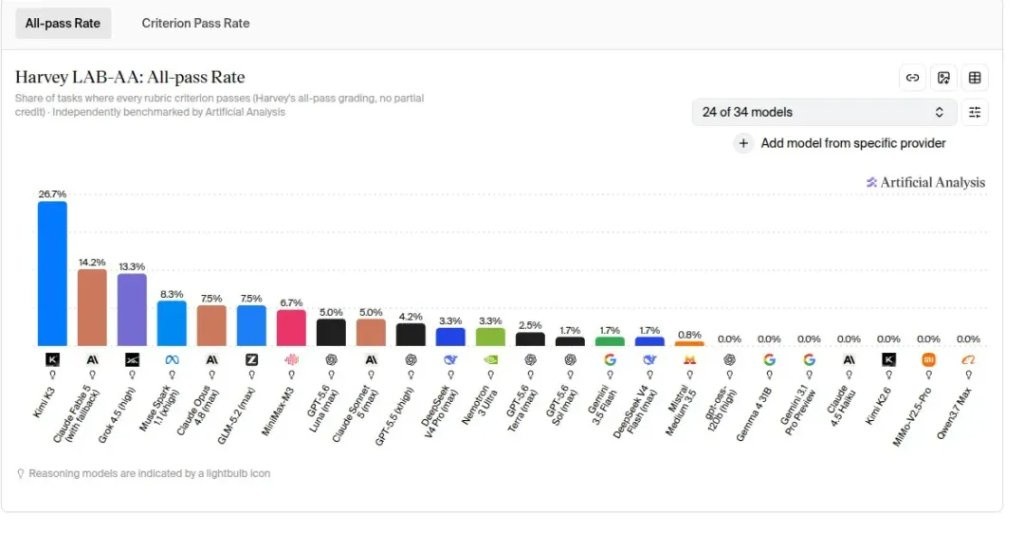
On the leaderboard of the well-known AI model ranking platform Arena, Kimi K3 ranked first in charts evaluating AI model performance on certain tasks, leading with a 26.7% success rate in the legal autonomous work benchmark, nearly double that of Claude Fable 5.
Ian Stoica, Professor of Computer Science at the University of California, Berkeley, and co-founder of Databricks and Arena, pointed out that early results (especially in coding) indicate that Kimi K3 is on par with Anthropic's Fable and OpenAI's high-end GPT-5.6 Sol models.
Stoica stated that it used to be said that open-source models, especially those from China, lagged behind frontier models by about six to nine months, but now the gap may be only two to three months.
Moonshot AI acknowledged that it still lags behind Anthropic's Claude Fable 5 and OpenAI's GPT-5.6 Sol in overall benchmarks, but it has narrowed the gap by 4 points in key evaluation metrics.
On the day Kimi K3 was released, Cursor, a world-leading AI code editor, quickly announced its integration. More practically, through this integration, US corporate teams now have a compliant path to run the model locally, with no Chinese infrastructure involved in the entire process.
Cursor's integration was not achieved overnight. Cursor admitted in March that it had used the Kimi model as a foundation when building its product. This origin makes the integration on the first day of release look less like a temporary cooperation out of convenience and more like the emergence of long-existing cooperative ties.
03 Price War Dimensional Strike: The Strategic Embarrassment of Silicon Valley Labs
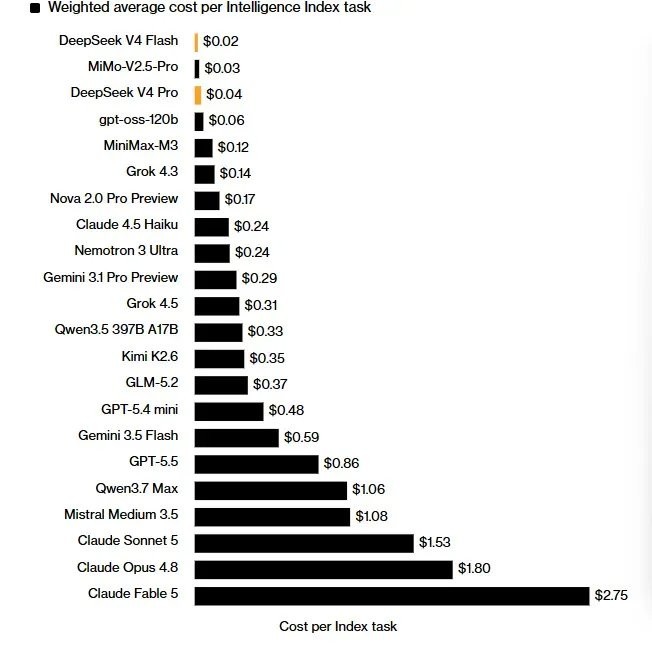
Low-cost AI reshapes the landscape: Chinese models achieve frontier performance at a fraction of the cost of US competitors.
The release of Kimi K3 aligns with a larger trend: According to CNBC, as usage costs for OpenAI and Anthropic soar, Chinese open-source models are gaining increasing market share among US enterprises.
This price gap is by no means insignificant. Chinese models are up to 9 times cheaper in token costs than their US counterparts, and in some workloads, cost savings reach as high as 90%.
DeepSeek V4 Flash quotes input tokens at $0.14 per million, while GPT-5.2 quotes $1.75. This means that for the same $1, DeepSeek V4 Flash can process 7.14 million input tokens, whereas GPT-5.2 can only process 570,000.
The resulting adoption data is striking: OpenRouter data shows that since February 8, the share of tokens consumed by US companies on Chinese models has remained above 30% weekly, reaching as high as 46% in some weeks, compared to a 12-month average of only 11% prior to that.
It is reported that OpenAI is considering significantly lowering token prices, indicating that the company views price pressure from China as a survival threat rather than a marginal challenge.
This places US AI labs in a very awkward strategic position. They have built moats around closed-source proprietary weights, corporate contracts, and the assumption that "model quality will continue to attract customers to pay a premium."
However, Chinese labs like Moonshot AI, DeepSeek, and Zhipu are offering top-tier weights for free or at very low prices, and their model quality is continuously approaching frontier levels. The quality gap that previously supported the high pricing of OpenAI and Anthropic is publicly narrowing in benchmarks visible to everyone.
04 The "Second War" of Chinese Chips
If listing is the first war won by the Chinese chip industry, then meeting the exploding demand for domestic large models and underpinning their token costs and inference economics will become the critical second battle.
"What Kimi K3 has proven so far is that its technical capabilities have entered the frontier; it has not yet fully proven that inference economics, product experience, and business models are equally viable," said a tech investor.
According to Artificial Analysis's "Intelligence Index" evaluation, Kimi K3 generated a total of approximately 130 million output tokens across all 9 tests, with the total bill for completing the full suite of evaluations reaching $2,709.75, while the median for similar participating models was only 63 million tokens. Broken down by single task, Kimi K3's average cost was $0.94, compared to $1.04 for GPT-5.6 Sol and $1.8 for Claude Opus 4.8.
Looking at pricing alone, Kimi K3's tokens are not exactly cheap.
Renowned developer Simon Willison commented in a blog post that Kimi K3 is "the most expensive model released by a Chinese AI lab to date."
The confidence to set a high price stems from Moonshot AI's judgment that K3 performs excellently in coding and other high-value agent tasks, sufficient to charge customers a premium. Moonshot AI's own explanation for this issue is: Chinese open-source models should not be labeled with the "cost-performance ratio" tag; SOTA models (referring to the best-performing models in a certain domain/task/benchmark) should have their own pricing power.
Chasing cost-performance is essentially chasing higher economics. Hu Yanping, a senior expert in internet and digital economy research, proposed the view of "volume-efficiency ratio," pointing out that without considering the volume-efficiency ratio, long-term competition will face the problem of "token inefficiency."
He cited Nvidia as an example, emphasizing that the ROI of tokens on H200 might be loss-making, but it is quite different after upgrading to B300. This puts forward new requirements for domestic computing power: it must ensure model supply while also releasing the economics of tokens at the hardware level.
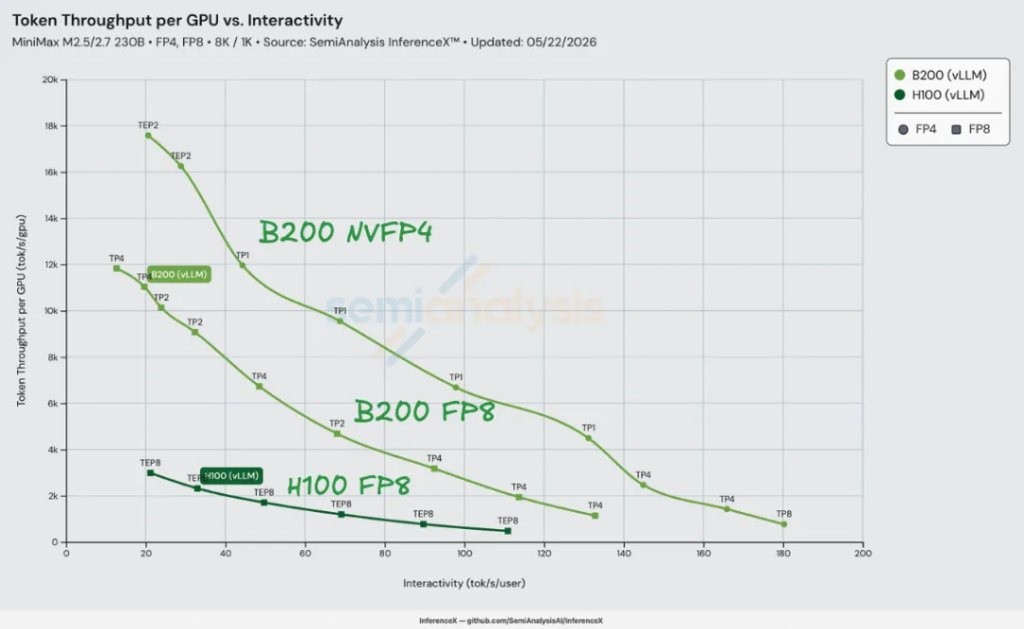
Cost comparison of running Minimax 2.5 under high interaction loads: B200 NVFP4 vs. H100 FP8
A SemiAnalysis report in May showed that under MiniMax-M2.5's 8K/1K load, B200 NVFP4 achieved $0.09 per million tokens thanks to hardware and kernel optimization; whereas H100 FP8 was $0.74 under unified conditions, achieving a cost-performance improvement of over 8 times.
Regarding the evolution of domestic computing power, the 2026 World Artificial Intelligence Conference (WAIC) showcased positive trends. The most typical example is Huawei's evolution from CloudMatrix 384 to Atlas 950 super nodes—increasing from 32 cards to 64 cards per cabinet, and from 12 to 16 compute cabinets, expanding from supporting hundred-billion-parameter training to low-precision training and hybrid inference of trillion-parameter models.
Behind the evolution of domestic computing power lies a compelling story: as companies list, employees receive equity incentives, and the market begins to reprice Chinese chips.
Although Kimi K3 still has room for improvement in overall performance, and its IPO process depends on market conditions, Moonshot AI has already made it impossible for people on the other side of the Pacific to ignore its existence.
Risk Warning and Disclaimer
The market carries risks; investment requires caution. This article does not constitute personal investment advice, nor does it consider the specific investment objectives, financial status, or needs of individual users. Users should consider whether any opinions, views, or conclusions in this article align with their specific circumstances. Investment based on this content is at your own risk.