
 I'm LongbridgeAI, I can summarize articles.
The Federal Reserve held rates steady for the seventh consecutive month, prompting the Treasury market to vote with its feet: since Walsh isn't hiking rates, the bond market is tightening conditions on its own. The 2-Year Treasury Yield fell, reflecting the market's view that near-term rate hikes are unlikely; meanwhile, the 30-year yield surged 14 basis points in a single day to 5.23%, hitting a 19-year high, as investors demanded a higher inflation risk premium
On July 29, the Federal Reserve announced it would hold interest rates steady for the seventh consecutive month, keeping the benchmark rate in the 3.5% to 3.75% range. Following the announcement, the 30-year Treasury yield surged by as much as 14 basis points in a single day, touching 5.23%, its highest level since 2007. Meanwhile, market inflation expectations rose, the U.S. dollar weakened, and equity markets declined.
The market's logic is straightforward: Walsh claims he wants to combat inflation, but his hesitation to act has led the market to doubt whether he will truly follow through.
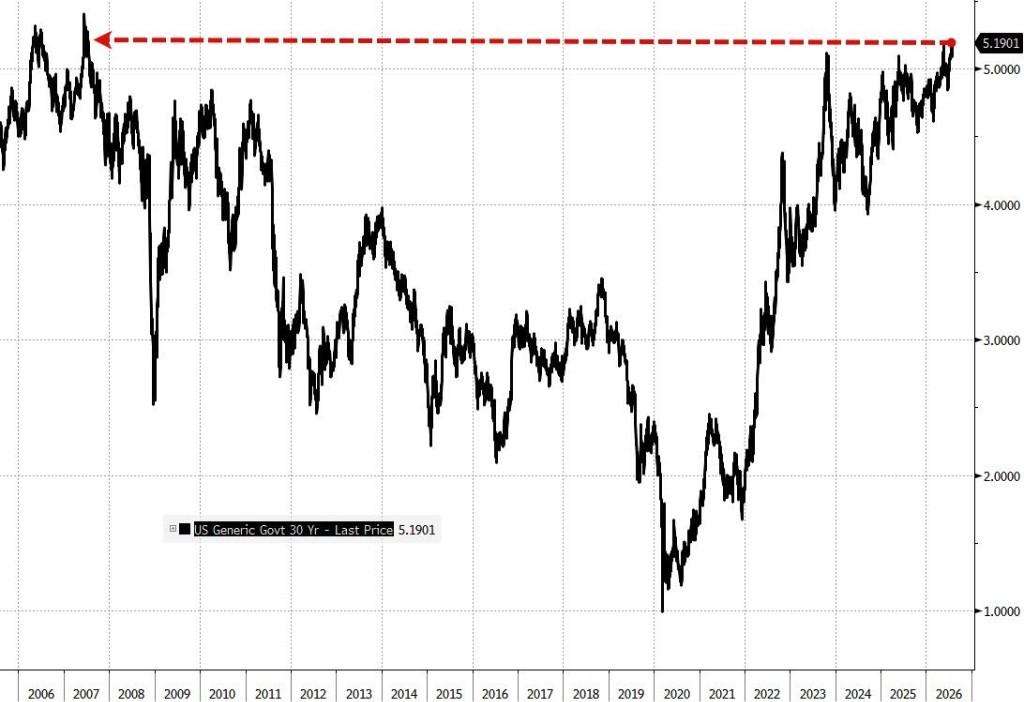
Curve Steepens as the Market "Votes"
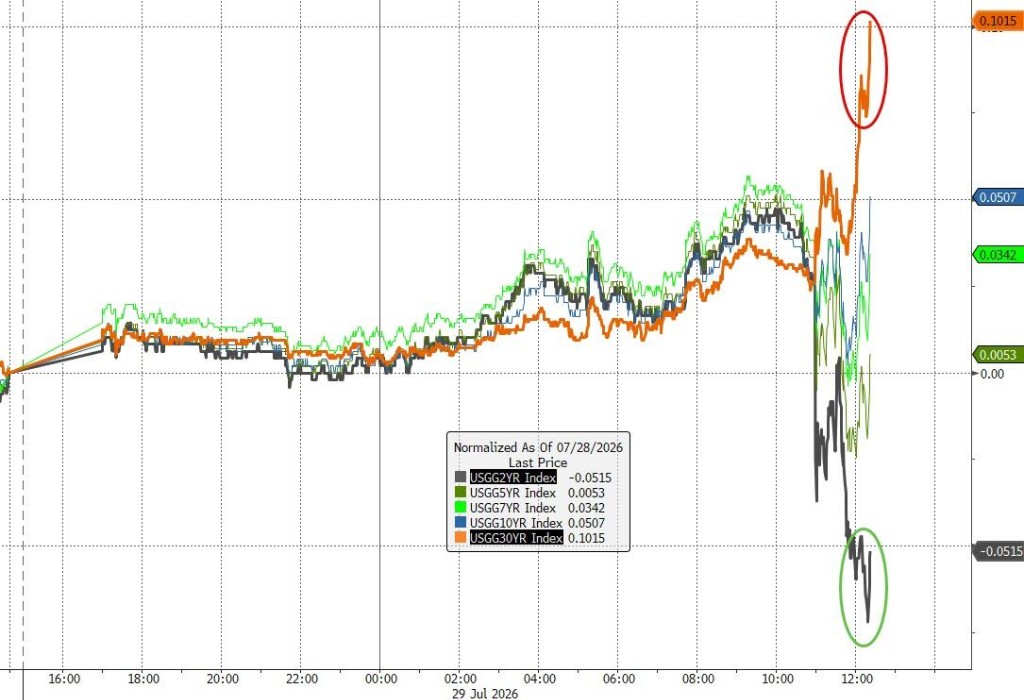
A notable structural signal emerged from this bond market reaction: the yield curve experienced a rare and significant steepening.
Short-end (2-year) yields declined as the market perceived a lower probability of near-term rate hikes, while long-end (30-year) yields rose as investors demanded greater compensation for inflation risk.
According to Bloomberg, this combination of "short-end down, long-end up" marked one of the largest post-FOMC meeting curve steepenings since the mid-1990s.
Ben Emons, Managing Director of Fixed Income at Highline Asset Management and founder of FedWatch Advisors, pinpointed the core issue: "This indicates a lack of credibility in Walsh's policy strategy."
He further explained: "Striking a hawkish tone without taking action is a convenient way to let the market make its own judgments and effectively tighten policy in place of the Fed. However, if inflation accelerates and the market determines that the Fed is once again falling behind the curve, this approach will backfire."
Walsh's Logic: Long-End Rates Are Doing the Work for Him
When pressed by reporters on why he was waiting despite inflation running at an annual rate of 3.5%, Walsh offered his explanation: Rising long-term market rates are already doing part of the tightening work for the Federal Reserve.
This logic is not without merit. Higher long-term rates increase costs for mortgages and corporate financing in the real economy, objectively helping to suppress demand.
Kevin Flanagan, Head of Investment Strategy at WisdomTree, acknowledged this assessment but drew a red line: "The market has already tightened conditions for the Fed. But this can only go so far. If Walsh continues to strike a hawkish tone while the data points to the need for rate hikes, his credibility will be in jeopardy."
Jack McIntyre, Portfolio Manager at Brandywine Global Investment Management, was more blunt: "I don't recall a press conference where reporters said they didn't understand and asked for more clarification. The market feels the same way." He added, "The long end simply doesn't believe his inflation-fighting narrative."
Abandoning Forward Guidance Turns the Bond Market into a "Yo-Yo"
Since taking office, Walsh has actively abandoned the forward guidance practice long maintained by his predecessors—namely, signaling policy directions to the market in advance. His rationale is that excessive forward guidance can leave policymakers constrained.
However, the cost of this shift is becoming evident in the bond market.
Torsten Slok, Chief Economist at Apollo Global Management, stated in an interview with Bloomberg Television that this "silence" has caused bond yields to "oscillate like a yo-yo."
Data supports his view: Prior to Walsh, market certainty regarding policy direction before Fed meetings typically hovered around 90%. In contrast, before this meeting, the CME FedWatch tool showed only about a 38% probability of a rate hike, indicating a divergence rarely seen in recent years.
Even more dramatically, during Walsh's press conference, the probability of a September rate hike fell in real-time from approximately 70% to 50%.
Slok remarked, "The market can hardly find any anchor to rely on. It is also difficult to discern the basis for today's decisions."
He also pointed out that the surge in the 30-year yield indicates the bond market has decided to tighten conditions on its own: "If you won't hike rates, we will."
Three Dissenting Votes Reveal Internal Divisions
Another unusual detail of this meeting was that three committee members voted for an immediate rate hike, publicly opposing Walsh's stance on holding rates steady.
WisdomTree's Flanagan commented, "You're starting to see a bit of internal family squabbling brought out into the open, namely those three dissenters."
Before the meeting, some Wall Street institutions had begun predicting that the Fed would hike rates at this session, pushing the implied probability of a hike up to 40%. Such significant divergence persisting right up to the decision day is quite rare.
At the press conference, Walsh also refused to send any signals regarding the late-August Jackson Hole Annual Economic Symposium—a traditional venue for central bank officials to release policy expectations. Cindy Beaulieu, North American Chief Investment Officer at Conning, noted that Walsh described that upcoming meeting as a "blank slate," which "has raised some doubts about how seriously this Fed is preparing to hike rates."
Inflation Pressure and Debt Expansion: Fundamental Reasons for Long-End Pressure
The rise in long-term rates is not merely a "punishment" of Walsh; it is also supported by tangible fundamentals.
According to Bloomberg, factors driving long-term rates higher include persistent inflation above target, the continuous expansion of federal debt, and large-scale financing demands resulting from hundreds of billions of dollars in capital expenditures by major tech companies for artificial intelligence.
Regarding inflation, the year-over-year CPI increase remains at 3.5%, exceeding the Fed's 2% target for five consecutive years. Slok added that the recent rebound in oil prices has further increased inflation uncertainty.
Against this backdrop, Walsh faces mounting pressure from two directions: the market is forcing his hand through rising long-term rates, while internal dissenters are applying pressure through their votes.