
微软 (MSFT.US) 破局 “AI 烧钱恐慌”!Q4 业绩全线超预期:云业务增长指引提速,下修今年资本支出预测
 Complete. Here is the key summary
微软 Q4 业绩全面超预期,营收 900.1 亿美元,净利润同比大增 31%。Azure 增速创四年最快,全年收入首破千亿美元。公司下调 2027 财年资本支出预测至 1750 亿美元,缓解 AI 投资担忧,盘后股价大涨超 8%。
According to Zhitong Finance APP, after weeks of concerns about AI investment returns overshadowing Wall Street, Microsoft (MSFT.US) provided the strongest response with a comprehensive earnings report that exceeded expectations—both revenue and profit crushed forecasts, and Azure's growth rate hit its fastest pace in four years. More importantly, the company proactively lowered its capital expenditure forecast for fiscal year 2027 from $190 billion to $175 billion, alleviating market fears of "unrestrained AI spending." After the earnings report was released, Microsoft's after-hours stock price surged over 8%, reaching $423.04.
Key Financial Data: Comprehensive Beat on Expectations, Net Profit Soars 31%
For the entire fiscal year 2026, Microsoft's total revenue reached $331.8 billion, a year-on-year increase of 18%; net profit was $133.7 billion, a year-on-year increase of 31%. Annual Azure revenue surpassed the $100 billion mark for the first time, becoming the second cloud service provider to reach this milestone after Amazon AWS. In the fourth fiscal quarter, Microsoft achieved revenue of $90.01 billion, a year-on-year increase of 18%, far exceeding analysts' expectations of $87.7 billion.
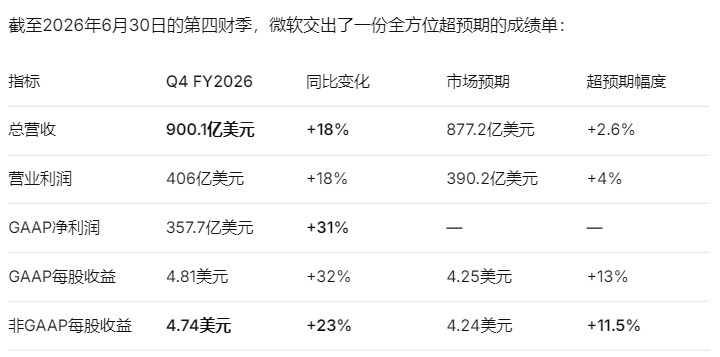
Among them, the non-GAAP earnings per share of $4.74 excluded the impact of the investment in OpenAI, exceeding market expectations of $4.24 by 11.5%. GAAP net profit surged 31% year-on-year to $35.77 billion.
The investment in Anthropic contributed unexpected gains. This quarter's performance included a $3.2 billion investment gain—stemming from Microsoft's equity investment appreciation in the AI lab Anthropic. Additionally, the costs related to the voluntary retirement plan implemented by the company were lower than expected, further boosting profits.
Earnings Guidance: Q1 Outlook Exceeds Expectations
For the first quarter of fiscal year 2027 (July to September 2026), Microsoft expects:
Total revenue: $89.85 billion to $90.95 billion, with a midpoint of $90.4 billion, higher than analysts' expectations of $89.66 billion;
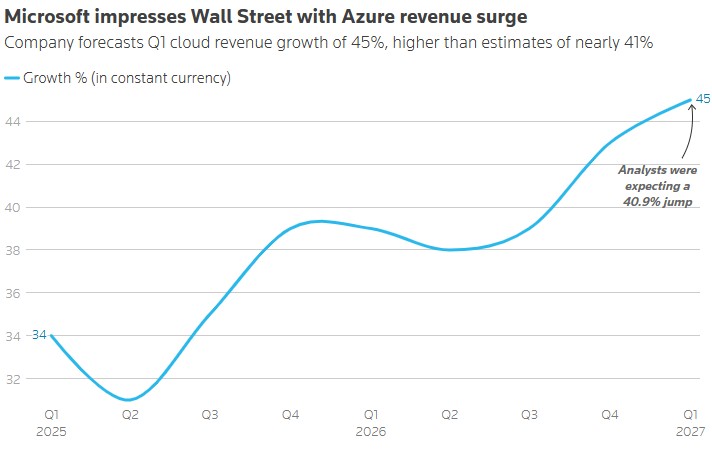
Azure growth: approximately 45% on a constant currency basis, far exceeding analysts' expectations of 41.4%;
Productivity and Business Processes: $36 billion to $37 billion, a year-on-year increase of 11%-12%;
Intelligent Cloud: $36.7 billion to $37 billion, a year-on-year increase of 33%-34%;
More Personal Computing: $12.2 billion to $12.7 billion;
The company also stated that despite a strong performance in Q4 of fiscal year 2026, it expects growth in the first half of fiscal year 2027 to accelerate further.
Azure Cloud Business: 43% Growth Rate Hits Four-Year High, Annual Revenue Surpasses $100 Billion
The Azure cloud business, which attracted the most market attention, delivered an impressive report card. In the fourth fiscal quarter, Azure and other cloud services revenue grew by 43% year-on-year (on a constant currency basis), not only higher than the previous quarter's 40% but also far exceeding analysts' expectations of 39.6% to 40%. This is Azure's fastest quarterly growth rate since early 2022 Microsoft CFO Amy Hood expects Azure's constant currency growth to further accelerate to 45% next quarter, exceeding market expectations of 40.9%.
Microsoft's overall cloud business (including Azure, Office 365 cloud version, etc.) generated revenue of $59.3 billion, a year-on-year increase of 27%.
CEO Satya Nadella stated in a statement: "This year, Azure revenue has surpassed $100 billion for the first time, and Microsoft 365 Copilot paid user seats have exceeded 30 million, reflecting customer confidence in our efforts to drive their AI transformation."
The Intelligent Cloud segment (including Azure, server products, and enterprise services) generated total revenue of $39.31 billion, a year-on-year increase of 32%, also exceeding the market expectation of $38.17 billion.
Microsoft also disclosed that as of the end of the quarter, the backlog of cloud business contracts reached $678 billion, up from $627 billion in the previous quarter, adding approximately $50 billion in future sales. The company emphasized that these new commitments mainly come from enterprise customers outside of leading AI model manufacturers in the U.S., indicating that AI demand is spreading to a broader economic sector.
Azure's annual revenue has surpassed $100 billion for the first time, with a year-on-year increase of 41%, becoming another "billion-dollar" business pillar for Microsoft after Office and Windows.
Acceleration of AI commercialization: Copilot paid users exceed 30 million
The commercialization of Microsoft's AI products is accelerating. Microsoft 365 Copilot—sold as an add-on product for Office software AI assistant—has reached over 30 million paid user seats, up from about 20 million three months ago. Analysts' previous average expectation was 26.9 million. Over 300,000 enterprise customers have purchased Copilot services, and over 90% of Fortune 500 companies are using some form of Copilot.
CEO Nadella revealed during the earnings call that hundreds of enterprise customers have purchased tens of thousands of high-end E7 productivity software suites. GitHub Copilot programming assistant users have reached 50 million. Microsoft is accelerating the enterprise-level deployment of Copilot through channel partners like Accenture, with single transactions reaching 740,000 seats.
However, Microsoft's AI business penetration also faces structural challenges. Deutsche Bank pointed out last week that there is a "certain concentration risk" in Microsoft's relationship with OpenAI, especially against the backdrop of the rise of open-source models. Microsoft disclosed in January that about 45% of its $625 billion commercial unfulfilled obligations are related to OpenAI.
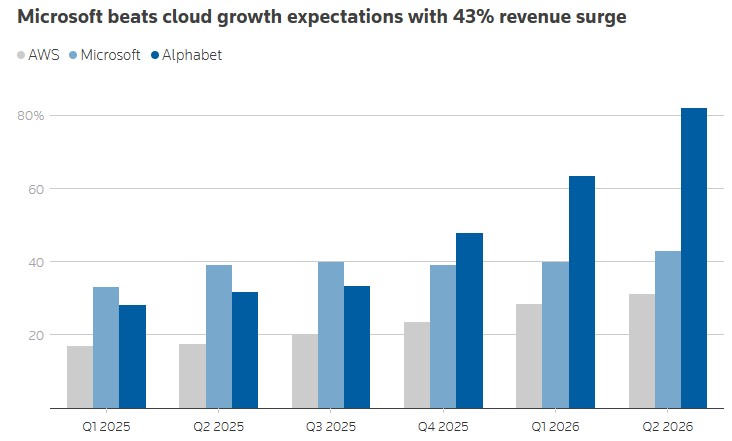 Microsoft's report closely follows that of Google (GOOGL.O), which has seen explosive growth in its cloud business, with last week's cloud revenue soaring 82%, far exceeding market expectations. Dave Wagner, portfolio manager at Aptus Capital Advisors, stated, "Google seems to be capturing market share from everyone. If they continue this growth momentum, they could catch up to Azure's market share. But Azure has shown us that it remains competitive."
Performance of Other Business Segments: Software Resilience Exceeds Expectations
The Productivity and Business Processes segment (including Office, Dynamics, LinkedIn) generated revenue of $37.85 billion, a year-on-year increase of 14.3%, surpassing market expectations of $37.19 billion. Microsoft 365 commercial cloud revenue grew by 16%.
The More Personal Computing segment (including Windows, Xbox, Surface, Bing) generated revenue of $12.85 billion, a year-on-year decline of 4.4%, but still above the expected $12.17 billion. Device sales and Windows licensing shipments fell by 7%, consistent with the 4.2% decline in PC shipments reported by research firm Gartner. Xbox business revenue declined by 10%, and earlier this month, the department's CEO announced layoffs and the divestiture of four studios.
Capital Expenditure: From "Source of Panic" to "Biggest Surprise"
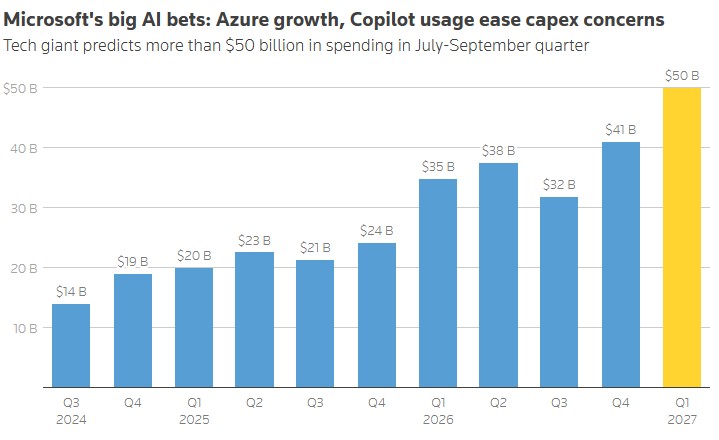
This is the real turning point of this earnings report. Capital expenditure for the fourth fiscal quarter (including finance leases) was $41 billion, a year-on-year increase of over 70%, slightly below market expectations of $42.37 billion. The company's capital expenditure for the previous three months was $31.9 billion. Free cash flow for this quarter was $19.64 billion, a year-on-year decline of 23%. However, Hood expects it to return to positive in fiscal year 2027.

This downward adjustment was mainly achieved through accounting adjustments: Microsoft extended the useful life of assets such as data centers and office buildings from 15 years to 25 years, while converting more future data center leases from finance leases to operating leases. The CFO emphasized that the company's actual investment plans "remain unchanged," and the adjustments only affect the reporting standards.
Capital expenditure was the most anxious variable for the market before this earnings report. Microsoft previously projected that capital expenditure for the calendar year 2026 would reach $190 billion. Against the backdrop of Alphabet's stock price plummeting due to an upward revision of expenditure guidance, investors were highly tense about whether Microsoft would further "increase" its spending. Microsoft's proactive downward adjustment of expenditure expectations, while also committing to positive free cash flow, sent a clear signal to investors: AI investments are still ongoing, but the company has the capability to complete this transformation without sacrificing financial health.
But what excites the market even more is the guidance for the future. Microsoft emphasized that the actual investment plan has not changed, but the accounting adjustments have led to a decrease in reported capital expenditure figures Hood expects capital expenditures for the first quarter of fiscal year 2027 to be approximately $50 billion, lower than the market expectation of $56 billion. In the earnings call, Microsoft revised its calendar year 2026 capital expenditure forecast down from $190 billion to $175 billion.
Microsoft disclosed that the amount of data center leasing contracts that have not yet begun to take effect totals $329.1 billion, with lease terms ranging from fiscal year 2027 to fiscal year 2033. Jonathan Nelson, Vice President of Investor Relations at Microsoft, stated: “These contracts will last for many, many years... This again shows that the demand signals we see are always key.” This means that Microsoft's AI infrastructure expansion is far from over; only the pace of spending and the accounting presentation have changed.
A Key Battle Deciding the Fate of $700 Billion in AI Investment
The strong market reaction to Microsoft's earnings report is due to its status as a "barometer" for the global AI industry chain. Microsoft's capital expenditure decisions directly impact orders for NVIDIA GPUs, AMD CPUs, Broadcom and Marvell's networking equipment, SK Hynix and Micron's high-bandwidth memory, TSMC's advanced packaging, as well as semiconductor equipment manufacturers like ASML and Applied Materials.
Moody's expects that capital expenditures for six major cloud service providers will reach $785 billion in 2026, further rising to about $1 trillion in 2027. Goldman Sachs predicts that related expenditures will approach $1.2 trillion in 2027. The core message conveyed by Microsoft's earnings report is that the AI investment cycle is not only not slowing down but is accelerating—however, the massive capital expenditures are being "soft-managed" through accounting methods to alleviate market concerns about cash flow.
Before the earnings report was released, Microsoft's stock price had fallen approximately 19% year-to-date, making it one of the worst performers among the "Seven Giants." Although the company had exceeded EPS expectations for four consecutive quarters, its stock price fell after each of the three previous earnings reports. This time, the situation is completely different. After the earnings report was released, Microsoft's after-hours stock price surged over 8%. As of the time of writing, the after-hours trading price is in the range of $398 to $423.
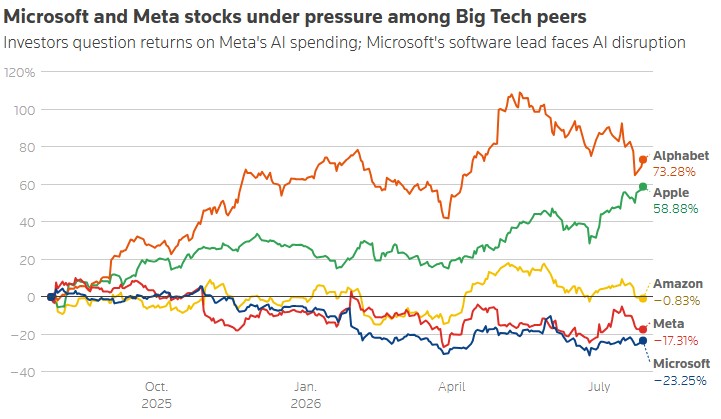
Seeking Alpha analyst Julia Ostian pointed out: “Microsoft's cloud and AI growth is undoubtedly rapid and impressive, but it is important to remember that a large part of it heavily relies on substantial ecosystem investments, which will severely drag down operational profitability in the next 3-5 years.” The value of Microsoft's financial report goes far beyond the words "better than expected." After weeks of collective declines in AI chip stocks and growing market anxiety over the returns on massive capital expenditures, Microsoft provided the strongest answer with solid performance: the demand for AI is real and accelerating, and the company is capable of finding a balance between substantial investment and financial health.
Investing Group Leader Julian Lin believes: "Microsoft faced concerns about the sustainability of its software business and the noticeably poor performance of Azure as it entered the earnings report. The company responded to these concerns with execution, highlighted by robust software growth and an unexpected acceleration in Azure growth."