
Goldman Sachs Korea Memory Expert Call: DRAM Prices to Continue Rising This Year, HBM Prices to Surge Next Year, Long-Term Agreement Coverage Further Expands
 Complete. Here is the key summary
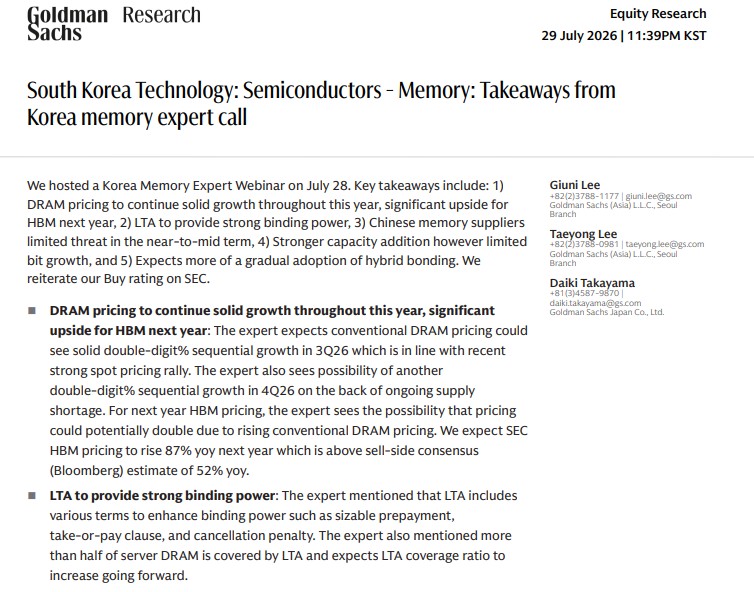
Goldman Sachs hosted a conference call with Korean memory experts. The experts anticipate that traditional DRAM prices will achieve consecutive double-digit quarter-on-quarter growth in the third and fourth quarters of this year, supported primarily by supply shortages. They believe there is potential for HBM prices to double next year, while Goldman Sachs forecasts an 87% year-on-year increase in Samsung's HBM selling prices next year. Meanwhile, more than half of server DRAM has been locked in by stringent long-term agreements, making it difficult for Chinese memory manufacturers' capacity expansion to pose a substantial threat in the short to medium term
Goldman Sachs held a webinar with Korean memory experts on July 28 and released the minutes on July 29. Participating experts believed that traditional DRAM prices will maintain strong "double-digit percentage" growth momentum this year, while HBM has room for significant price increases, potentially even doubling, next year. The binding power of long-term agreements on the market is strengthening, and the threat from Chinese competitors remains limited in the short to medium term. Goldman Sachs maintains its Buy rating on Samsung Electronics.
DRAM Prices to Rise Continuously This Year, HBM Prices May Double Next Year
The experts provided a clear judgment on the trend of DRAM prices this year.
According to the minutes, the experts expect traditional DRAM prices to achieve "double-digit percentage" quarter-on-quarter growth in the third quarter of this year, consistent with the recent strong rebound in spot prices. Entering the fourth quarter, supported by persistent supply shortages, the experts believe it is also possible to "achieve double-digit quarter-on-quarter growth again."
They argue that with no significant increase in supply and continuous demand pull from AI servers, prices are naturally prone to rise rather than fall.
The narrative for HBM is more aggressive. The experts believe that due to rising traditional DRAM prices, there is a "possibility of doubling" for HBM pricing next year. Goldman Sachs' own forecast is that Samsung's HBM prices will rise by 87% year-on-year in 2027, a figure higher than the 52% consensus estimate among sell-side analysts compiled by Bloomberg.
Enhanced Binding Power of Long-Term Agreements, Over Half of Server DRAM Locked In
Whether price increases materialize depends on the ability to uphold contracts.
According to the minutes, the experts pointed out that long-term agreements (LTAs) include several stringent clauses: large upfront payments, "take-or-pay" clauses, and penalties for contract cancellation. This means that once buyers sign, the cost of exit is extremely high.
Currently, more than half of server DRAM is covered by LTAs, and experts expect this proportion to continue rising in the future.
What does this mean for memory manufacturers? Higher revenue visibility and stronger bargaining power in price negotiations. Goldman Sachs explicitly stated in its investment thesis that, compared to the past, the binding force of this round of LTAs is stronger, helping to support Samsung's earnings expectations.
Chinese Manufacturers Unlikely to Pose a Threat in the Short to Medium Term
The market has been concerned about the impact of capacity expansion by Chinese memory manufacturers, but the experts remain reserved on this issue.
According to the minutes, the experts acknowledged that Chinese suppliers are actively expanding capacity but believed that "the likelihood of them becoming a significant threat to leading players in the near to medium term is low." The reason is that Chinese manufacturers still lag behind top players in production yield and technological levels.
In other words, the scale of capacity expansion does not equal effective supply, and technical barriers are difficult to overcome in the short term.
Accelerated Capacity Expansion, but Limited Growth in Effective Bits
Capacity is expanding, but the actual incremental supply is not equivalent.
According to the minutes, the experts expect the pace of capacity expansion this year to be stronger than historical levels. However, due to the high wafer trade ratio for HBM—producing the same quantity of HBM consumes more DRAM wafers—the actual bit growth is expected to be lower than the historical average.
This is key to understanding the current supply and demand landscape: on the surface, capacity is expanding, but in reality, the effective supply available for traditional DRAM has not increased synchronously, which is the structural reason supporting continuous price increases.
Hybrid Bonding Technology: Gradual Progress, Not a Leapfrog Breakthrough
In terms of the HBM technology roadmap, hybrid bonding is seen as the next-generation direction, but the experts hold a cautious view on its implementation pace.
According to the minutes, the experts believe that as the number of stacked DRAM chip layers increases, existing bonding technologies will face growing challenges. However, at the same time, the experts do not expect hybrid bonding to be adopted on a large scale ahead of schedule, because "achieving sufficient yield at mass production scale requires considerable time and effort."
The experts judge that memory manufacturers will explore various technical paths, including fluxless bonding, while gradually advancing the introduction of hybrid bonding, rather than implementing it in one step.
Based on the above judgments, Goldman Sachs maintains its Buy rating on Samsung Electronics' common stock, with a 12-month target price of 480,000 South Korean won, and a target price of 360,000 South Korean won for its preferred stock.
The report points out that Samsung has begun to show "substantial progress" in the HBM field, coupled with higher expectations for shareholder returns, maintaining a positive outlook on the stock. Major downside risks include a significant deterioration in memory supply and demand, a sharp contraction in smartphone business margins, and a loss of market share in mobile OLED.