
Has Deleveraging in the Korean Stock Market Completed? JPMorgan: "Institutional Deleveraging Near End"; HSBC: "Retail Leverage Remains High"
 Complete. Here is the key summary
JPMorgan believes that deleveraging of leveraged ETFs in South Korea is largely complete, with hedge fund deleveraging approximately 90% done. The KOSPI's valuation has dropped to a "crisis level" of 5x P/E, making overall allocation attractive. In contrast, HSBC points out that retail margin balances have only fallen about 15% from their peak, remaining high at approximately $22 billion. Furthermore, the shrinkage in ETF size is primarily driven by losses rather than active withdrawal, indicating that deleveraging is far from over
On the same day, two top investment banks offered starkly different assessments of the deleveraging process in the Korean market.
Since its peak on June 22, the KOSPI index has plummeted by nearly 40%. This decline began with concerns over fundamentals and capital rotation, was subsequently amplified by forced liquidations of leveraged ETFs, and recently compounded by concentrated unwinding of hedge fund positions. The market experienced severe structural shocks within a short period.
JPMorgan: Institutional Deleveraging Nearing End, Valuations at "Crisis Levels"
JPMorgan's Equity Macro Research team noted in a report on July 29 that the deleveraging process in the Korean market has advanced significantly.
Regarding Leveraged ETFs, the size of leveraged ETFs targeting Korean assets swelled to $50 billion in late June, four times the relative market cap size of similar US products, acting as the core amplifier of this volatility. As the market declined, this size contracted to $17 billion, with recent capital inflows stagnating noticeably. The bank believes that deleveraging in this segment is "largely complete."
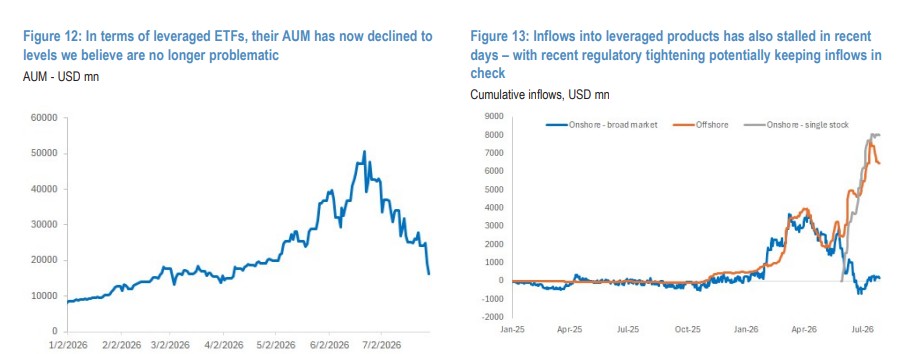
Chart of Leveraged ETF Size Changes and Cumulative Capital Inflows into Leveraged Products
Regarding Hedge Funds, data from JPMorgan Prime accounts shows that the long/short ratio (L/S ratio) in the Korean market dropped from a peak of 5.7x to 3.2x on July 27. Combined with the significant retracement of price momentum factors between July 28 and 29, the bank judges that hedge fund deleveraging is approximately 90% complete, "approaching the upper bound of the 2025 range."
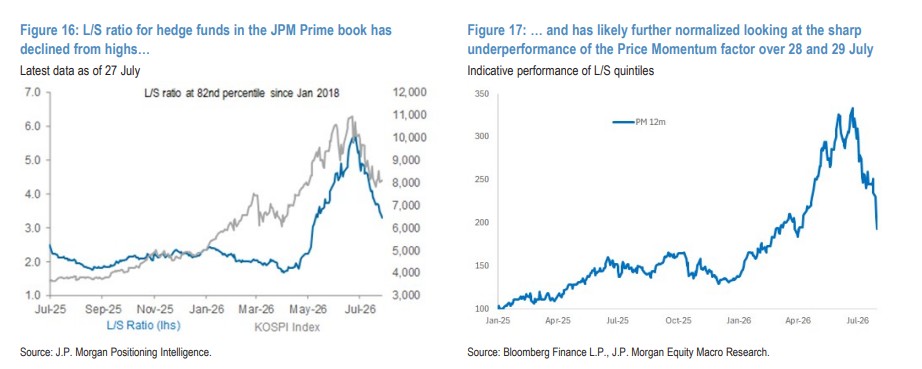
Chart of Hedge Fund Long/Short Ratio Changes and Price Momentum Factor Performance
Regarding Retail Margin Financing, JPMorgan's assessment is relatively optimistic. Margin balances currently stand at approximately $20 billion, without rapid increases, and their proportion to market capitalization has actually decreased year-to-date. The bank believes that Korean retail investors still hold sufficient floating profits in stocks, cash reserves, and overseas assets, possessing the capacity to handle margin calls, meaning "retail leverage risk is relatively controllable."
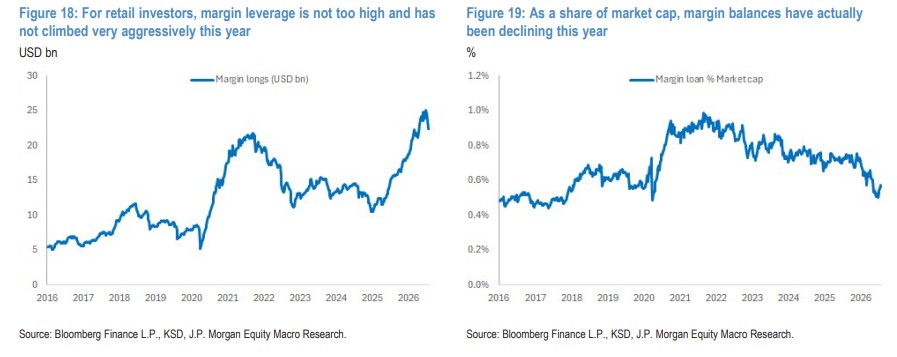
Chart of Absolute Retail Margin Balances and Margin Balances as a Percentage of Market Cap
Regarding Foreign Capital, foreign investors have cumulatively sold over $110 billion worth of Korean stocks year-to-date. However, the bank points out that 90% of these outflows were concentrated in two leading memory chip stocks. As the weights of these two stocks in the MSCI Emerging Markets Index fell from 9.5% and 8.3% in late June to 6.5% and 4.5% respectively, passive selling pressure has eased significantly.
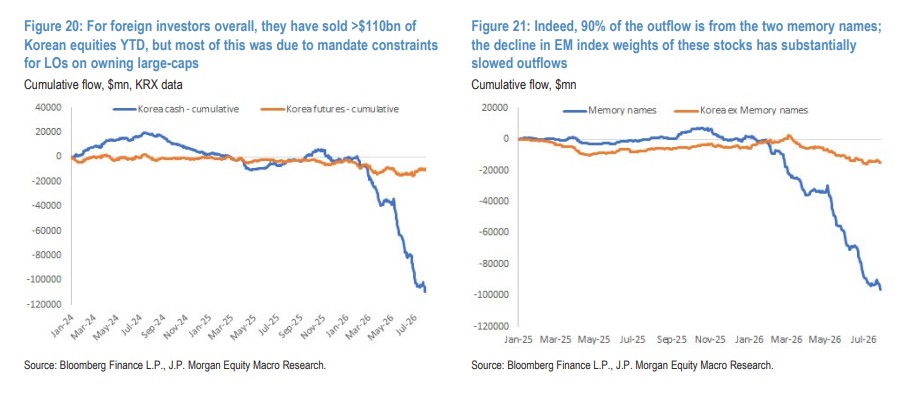
Chart of Cumulative Net Foreign Outflows and Proportion of Outflows from the Two Major Memory Stocks
In terms of valuation, the bank notes that the forward P/E ratio of the KOSPI has dropped to 5x, and free cash flow valuation is also at "crisis levels." Coupled with improved positioning, overall allocation attractiveness has emerged.
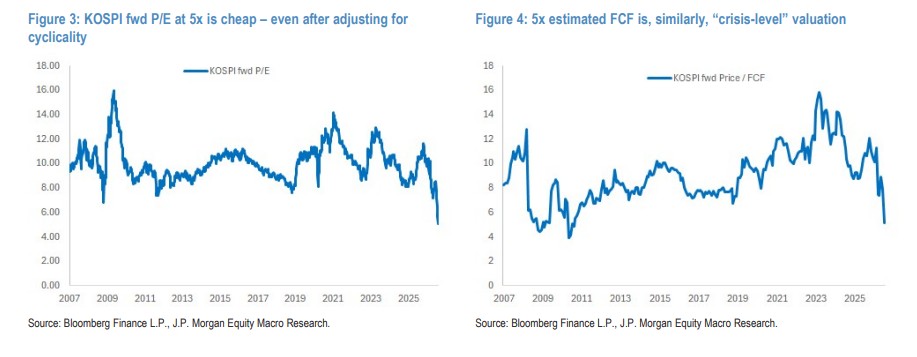
Chart of KOSPI Forward P/E Ratio and Free Cash Flow Valuation
HSBC: Retail Leverage Remains High, Deleveraging Far From Over
In a report released on the same day, HSBC's Asia-Pacific Equity Strategy team held a more cautious view on the deleveraging process in South Korea.
HSBC's core concern lies in retail margin balances. Data shows that as of July 27, retail margin balances in South Korea were approximately 32 trillion won (about $22 billion), down only about 15% from the June peak, "still remaining at high levels." Forced liquidations increased in July, but the margin balances subject to liquidation accounted for only 2% of the total, indicating very limited deleveraging intensity.
Another focus for HSBC is single-stock leveraged ETFs. The size of these products has shrunk from its peak to about $10 billion, roughly one-third of the peak level. However, HSBC emphasizes that this shrinkage is "primarily driven by capital losses rather than active investor exit"—retail investors continue to buy, whether in single-stock leveraged ETFs or index-linked products.
This judgment forms a clear divergence from JPMorgan. While JPMorgan views the decline in ETF size as a signal of completed deleveraging, HSBC believes that the shrinkage reflects losses rather than withdrawal, meaning potential risks have not truly been released.
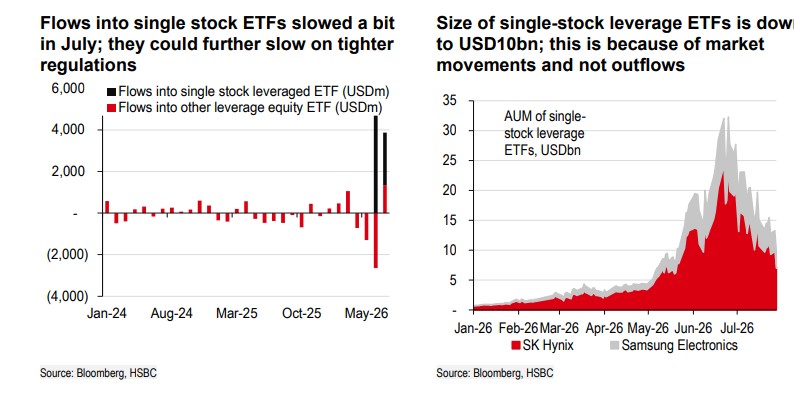
Chart of Single-Stock Leveraged ETF Size
Regulatory Action: FSC Tightens Rules on Leveraged Products Ahead of Schedule
Facing severe market volatility, the Korean Financial Services Commission (FSC) has taken action.
Specific measures include: raising the minimum margin requirement for retail investors investing in single-stock leveraged ETFs from 10 million won to 30 million won, which must be paid in cash and cannot be substituted with securities; suspending the listing of new single-stock leveraged ETFs; and planning to increase the minimum trading lot size for domestically listed single-stock leveraged products from 1 share to 20 shares. The implementation date for these measures has been moved up from the originally scheduled August date to July 31.
HSBC points out that while these measures should reduce capital inflows into single-stock leveraged products, "investors may continue to use other leverage tools," leaving room for further overall deleveraging.
Additionally, the bank warns that the tax exemption enjoyed through RIA accounts will drop to 50% starting in August, which may further impact retail investment behavior.
Fundamental Pressure: The Narrative on Memory Chips Is Shifting
Both reports mentioned the fundamental background behind the decline in the Korean market.
SK Hynix has fallen 53% from its June high, and Samsung Electronics has dropped 43%. HSBC believes that the narrative around AI trades is shifting, with multiple factors creating pressure: memory chip manufacturers are beginning to sign long-term contracts, leading to conservative expectations for upward price potential; doubts exist regarding whether the high capital expenditures of hyperscale data center operators can be effectively monetized; New York State has become the first US state to implement a moratorium on large data center construction; and Chinese memory chip manufacturer Changxin Technology has raised $9.8 billion through financing on the Shanghai STAR Market, increasing supply-side pressure.
JPMorgan, through model calculations, points out that current market pricing implies the assumption that memory chip prices will begin to revert to pre-AI levels in early 2027. For every additional year that current price levels are maintained, the corresponding valuation increment is approximately $150 billion.
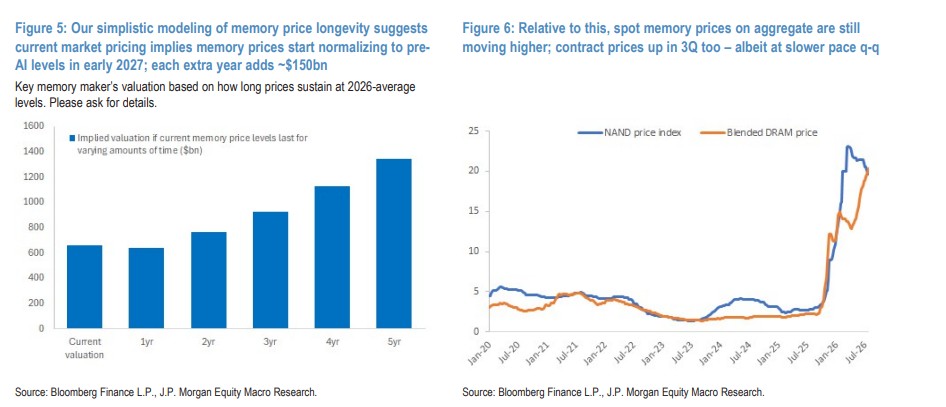
Chart of Relationship Between Duration of Memory Prices and Valuation, and Trend of Spot and Contract Prices
Diversified Allocation Opportunities: JPMorgan Highlights Four Diversification Themes
Against the backdrop of improved positioning and valuation repair, JPMorgan proposed four directions for diversified allocation:
-
Beneficiaries of the "Wealth Effect": Department stores, beauty products, tourism, securities firms, and construction, benefiting from consumption upgrades driven by resident asset appreciation;
-
Biopharma: Significantly lagging behind the KOSPI, expected to benefit from improved sentiment in the global healthcare sector;
-
Preferred Stock Discounts: Discount levels near historical maximums, offering attractive dividend yields;
-
Bank Stocks: A triple tailwind of improved asset quality coupled with interest income growth, benefits to net interest margins (NIM) from the Bank of Korea's rate hike cycle, and increased brokerage revenue driven by rising market trading volumes.