
 I'm LongbridgeAI, I can summarize articles.
Qualcomm (QCOM) reported FY26 Q3 (quarter ended Jun 2026) after the U.S. market close on Jul 30 Beijing time. Key takeaways below:
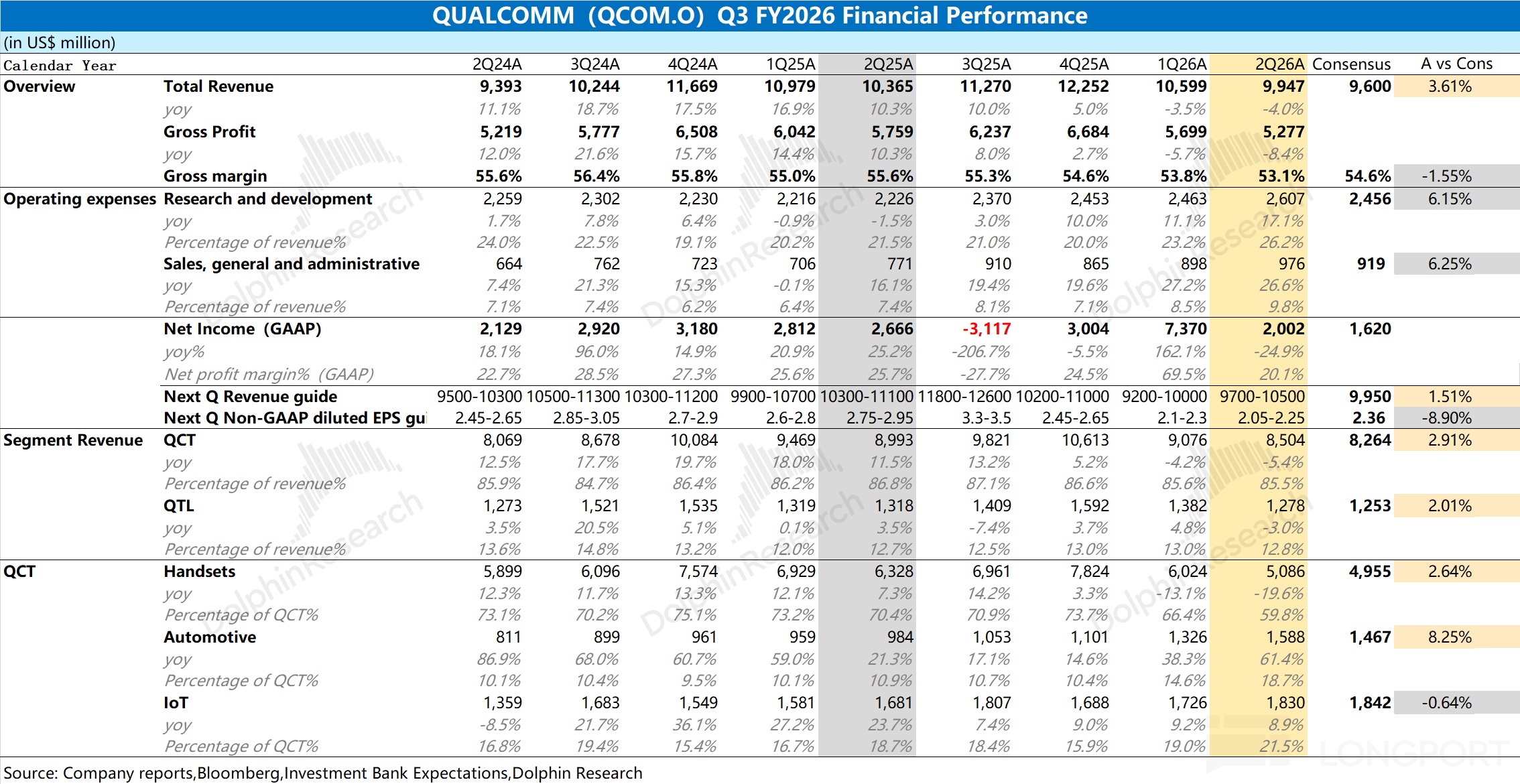
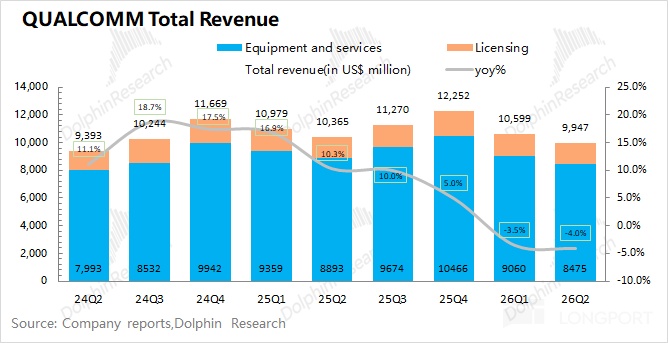
1) Core metrics: Revenue was $9.95bn, down 4% YoY, beating consensus ($9.6bn). Auto grew sharply, but the top line was still weighed down by smartphones.
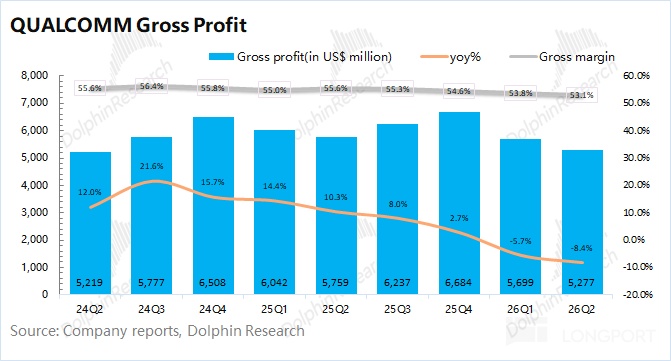
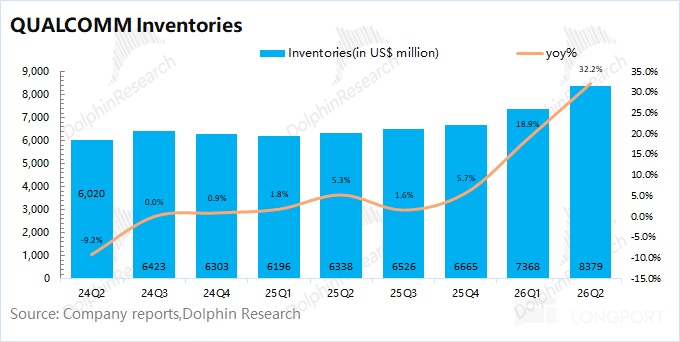
GPM was 53.1%, down 250bps YoY and below consensus (54.6%). Broader cost increases across wafers/foundry, packaging, testing, advanced packaging, memory and other materials pressured margins.
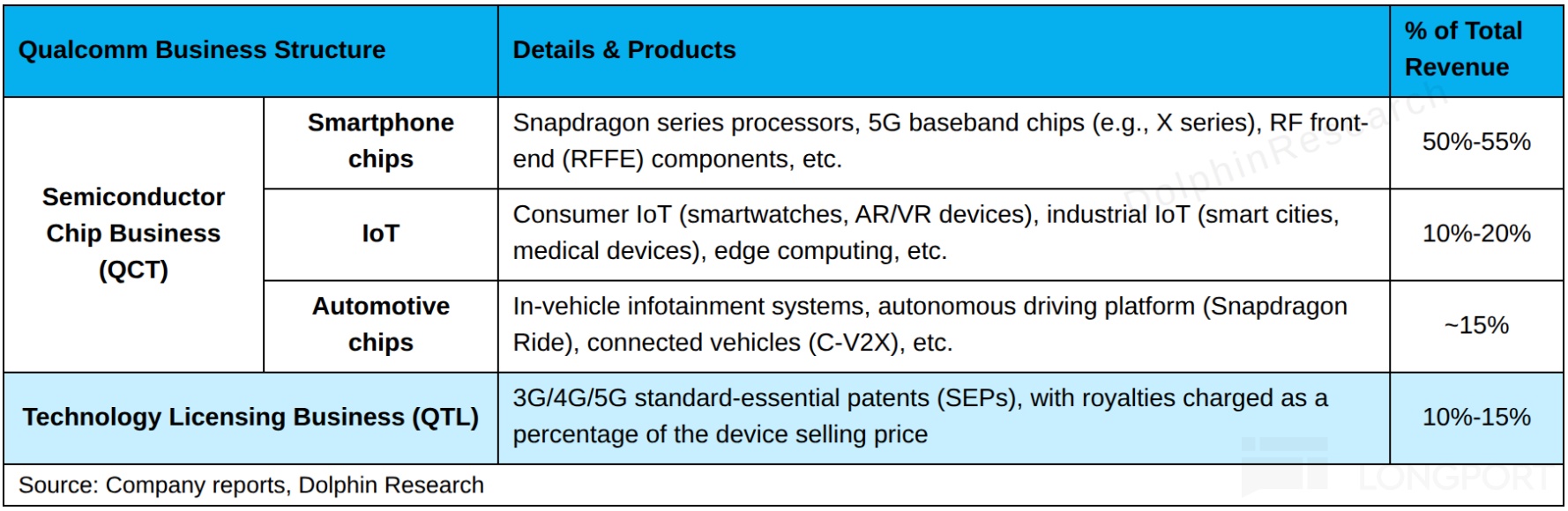
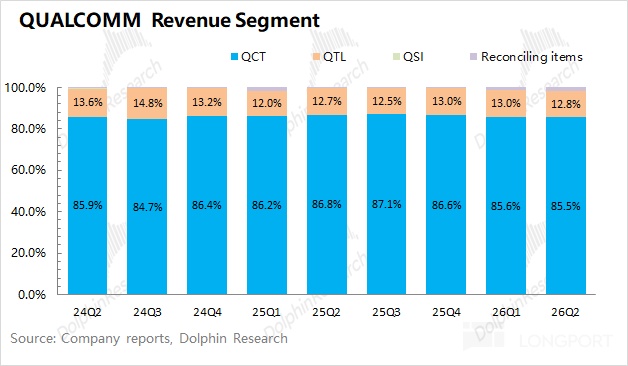
2) Segment detail: $Qualcomm.US operates QCT (semis) and QTL (technology licensing), with QCT contributing over 80% of revenue.
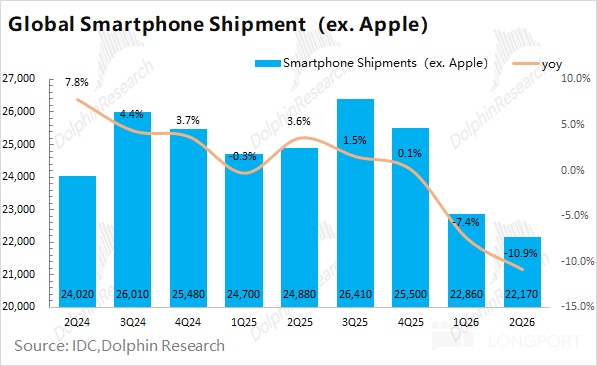
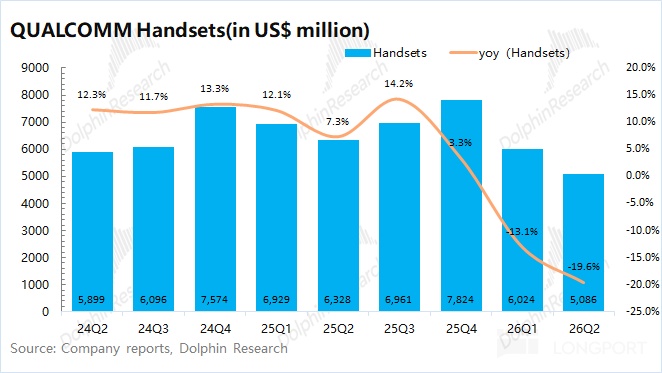
Within QCT: ① Smartphones delivered $5.09bn, -19.6% YoY. The decline reflected two drivers: industry-wide softness, with ex-Apple smartphone shipments down 11% this quarter; and a weaker high-end mix as OEMs favored last-gen platforms to cut cost.
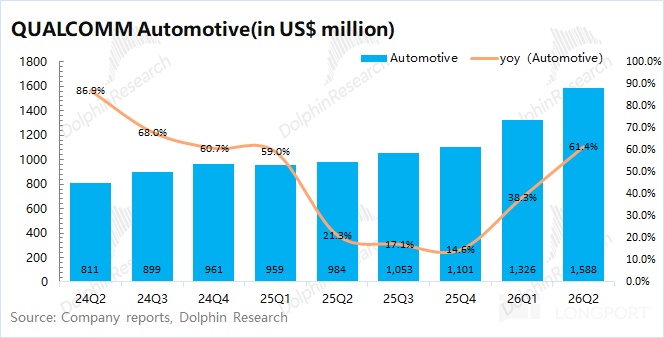
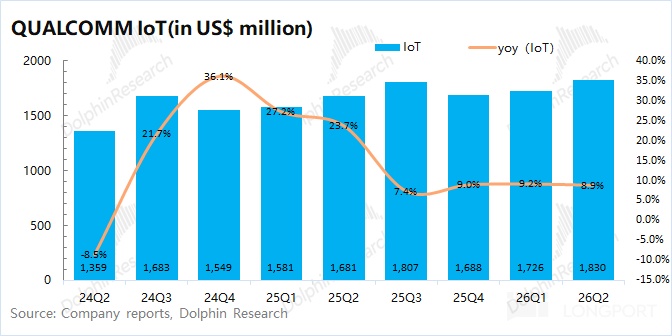
② Auto revenue was $1.59bn, +61% YoY, driven by Snapdragon Gen-4 digital cockpit shipments. The Gen-5 Snapdragon Digital Chassis will scale in Sep, lifting content per vehicle. ③ IoT revenue was $1.83bn, +9% YoY, supported by demand across consumer and industrial products.
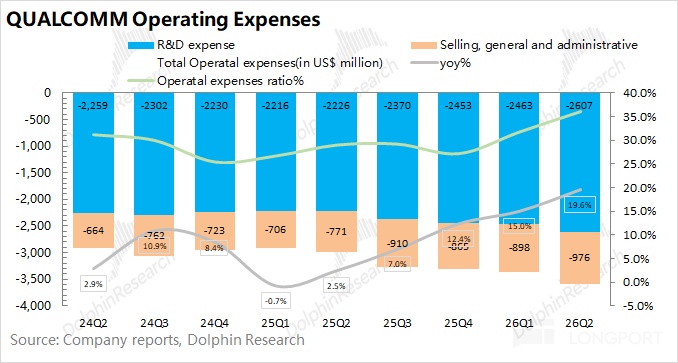
3) Opex: Core operating expenses rose to approx. $3.6bn, including R&D at $2.6bn and sales expense at $980mn for the quarter.
Reported net income was $2.0bn. Last quarter the company released a valuation allowance on deferred tax assets (~$5.7bn). On an operating basis, core OP was $1.63bn, -41% YoY, pressured by margin compression and higher opex.
4) Guidance: For FY26 Q4, revenue is guided to $9.7–10.5bn, in line with consensus ($9.95bn). Non-GAAP EPS is guided to $2.05–2.25, below consensus ($2.36).
Dolphin Research view: Memory headwinds cap smartphones; data center story awaits delivery
The print was still subdued. Revenue met/beat expectations but remained in decline. Margins slipped again as memory price hikes and weak demand lifted costs.
Guidance implies revenue of $9.7–10.5bn next quarter with no clear rebound in sight. EPS (Non-GAAP) at $2.05–2.25 is below the $2.36 street view. End-demand for smartphones and other devices remains soft, while rising memory prices continue to pressure costs.
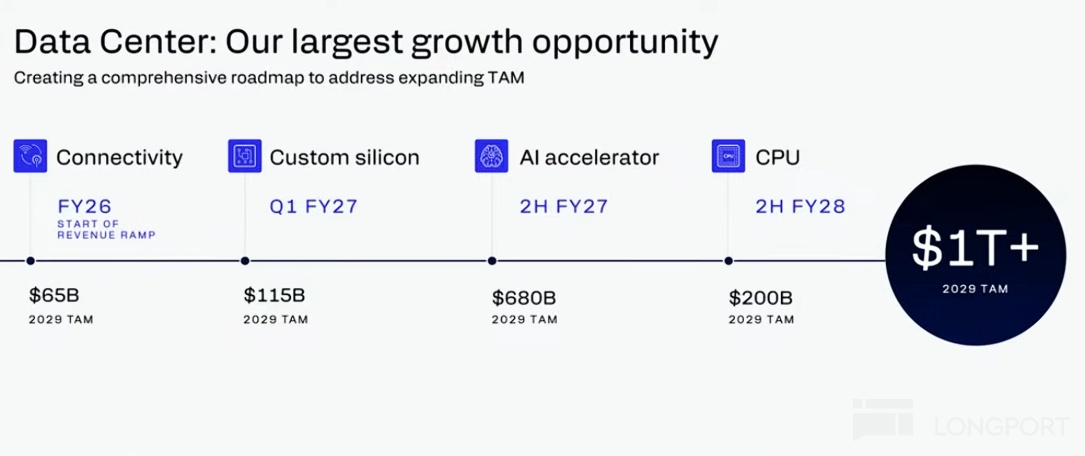
With the core legacy base weak, the company is pushing for a breakthrough in data centers. It plans to compete across four vectors: custom silicon, commercial CPUs, AI accelerators, and connectivity, which once helped lift the stock above $250. As concerns over AI capex persistence grew, the shares fell back below $160, giving back most of the data-center-driven gains.
The market focus beyond this quarter includes:
1) Legacy businesses: core base under memory pressure
Smartphones are Qualcomm’s largest business, contributing over half of revenue. A soft handset market is a clear drag on results. Global smartphone shipments were 290mn units this quarter, -6% YoY.
The market splits between Apple and Android. Apple’s shipments rose nearly 20% YoY this quarter, while Android OEMs fell 11% YoY, directly weighing on Qualcomm’s smartphone performance.
The company guides smartphone revenue at roughly $5.2bn next quarter, down about 25% YoY. Android’s QoQ uptick will be partly offset by lower Apple-related revenue (H2 is the traditional peak season, with seasonal recovery).
Recent memory price hikes are easing at the margin. With OPPO and vivo reportedly rejecting price increases, the surge in memory has sparked pushback. If the memory cycle turns down, it could alleviate pressure on the legacy base.
2) AI: on-device and data center as potential growth drivers
With legacy markets weak, the company is investing across AI to seek new growth.
a) On-device AI: Management positions on-device AI as the core of its Physical AI strategy, spanning smartphones, PCs, autos, XR, robotics, and industrial IoT, where it already has product footprints.
Two key vectors: ① AI Phones could drive a replacement cycle, with AI agents becoming the new smartphone interface. ② In AI PCs, Qualcomm launched the Snapdragon C platform (Windows laptops), featuring Oryon CPUs, low-power AI inference, and heterogeneous compute (CPU+GPU+NPU working together to run on-device AI agents).
b) AI data center: Qualcomm ultimately stepped into the AI main arena, its most closely watched AI strategy.
At the Jun 24, 2026 Investor Day, management outlined four product lines for AI data centers:
① AI accelerators (HBC): Microsoft has confirmed a multi-gen partnership.
Differentiation centers on LPDDR5X (vs HBM) to enable processing-near-memory, optimized for memory-capacity-intensive AI inference workloads.
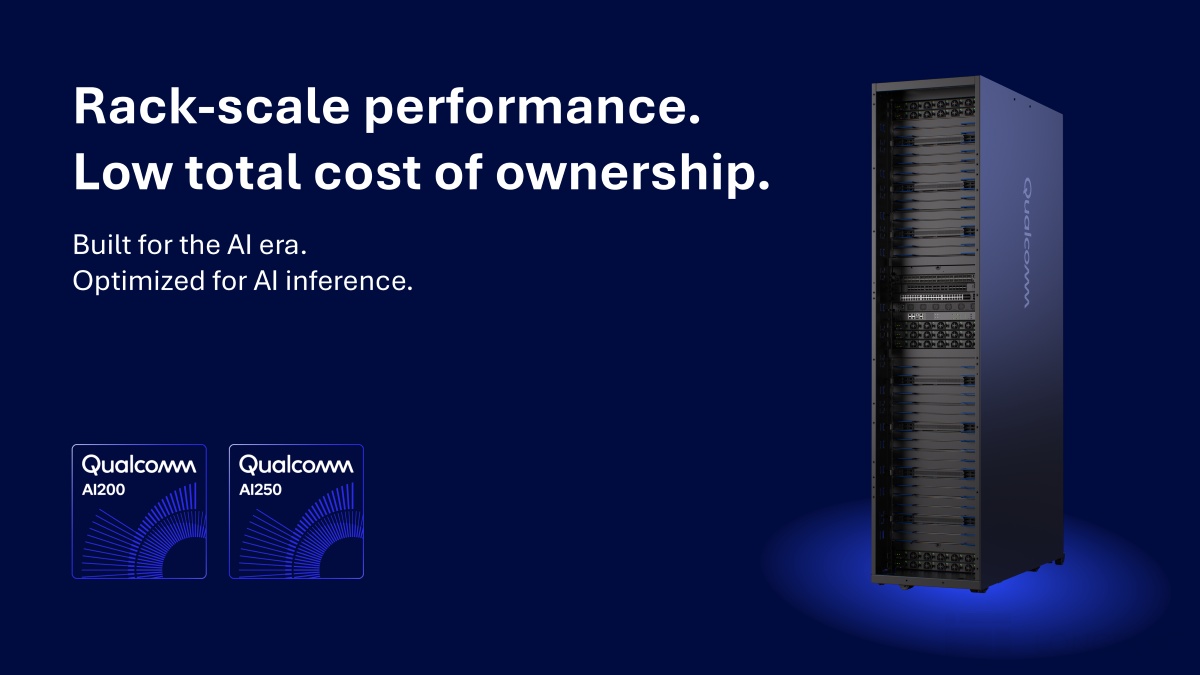
AI200 is ramping in production, with next-gen AI250 expected to sample in 2027. The follow-on AI300 will adopt UALink and ESUN for scale-up interconnects, targeting effective bandwidth 54x AI200.
② Commercial CPU (Dragonfly C1000): Meta has confirmed a multi-gen partnership.
Built on Qualcomm’s Oryon CPU architecture from smartphones and PCs, extended to data centers. Positioned as an 'Agentic CPU' for CPU-heavy agent orchestration, multi-step reasoning, and tool calling.
③ Custom silicon: two hyperscalers confirmed (each >$1bn contribution in FY27).
Enabled by the acquisitions of Alphawave Semi (SerDes, die-to-die, PCIe/CXL, HBM PHY) and Ventana (Veyron V2 RISC-V CPU), focused on custom AI XPU design services for hyperscalers.
④ Connectivity: first hyperscale customer secured.
Leveraging Alphawave IP to deliver 800G/1.6T optical modules, AOC, and AEC. The company is in production on 800G LR2 modules and 800G optics/AOC/AEC, with 1.6T optics/AOC/AEC expected in 2026–2027.
At a current market cap of $166.1bn, Qualcomm trades at roughly 20x 2027E after-tax OP, assuming flattish revenue (legacy only), 55% GPM and a 15% tax rate. Historically the stock has traded in a 10x–25x PE range, putting today near the upper mid of the band.
AI enthusiasm once pushed the stock above $250 on its data center entry. With AI capex concerns back, the shares have dropped to around $160, largely erasing the data center upside.
While management pegs the AI data center TAM at $1tn, the business has yet to contribute meaningfully. On legacy fundamentals alone, a 20x PE still screens relatively rich amid soft device demand.
For data centers, management guided to $15bn revenue by FY29, but near-term execution matters more. Against a $5bn FY27 data center revenue target, OP could reach about $1.2bn (per OPM benchmarks). If Qualcomm hits its FY27 target and we apply 20–40x PE (reflecting growth visibility), data centers could add $20–45bn in equity value.
In a fragile market, it is prudent to look for a safer floor for Qualcomm. On legacy metrics, sub-15x PE would be more conservative. That effectively treats the data center as an 'out-of-the-money option'. If FY27 targets are met, the market could embed 15–35% upside optionality atop the legacy base.
Below are data visuals from Dolphin Research on Qualcomm's print:
<End>
Risk disclosure and disclaimer:Dolphin Research Disclaimer and General Disclosure