
 I'm LongbridgeAI, I can summarize articles.
Qualcomm reported third-quarter fiscal 2026 revenue of $9.95 billion, a 4% year-over-year decline that slightly exceeded expectations. However, Non-GAAP earnings per share fell 20%, missing forecasts, leading to a post-market stock drop of over 4%. Performance was mixed: smartphone chip revenue plummeted 20% year-over-year to $5.086 billion due to soaring memory costs and weak demand; automotive business revenue grew by a record 61%; and custom data center chips are scheduled for shipment by year-end. Management expects orders from Chinese OEMs to bottom out in the third quarter, with growth resuming in the fourth quarter
On July 29, Qualcomm delivered a financial report that left the market unsure how to grade it.
The earnings report showed that in the third quarter of fiscal 2026 (ended June 28, 2026), Qualcomm’s revenue was $9.95 billion, a 4% year-over-year decrease, slightly beating Wall Street’s expectation of $9.62 billion. Non-GAAP earnings per share were $2.21, a 20% year-over-year decline, missing estimates by one cent. The stock price initially fell in after-hours trading before narrowing losses, but remains down more than 4%.
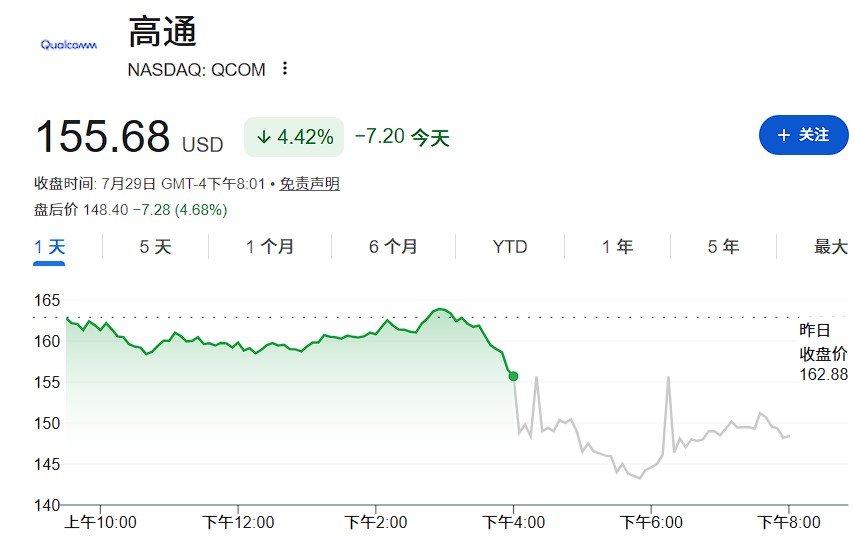
The awkwardness of this earnings report lies in its divergence: Looking at smartphones, revenue plunged 20% year-over-year to just over $5 billion, marking the worst quarter in recent years; looking at automotive, growth hit a record 61%; looking at data centers, the company confirmed that custom chips will begin shipping by the end of the year.
One company, three completely different scorecards. Which one should investors trust?
Smartphones: Qualcomm’s Old Foundation Is Crumbling, But Not Collapsed
Smartphone chip revenue stood at $5.086 billion, a 20% year-over-year drop. From the peak of $7.6 billion in FY25 Q1 to now, it has shrunk by one-third over three quarters.
The root cause is not on the demand side. Global smartphone shipments are indeed declining—IDC data shows a 6.7% year-over-year drop in the second quarter, marking two consecutive quarters of decline—but the drop is not cliff-like. What is truly strangling Qualcomm is memory chips.
Memory chip costs surged approximately 300% year-over-year this quarter. AI data centers have absorbed HBM and DRAM capacity, leaving smartphone OEMs unable to secure volume or afford prices. The result has been production cuts to clear inventory, which subsequently slashed orders for Qualcomm chips.
Qualcomm CEO Cristiano Amon was quite blunt on the conference call: Consumers are starting to buy lower-spec models within the high-end segment, or simply opt for last year’s older models. Even Qualcomm’s most stable base in the high-end Android market is loosening.
However, the situation is not entirely linear. Management explicitly stated that orders from Chinese OEMs will bottom out in the third quarter and return to double-digit quarter-over-quarter growth in the fourth quarter. The Samsung Galaxy S26 series will still feature a custom version of the Snapdragon 8 Elite Gen 5. The high-end smartphone base has not collapsed; it is merely temporarily suppressed by rising memory costs.
The proportion of smartphone revenue within QCT (Qualcomm CDMA Technologies) has dropped from 67% a year ago to 60%. According to the company’s investor day roadmap, this figure will fall to one-third by fiscal 2029. Smartphones will not disappear, but their weight in Qualcomm’s portfolio is being systematically diluted.
Automotive: Not Just a Proof of Concept, But Truly Profitable
The financial report showed that automotive chip revenue reached $1.588 billion, a 61% year-over-year increase, setting records for several consecutive quarters.
Annualized revenue has reached $6.35 billion. Three months ago, the company set an annual target of $7 billion, which many analysts privately considered optimistic. It now seems likely that Amon’s target will be met.
The logic is straightforward. The chip value per internal combustion engine vehicle is around $100, whereas smart electric vehicles equipped with digital cockpits and ADAS solutions can push this figure to between $500 and $1,500 per vehicle. Qualcomm’s Snapdragon Digital Chassis and Snapdragon Ride platforms are positioned precisely at the throat of this transition.
New contracts with BMW and Stellantis were signed this quarter. Previous mass-production customers include Mercedes-Benz, GM, Ford, Honda, Hyundai, and BYD. The design win pipeline has accumulated to $65 billion. Revenue visibility is high.
The only hesitation lies in gross margins. Automotive chips involve a high degree of customization and long validation cycles, resulting in gross margins 5 to 10 percentage points lower than smartphone chips. As the proportion of automotive revenue continues to rise from 17%, it will drag down QCT’s overall gross margin. This is not a major issue, but it requires continuous monitoring.
Management raised the fiscal 2029 automotive revenue target from $8 billion to $10 billion. Given the current growth rate and design win conversion pace, this is not exaggerated.
Data Centers: Grand Vision, But the Breakthrough Has Yet to Come
At the investor day on June 24, Qualcomm directly raised its fiscal 2029 non-smartphone revenue target from $22 billion to $40 billion, with data centers accounting for $15 billion. Breaking down this figure reveals a three-step strategy:
First, custom chips. Multi-generation orders from two hyperscale cloud providers have already been signed, with the first product shipping by the end of the year. Management describes this as a "multi-year partnership," not a one-off deal.
Second, standard chips. The Dragonfly C1000 server CPU was unveiled at the investor day, featuring the self-developed Oryon architecture and focusing on energy efficiency. Meta is among the first customers, but mass production is not expected until 2028.
Third, software. The acquisition of Modular (valued at $3.9 billion) brings its MAX inference platform and Mojo language to compete with NVIDIA’s CUDA. The acquisition of Alphawave Semi ($2.4 billion) late last year completed the puzzle piece for high-speed interconnects.
The scope is vast, but pacing is an issue. Connectivity chips will contribute revenue this year, custom chips will start next year, general-purpose AI accelerators will arrive in the second half of next year, and server CPUs will not be ready until the second half of the following year.
Goldman Sachs assigned a "Neutral" rating after the investor day, with a 12-month target price of $145, lower than the current stock price. Its exact words were: There is still a long distance between early-stage collaborations and large-scale revenue.
Frankly speaking, this judgment is not conservative. The market’s valuation of the data center business bets on the period from 2028 to 2029. During this two-year execution window, any hiccup in any link will result in a discount.
Apple: The Negative Impact Arrived Faster Than Expected
Among all the issues troubling Qualcomm, the progress of Apple’s self-developed baseband chips is the most underestimated by the market.
For the first time, this financial report explicitly warned: Revenue from Apple products is accelerating in its decline. Management stated on the conference call that Qualcomm’s baseband share in the upcoming iPhone would be "far below the previous expectation of 20%," and Apple-related revenue could halve quarter-over-quarter in the fourth quarter.
Discussions over the past five years regarding "when Apple will kick out Qualcomm’s baseband" have been continuous, each time stalled by technical difficulties. Now, this process is substantially accelerating.
Let’s do the math: Apple contributes $1.5 to $2 billion in chip revenue (baseband plus RF front-end) to Qualcomm each quarter. If the share drops from approximately 20% to below 10%, that means $6 to $8 billion in high-margin annual revenue disappears.
Amon’s response is: Non-smartphone QCT revenue growth in FY2027 will exceed 60%, directly covering the impact of Apple’s loss. The automotive, IoT, and data center lines must all ramp up simultaneously. Belief in this depends on your judgment of the growth rates of these three businesses. Personally, I find the automotive line the most stable, while the data center segment carries the most uncertainty.
Price Hikes: A Test With Little Room for Retreat
Qualcomm announced an across-the-board price increase starting September 1, with double-digit percentage hikes. Amon’s phrasing was: "Costs have gone up, so prices must follow."
This is not Qualcomm’s first price hike, but this time is different. Previous hikes relied on process node upgrades, making it natural to sell new products at higher prices. This time, wafers, packaging, memory, and materials are all seeing comprehensive price increases, and internal absorption capacity has been exhausted.
Qualcomm indeed holds pricing power in Android flagship chips. Samsung, Xiaomi, OPPO, vivo, and Honor have almost no alternative options for their flagship phones outside of Snapdragon. These customers are likely to accept the price hikes and pass them on to consumers.
However, there is a reflexivity issue. With memory up 300%, chips up by double digits, and another round of increases at the terminal level, mid-to-low-end phones may see price hikes of 300 to 500 RMB. The mid-to-low-end market is inherently price-sensitive; will volumes shrink further?
Volume and price are pulling against each other.
The financial report shows that FY26 Q3 gross margin was 53.77%, compared to 55.56% a year ago. The effect of the price hikes will only become clear after two quarters, with answers earliest in FY27 Q1.
Qualcomm currently has a market cap of approximately $180 billion. Smartphones support the floor, automotive and IoT provide medium-term certainty, and data centers determine how high the valuation can bounce.
The three businesses are at completely different stages, but all face concentrated verification nodes from the end of this year to early next year. In the December quarter, whether smartphones will bottom out and rebound as management claims, and whether custom chips can ship on time—the answers to these two questions carry more weight than any target number presented at the investor day.
Risk Disclosure and Disclaimer
The market involves risks; investment requires caution. This article does not constitute personal investment advice, nor does it consider the specific investment goals, financial status, or needs of individual users. Users should consider whether any opinions, views, or conclusions in this article align with their specific circumstances. Investment based on this content is at the user's own risk.