Technology cools down, defense rises! During the U.S. earnings season, funds are migrating significantly. Which undervalued consumer staples companies are worth paying attention to?
 Complete. Here is the key summary
During the second quarter earnings season of the US stock market, market styles shifted, with funds flowing from the technology sector to the defensive consumer staples sector. SeekingAlpha selected Conagra Brands, Campbell Soup Company, and other undervalued leaders with valuation discounts and A+ ratings, suggesting that investors pay attention to their pricing strategies and profit margin trends to obtain a margin of safety
According to Zhitong Finance APP, as the second quarter earnings season for U.S. stocks enters a concentrated disclosure window, investors are turning their attention to the consumer staples sector against the backdrop of economic uncertainty, focusing on the pricing strategies, consumer demand, and profit margin trends of related companies to filter for high-quality targets with a margin of safety.
Seeking Alpha states that many blue-chip stocks are viewed as defensive investments, and companies with attractive valuations may attract more attention. The agency has selected a group of undervalued consumer staples leaders worth focusing on during the second quarter earnings season, covering various segments including packaged foods, food distribution, supermarket retail, tobacco, beverages, and household and personal care.
Among them, Conagra Brands (CAG.US), Campbell Soup Company (CPB.US), General Mills (GIS.US), and United Natural Foods (UNFI.US) received the highest A+ rating, being the most significantly undervalued targets in the current sector;
Following closely are high-quality companies with an A rating, including Albertsons (ACI.US), Darling Ingredients (DAR.US), Kraft Heinz (KHC.US), Altria (MO.US), Pilgrim's Pride (PPC.US), and Molson Coors Beverage Company (TAP.US);
Additionally, Cal-Maine Foods (CALM.US), Clorox (CLX.US), and Coty (COTY.US) received an A- rating, also possessing considerable valuation recovery potential.
Market Style Shift: Funds Have "Voted with Their Feet"
As the earnings season continues, there has been a significant shift in market style. Previously boosted by the AI craze, high-valuation technology sectors such as chips are under continued pressure, with stock prices experiencing substantial corrections. Market risk aversion has increased, leading to a large outflow of funds from high-volatility growth sectors, shifting towards defensive sectors with strong earnings certainty and reasonable valuations.
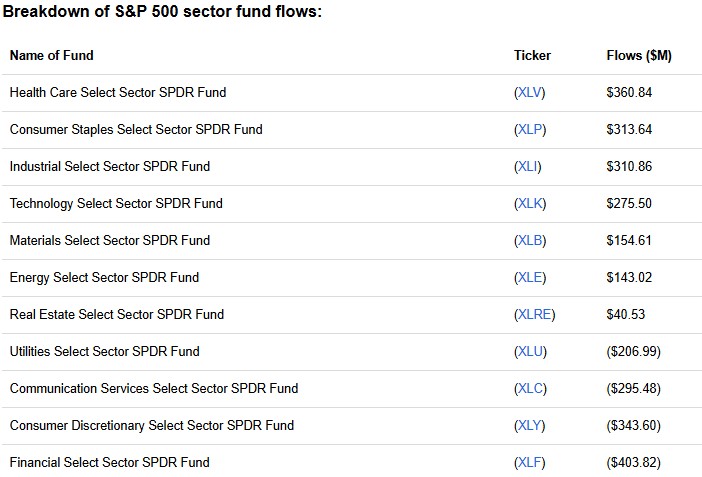
The latest weekly data on U.S. stock ETF fund flows clearly confirms the market's risk-averse rotation logic. As of the week ending July 24, among the 11 major sectors of the S&P 500 index, 7 sectors experienced net inflows, with defensive sectors capturing the top positions for fund inflows, while high-volatility growth and financial sectors faced outflows.
According to data from etfdb.com, the total net inflow for 11 S&P 500 sector-tracking ETFs last week was approximately $349.11 million. Defensive sectors led in capital attraction, with the healthcare sector ETF (XLV) ranking first with a net inflow of $360.84 million, followed closely by the consumer staples sector ETF (XLP) with a net inflow of $313.64 million, and the industrial sector ETF (XLI) with a net inflow of $310.86 million.
In contrast, the financial sector ETF (XLF) saw a net outflow of $403.82 million for the week, making it the sector with the largest outflow; the consumer discretionary sector ETF (XLY) and the communication services sector ETF (XLC) experienced net outflows of $343.6 million and $295.48 million, respectively.
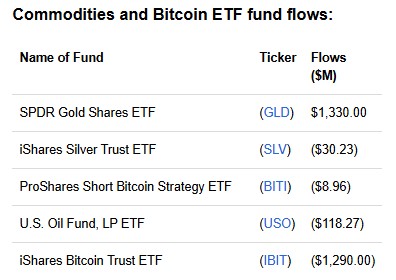
 At the same time, the performance of precious metals showed divergence, with the Gold ETF (GLD) experiencing a net inflow of $1.33 billion for the week, and its price rising by 1.12%; however, the Silver ETF (SLV) saw a slight net outflow of $30.23 million.
Cryptocurrency assets became a major area of capital outflow for the week. The Bitcoin ETF (IBIT) had a net outflow of $1.29 billion, while the price of Bitcoin fell by 3.26%, highlighting the market's risk asset sell-off sentiment. The 1x short Bitcoin futures ETF (BITI) saw an outflow of $8.96 million.