
Samsung Says Supply Will Remain Tight Until 2028, But the Market Is Skeptical
 Complete. Here is the key summary
Samsung and SK Hynix reported record-high Previous Quarterly Performance for the second quarter, but management expects the shortage of memory chips to persist until 2028. In contrast, the market's implied judgment suggests prices will decline in the first half of next year, creating a divergence in expectations of over one year. Affected by significant Financing Outflow and concerns about an inflection point in cloud providers' capital expenditures, the stock prices of both companies have experienced severe volatility recently, putting pressure on their valuations
On July 29 and 30, SK Hynix and Samsung Electronics released their second-quarter earnings reports, respectively. The combined operating profit of the two companies was approximately 150 trillion Korean won (about $104 billion).
On July 29, the day SK Hynix released its financial report, the Korean KOSPI index plummeted more than 12% during intraday trading, triggering a circuit breaker. SK Hynix closed down 9.61%, and Samsung fell 5.23%. On July 30, after Samsung released its earnings, the stock closed slightly down 0.72%, with an intraday amplitude exceeding 11%.
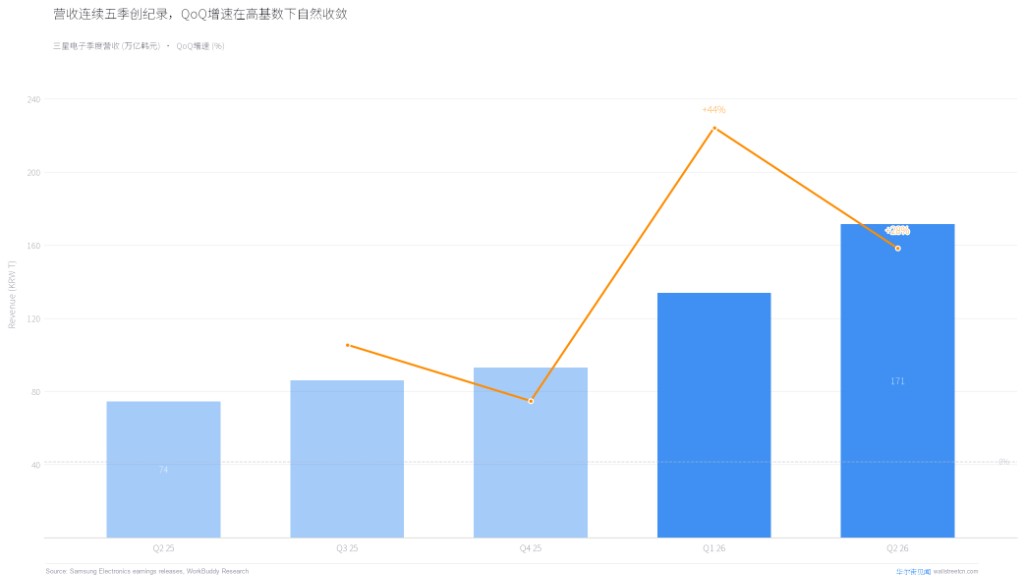
The performance itself was solid. Samsung’s second-quarter revenue was 171.5 trillion Korean won, and operating profit was 89.5 trillion Korean won, both marking historical highs and continuing to break records since the third quarter of 2025. SK Hynix reported revenue of 79.3 trillion Korean won and operating profit of 60.5 trillion Korean won, representing year-on-year increases of 257% and 557%, respectively.
Management and Market Timelines Diverge by More Than a Year
During conference calls for both companies, management repeatedly emphasized the same point: the supply tightness will not end soon.
Samsung expects the shortage of memory chips to last at least until 2028, with the gap in 2027 being larger than in 2026. SK Hynix stated that demand for HBM and server DRAM is still accelerating, and the new capacity added this year is insufficient to meet orders. Samsung has signed 60% to 70% of its memory production capacity into five-year long-term contracts, which include prepayment and penalty clauses. SK Hynix has signed similar five-year long-term contracts with about 10 core customers but did not disclose the proportion of capacity covered by these contracts.
However, the market values Samsung at approximately 5.4 times forward P/E. This valuation implies the judgment that memory prices will begin to decline in the first half of next year. This differs from the timeline provided by management by more than a year.
This is not the first time management and the market have diverged in their cycle judgments. In previous memory cycles, the market usually spotted the inflection point earlier than the companies. But this time, the direction has reversed: the company is extending its cycle outlook, while the market is pricing in a downturn ahead of time.
Three Concerns of the Market
Changes in foreign investor positions provide a reference. From the beginning of the year to date, foreign funds have net sold more than $110 billion in the Korean stock market. About 90% of this was concentrated in Samsung and SK Hynix. The asset size of leveraged ETFs shrank from $50 billion to $17 billion. The long-short ratio of hedge funds dropped from 5.7 times to 3.2 times.
The biggest concern is the inflection point in the growth rate of capital expenditures by cloud providers.
Goldman Sachs data shows that in 2026, the total capital expenditure of hyperscale cloud providers will be about $755 billion, a year-on-year growth rate of about 84%. The market consensus expects the growth rate to drop to about 22% in 2027,
while Goldman Sachs itself believes it could reach 45%. Microsoft has lowered its fiscal 2027 capital expenditure expectation from $190 billion to $175 billion, but the company emphasized that its actual investment plan remains unchanged, with the reduction mainly coming from accounting adjustments (extending asset depreciation periods and lease reclassification). However, the consensus expectation of the growth rate dropping from 84% to 22% itself indicates that the slope of memory demand growth may slow down next year.
Another uncertainty comes from the expansion speed of Chinese memory manufacturers. Changxin Memory Technologies recently completed its listing, and its global DRAM share rose from about 3% in 2025 to 8% in the first quarter of 2026. Judging by the speed of share change, investors have already reacted in their pricing.
There is also internal structural squeezing at Samsung.
While memory chip prices are rising, they are also pushing up the manufacturing costs of mobile phones and home appliances. In the second quarter, Samsung's MX division (Mobile eXperience) lost 0.7 trillion Korean won, and the VD/DA division (TVs and home appliances) incurred a slight loss. The company's semiconductor department accounted for 99.7% of its operating profit. If chip prices remain at current levels, losses in the device business may persist. The market is assigning a cyclical stock valuation to a company that relies almost entirely on memory for profits.
What to Watch Next
The third quarter is a key period for the volume ramp-up of HBM4. Samsung's guidance is a quarter-on-quarter increase of more than three times. If achieved, it would mean that yield rates and mass production capabilities have crossed a critical threshold.
In October, major cloud providers will release their third-quarter capital expenditure data. If Microsoft, Amazon, or Google further compress their 2027 spending plans, the market's concerns will gain new data support.
By the end of the year, the execution of long-term contracts will face its first test. Whether the locked-in capacity of more than 60% can be fulfilled as agreed, and the actual binding force of the contract terms, will be verified.
These two quarters are a window for the market divergence to narrow or widen. The direction depends on shipment data and customer spending, rather than more statements.
Risk Warning and Disclaimer
The market involves risks, and investment requires caution. This article does not constitute personal investment advice, nor does it take into account the specific investment objectives, financial status, or needs of individual users. Users should consider whether any opinions, views, or conclusions in this article align with their specific circumstances. Investment based on this information is at the user's own risk.