
SemiAnalysis: AWS and Meta Push "Modular" Data Centers, Cutting Construction Time by 36% and Costs by 8%
 Complete. Here is the key summary
The efficiency battle in computing infrastructure heats up! Facing labor shortages, data centers are fully embracing "modularity." Factory prefabrication not only compresses construction timelines by 36% and reduces capital expenditure by 8%, but also accelerates revenue generation—each megawatt delivered a month early can generate $500,000 in revenue
Modular construction is reshaping the underlying logic of the data center industry.
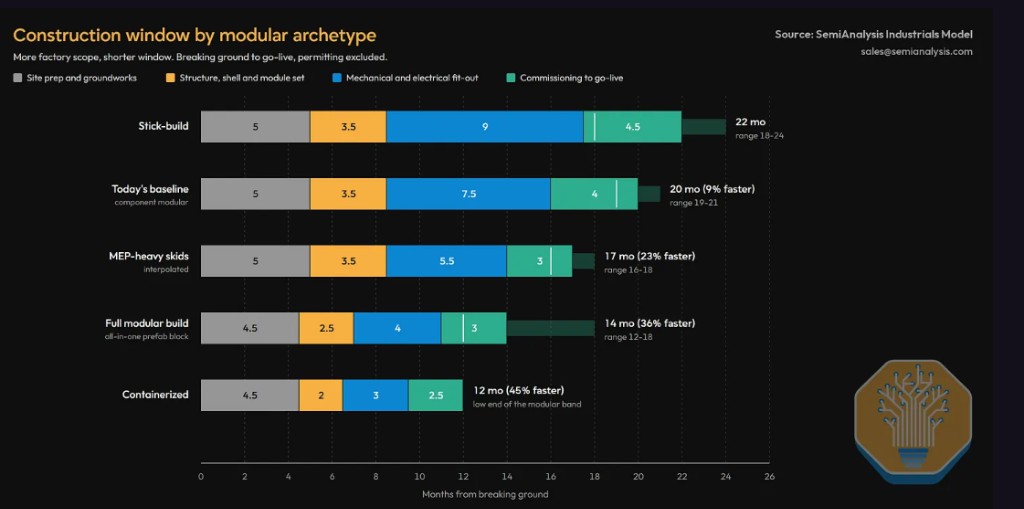
In its latest in-depth report, research firm SemiAnalysis points out that from hyperscale cloud providers to AI labs, modularity has become the default solution for rapid data center construction—construction cycles can be compressed by approximately 36% (equivalent to shortening the timeline by 7 to 9 months), and total capital expenditure per megawatt can be reduced by about 8%.
AWS is aggressively advancing its modular design codenamed "SAMDC." Its internal "Project Houdini" breaks down white space construction into standardized racks that can be prefabricated in factories, compressing the preparation time before server installation from up to 15 weeks down to 2–3 weeks. This approach also eliminates over 50,000 man-hours of on-site electrical installation work per module.
Meta, meanwhile, is deploying aluminum-frame fabric structure "tent" facilities at its Prometheus campus in New Albany, Ohio. Satellite imagery shows that eight structures were completed between the announcement of construction in July 2025 and April 2026—whereas the previous five permanent buildings on the campus took two to three years to build.
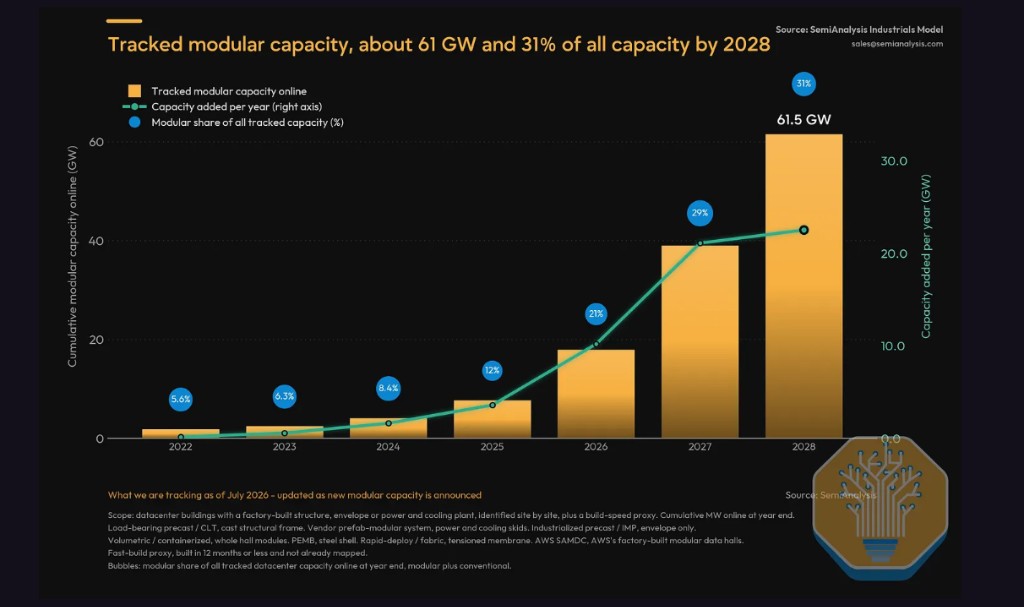
SemiAnalysis's modular tracker covers over 61 GW of modular capacity and more than 1,000 sites adopting some form of prefabrication strategy. It is estimated that by the end of 2028, modular construction will account for more than 30% of total online capacity. For cloud service providers, speed equals revenue. Each month a megawatt of IT computing power is delivered early conservatively captures about $500,000 in value for the owner-operator. For a 50 MW facility, this translates to approximately $200 million in undiscounted gains compared to pure on-site construction.
Labor Shortages Are a Structural Bottleneck; Modularity Is the Countermeasure
The core driver behind this shift is a shortage of skilled trade labor. Electricians account for 30% to 40% of total construction man-hours in data center projects. SemiAnalysis's labor model shows that the shortage of electricians will become apparent by 2027, driven by the construction of large-scale mission-critical facilities, and will be particularly acute in regions with high construction concentration such as Texas and Ohio.
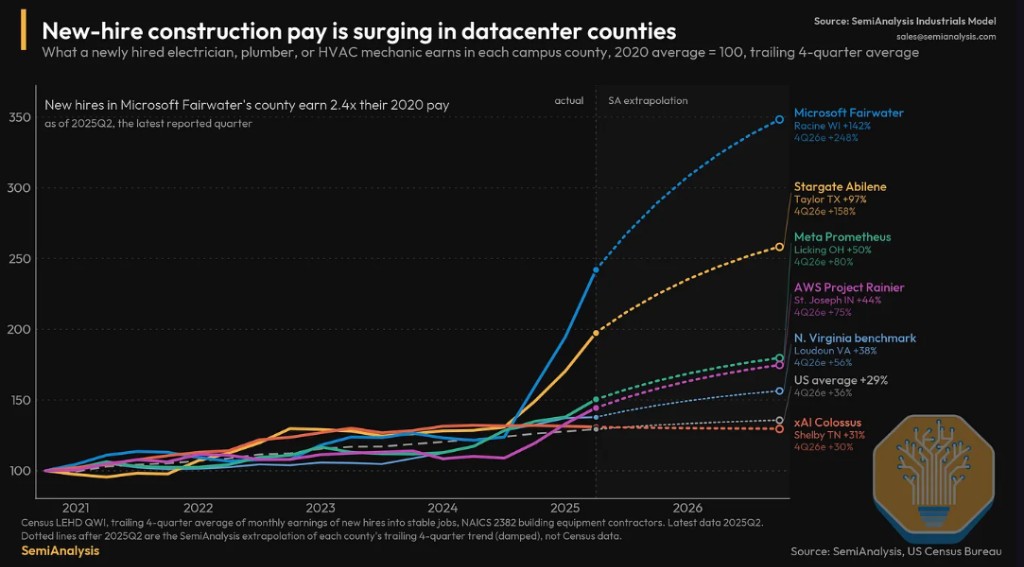
This constraint is already evident in reality. Previously, Crusoe raised wages by 30% to attract talent to its Abilene campus, which required over 9,000 workers at peak times. Under the traditional on-site construction model, a 50 MW AI data hall requires about 12,000 on-site man-hours per megawatt during the mechanical and electrical installation phase, with a single building peaking at around 300 skilled technicians.
The value of modularity lies in transferring repetitive tasks to factories for parallel completion while on-site construction proceeds simultaneously. According to SemiAnalysis's calculations, moving the scope of mechanical and electrical installation into factories reduces on-site man-hours by approximately 63% to 4,500 hours per megawatt, and cuts the demand for licensed electricians by about 85%. The factory model also avoids constraints imposed by weather and geographical conditions, leading to more stable quality control.
Modular Systems: From Prefabricated Components to Turnkey Delivery
SemiAnalysis categorizes modular product systems into five levels, ranging from low to high: individual components, skids, modules, containers, and prefabricated data center blocks. The first four levels belong to subsystem modularity, while the last level approaches overall facility modularity.
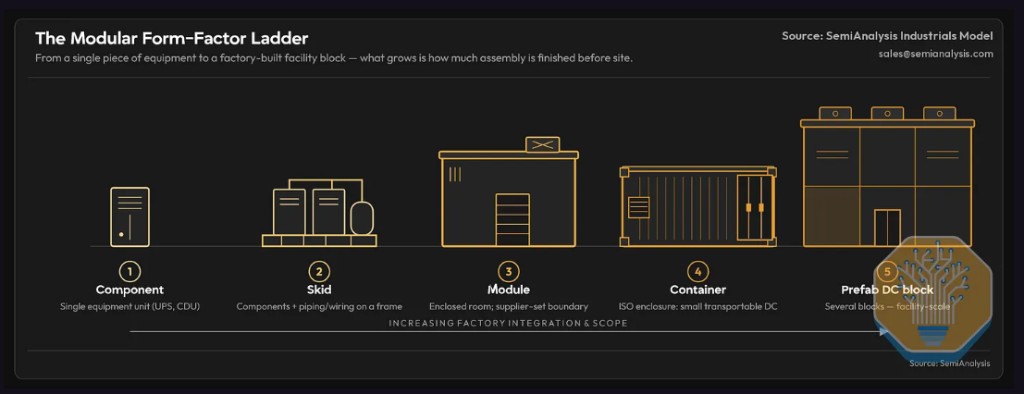
At the subsystem level, modular power pods and modular cooling systems are currently the two most concentrated areas in the market.
Taking Flex's Anord Mardix modular power solution as an example, it integrates transformers, switchgear, UPS, and battery systems into a single enclosed enclosure. This compresses the mechanical and electrical installation cycle from about 5.5 months to about 2.5 months, saving approximately 5% in cost per megawatt. On the cooling side, Airedale by Modine's rack-mounted CDU ships as a 2 MW prefabricated unit, requiring only the connection of two water lines and one power line upon arrival.
At the overall facility modularity level, Vertiv MegaMod integrates IT racks, power, and cooling into a unified module. Its accompanying OneCore platform provides standardized 12.5 MW power and cooling pods, which can be combined for larger-scale AI factory deployments. NVIDIA also officially launched its DSX reference architecture in March 2026, incorporating computing, networking, storage, power supply, cooling, and even civil structural design into a standardized blueprint. CoreWeave has adopted DSX Air to build digital twin models for its AI factories.
Who Leads Modularity: Three Integration Paths with Different Focuses
The ownership of modularity leadership directly determines the value capture space for various parties, forming three distinct models in the market.
In the operator-led model, operators design specifications themselves and procure equipment directly, handing over integration work to contractors. This model requires strong internal engineering and procurement capabilities and entails assuming risks related to equipment lead times and inventory. Therefore, it is effectively limited to the largest hyperscalers such as AWS and Meta.
In the EPC or system integrator-led model, operators set performance requirements, while engineering general contractors or specialized integrators handle procurement, coordination, and construction. Companies such as Comfort Systems, Sterling Infrastructure, and Cupertino Electric (under Quanta) fall into this category. Among them, Comfort Systems operates over 3.5 million square feet of factory capacity in Texas and North Carolina through Environmental Air Systems and TAS Energy. This model is particularly attractive to hyperscalers because operators can retain their own designs while shifting construction execution to factories.
The OEM-led model, represented by Vertiv OneCore, sees equipment manufacturers integrate their own power, thermal management, cooling, and IT infrastructure into complete platforms for sale. This model increases Vertiv's value content per megawatt from historically about $3.5 million to approximately $7 million, but at the cost of lead time: currently, the delivery cycle for Vertiv's modular solutions exceeds 12 months.
Differentiated Strategies of Major Operators
Various operators have not converged on a single modular path but have made different choices based on their scale, market positioning, and technology stacks.
Compass is the colocation operator with the longest history of modular operations, estimating that about 70% to 85% of the content of each building is prefabricated in factories. The frame and roof of a single building can be erected in 18 to 21 days, covering the full stack including the shell, white space, power modules, and medium-voltage switchgear. QTS, meanwhile, builds rapid delivery capabilities capable of responding to customer demands at any time by locking in designs early and maintaining a reserve of long-lead-time equipment in about 7 million square feet of warehousing capacity in Kansas. Its latest "Rapids" design has been adopted by two large AI companies.
Aligned Data Centers focuses on adaptability, keeping basic power and cooling architectures standardized while allowing room configurations to freely switch between air cooling, hybrid cooling, and liquid cooling as rack density evolves. Its Delta³ air cooling system supports about 50 kW per rack, while the DeltaFlow liquid cooling platform can support over 350 kW.
Crusoe applies both shell modularity and overall facility modularity at its Abilene Stargate campus: prefabricated insulated metal panels compress the roofing time of a single building to under 8 weeks. Its self-developed Spark units, each about 1 MW in scale, leave the factory in a near-complete state and have undergone scaled validation through Redwood Materials' project in Nevada.
Cost and Timeline Estimates: Supplier Promises Need Discounting
SemiAnalysis's underlying calculations reveal a key context: suppliers' publicly cited speed figures are often based on narrower statistical scopes rather than end-to-end timelines. Vertiv SmartRun's claimed 85% acceleration applies only to overhead busways and cable management; MegaMod's 50% figure measures the comparison between module deployment and on-site construction; Schneider's 60% figure applies only to power and cooling modules.
SemiAnalysis's full-cycle calculation for a 50 MW liquid-cooled AI data hall shows that the construction window for pure on-site construction is about 18 to 24 months, while full modular construction can be compressed to 12 to 18 months, which is about 36% faster than pure on-site construction and about 30% faster than the current baseline that already includes some modularity. If integrated prefabricated data center modules or container data centers are used, the construction window can be further compressed to under 12 months.
In terms of cost, the comprehensive expense for a fully modular solution is about $13.5 million per megawatt, lower than the approximately $14.6 million for pure on-site construction, a difference of about 8%. Savings mainly come from two aspects: moving mechanical and electrical installation into factories saves about $600,000 per megawatt in construction service fees and about $500,000 in installation fees; shorter construction cycles also save costs related to escalation, contingency reserves, and on-site management.
It is important to note that modularity also has inherent costs: compared to pure on-site construction, modular construction adds a layer of module supplier profit, which is the main source of cost friction. Furthermore, some operators and MEP contractors have reported reliability issues with certain modular solutions. Once quality defects occur, not only are the previously saved construction timelines lost, but valuable hardware assets are also put at risk.