
CICC: Fed's Hold Amplifies Market Risks
 Complete. Here is the key summary
CICC points out that although the Federal Reserve kept interest rates unchanged at its July meeting, hawkish forces within the committee strengthened, with three voting members advocating for a rate hike. Waller attempted to reduce policy intervention, relying on market-driven tightening of financial conditions. This move could undermine policy credibility and intensify market pricing of long-term inflation and "too late" risks. Long-end US Treasury yields rose; if subsequent data exceeds expectations, risk assets will face greater adjustment pressure
The Federal Reserve held rates steady at its July meeting, but internal hawkish forces have further strengthened, with three voting members supporting a 25 basis point rate hike. We believe the most significant change in this meeting was not the rate decision itself, but rather Waller's attempt to reduce policy intervention, relying more on the spontaneous rise in market rates to tighten financial conditions, effectively "outsourcing" part of the tightening function to the market. However, against the backdrop of inflation persistently above target, this approach can easily erode market confidence in the Fed's policy credibility. Following the meeting, long-end US Treasury yields surged, and the yield curve steepened significantly, possibly reflecting that investors are beginning to price in higher long-term inflation and policy risks. Looking ahead, we believe that if employment or inflation data exceed expectations, the market will not only further raise expectations for a September rate hike but may also price in the risk that the Fed is acting "too late." With long-end rates rising further, risk assets will face greater pressure to adjust.
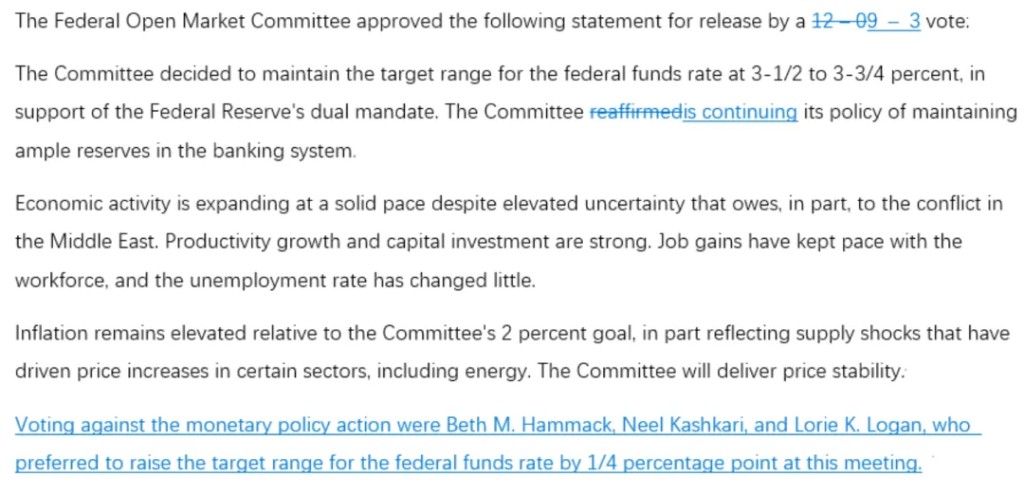
The Fed held steady at its July meeting, but hawkish forces are strengthening. The federal funds rate remained in the 3.5% to 3.75% range, in line with market expectations. The decision was passed by a vote of 9 to 3, with Dallas Fed President Logan, Cleveland Fed President Hammack, and Minneapolis Fed President Kashkari casting dissenting votes in favor of an immediate 25 basis point rate hike [1].
Although the rate was ultimately held unchanged, the three dissenting votes themselves sent an important signal—concerns about inflation risks within the committee are heating up. If inflation data continues to exceed the 2% policy target, more officials are likely to join the camp advocating for rate hikes. In fact, over the past three weeks, many officials have begun to consider the option of "preemptive" rate hikes, keeping the market's pricing of rate hikes within the year consistently high.
A more significant change came from Waller's remarks. He pointed out [2] that since the last meeting, both nominal and real interest rates have risen significantly, and financial conditions have tightened. As the Fed reduces forward guidance, "market participants are learning to play the ball, not the referee." Meanwhile, Waller reiterated that the Fed remains firmly committed to addressing inflationary pressures, with no "soft inflation target" other than 2%.
This statement implies that, in Waller's view, the Fed may not need to frequently adjust the policy rate to influence financial conditions but can instead rely on the spontaneous rise in market rates to achieve the goal of suppressing demand and reducing inflationary pressure. In other words, Waller is attempting to "outsource" part of the policy tightening function to the market.
We believe this approach is feasible during periods of stable economic operation, but it faces significant risks when inflation persists above target and the market is highly sensitive to central bank credibility. It leads the market to question whether the Fed possesses the policy credibility to fight inflation.
Market performance also reflected this concern. After the FOMC meeting, the 10-year yield rose by about 8 basis points, and the 30-year yield surged by 12 basis points, causing the yield curve to steepen noticeably. At the same time, the US Dollar Index fell, gold prices rose, and US stocks dropped sharply. This may indicate that the market perceives a lack of credibility in the Fed, with investors beginning to demand a higher long-term risk premium to compensate for future inflation and policy uncertainty. From this perspective, although there were three dissenting votes in this meeting, it failed to prove to the market that the Fed is ready to take action to control inflation.
Looking forward, we believe that the Fed's decision to hold steady this time has not only failed to alleviate market concerns about inflation but may also increase volatility in the bond market and exacerbate the risk of adjustment in the stock market.
First, today's market reaction is clearly not what the Fed hoped to see. To maintain policy credibility, more Fed officials are likely to release hawkish signals in the coming period. We expect that the three voting members who cast dissenting votes will continue to publicly support rate hikes, while a group of officials with hawkish leanings or open attitudes within the committee, such as Governor Waller, Vice Chair Jefferson, and Governor Cook, may also mention the option of rate hikes in future public speeches.
Second, abandoning the current window for a rate hike is not without cost; rather, it leaves more pressure for the future. If employment, wage, or inflation data in the next month exceed expectations, the probability of a September rate hike will further increase. At that time, the market will not only reprice the next rate hike but may also begin to factor in the risk that the Fed is acting "too late," pushing long-end US Treasury yields even higher. In other words, even if the Fed does not hike rates this time, financial conditions may not loosen; instead, they may tighten further through rising market rates.
Of course, this may be precisely the effect Waller hopes to achieve—achieving cooling demand and falling inflation through spontaneous market rate adjustments, without frequently adjusting the policy rate. However, this approach essentially exchanges greater market volatility for tighter financial conditions. Against the backdrop of continued adjustment in AI assets and escalating geopolitical risks in the Middle East, rising long-term rates may resonate with declining risk appetite, putting greater pressure on risk assets, including stocks.
Chart 1: Federal Reserve Monetary Policy Statement (July 2026 vs. June 2026)
Source: Federal Reserve, CICC Research Department
Source of this article: Liu Zhengning, Xiao Jiewen, et al., CICC
Risk Warning and Disclaimer
Investment involves risks; please invest with caution. This article does not constitute personal investment advice, nor does it take into account the specific investment objectives, financial status, or needs of individual users. Users should consider whether any opinions, views, or conclusions in this article are suitable for their specific circumstances. Investors bear full responsibility for their own investment decisions.