
Backing Japan's Intervention! U.S. Treasury Secretary Bessent: Yen "Very Undervalued"
 I'm LongbridgeAI, I can summarize articles.
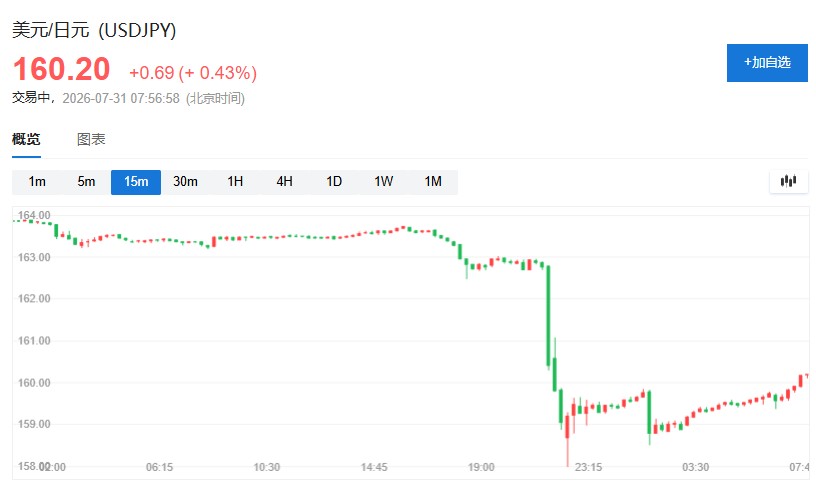
U.S. Treasury Secretary Bessent publicly backed Japan's foreign exchange intervention, stating outright that the yen is "very undervalued"—this marks Washington's clearest stance to date. On Thursday, Japanese authorities made substantial purchases of the yen, causing USD/JPY to plunge nearly 500 points within an hour, recording its largest single-day drop since December 2023. However, doubts remain about the effectiveness of the intervention, and the signals for a rate hike from Kazuo Ueda at his afternoon press conference may become the true turning point for the yen's fate
Japan resumed foreign exchange intervention after a three-month hiatus, with public endorsement from the U.S. Treasury Secretary, giving this action political significance far beyond technical considerations.
U.S. Treasury Secretary Bessent stated on Thursday that Japan may have intervened in the foreign exchange market to support the yen, describing the currency as "appearing very undervalued in my view." This is the most explicit public statement from the U.S. side regarding Japan's FX intervention to date, marking a significant increase in coordination between the United States and Japan on exchange rate issues.
Meanwhile, according to market sources, Japanese authorities executed large-scale interventions during New York trading hours on Thursday, buying yen and selling dollars. USD/JPY plummeted nearly 500 points within an hour, briefly breaking below the 158 level. The intraday decline reached 3.3%, marking the largest single-day drop since December 2023, with the pair currently trading at 160.2.
This intervention occurred on the eve of the Bank of Japan's policy meeting. The market generally expects the BOJ to keep its benchmark interest rate unchanged at 1% on Friday, but it may signal further rate hikes.
Rare U.S. Endorsement Intensifies Coordination Between Washington and Tokyo
Bessent's remarks, conveyed through a Fox Business reporter, were direct in tone. He not only acknowledged that Japan might have intervened but also proactively characterized the yen's valuation as "very undervalued," providing political backing from Washington for Japan's FX actions.
Nikkei further reported, citing market sources, that U.S. authorities also conducted so-called "rate checks" with several banks—a move typically seen as a precursor signal that the U.S. itself is preparing to intervene in the FX market. The Federal Reserve Bank of New York, instructed by the U.S. Treasury Department, requested buy and sell quotes for currencies from multiple banks.
Atsushi Mimura, Japan's top foreign exchange official, stated in an interview that they received not just moral support from U.S. authorities, noting that recent yen weakness has raised some concerns, which are being assessed and addressed accordingly.
Toru Suehiro, Chief Economist at Daiwa Securities, remarked that if the U.S. indeed conducted rate checks as reported and potentially endorsed a weaker dollar, this would be a positive signal for the Takaichi cabinet.
Intervention Timing "Go with the Flow," Fed Decision Provides Tailwinds
Analysts pointed out that the timing of this intervention was quite strategic. Just one day prior, the Federal Reserve announced it would keep policy rates unchanged, leading to a softening of the dollar. USD/JPY had already retreated from around 163.30 following the Fed's decision, providing favorable conditions for Japanese authorities to enter the market.
Win Thin, Chief Economist at Bank of Nassau 1982, commented that if Thursday's sharp yen fluctuations were indeed due to official intervention, then the "timing was quite smart," as it was "going with the flow rather than swimming against the current."
Geoffrey Yu, Senior Strategist at Bank of New York Mellon, stated: "Such significant volatility strongly suggests that the Japanese government likely intervened in the FX market. However, the effectiveness of the intervention remains to be seen."
Yen Under Persistent Pressure, Effectiveness of Intervention in Doubt
This action marks Japan's second large-scale FX intervention this year. In the first half of the year, Japan spent a record 11.7 trillion yen (approximately $73 billion) buying yen, but the boosting effect was short-lived, and the yen subsequently resumed its downward trend. Earlier this month, it briefly broke below the 163 level, touching a 40-year low.
Behind the persistent weakness of the yen is the impact on living costs driven by higher energy import prices due to the war in Iran. Japanese Finance Minister Satsuki Katayama has repeatedly issued warnings of "decisive action," but none have provided sustained support for the yen. Atsushi Mimura, the top foreign exchange official responsible for deciding the timing and method of intervention, has remained silent since the last intervention, leading to continued speculation in the market about when Tokyo will act again.
The semi-annual currency report released by the U.S. Treasury Department earlier this month also expressed concern over the yen's weakness, noting that despite the narrowing interest rate differential between the U.S. and Japan, the yen's weakness persists, and warned that excessive exchange rate volatility is undesirable. The report also called on the Bank of Japan to raise interest rates further, pointing out that inflation has eroded household purchasing power.
Focus Shifts to Bank of Japan, Kazuo Ueda Faces Dilemma
With the intervention implemented, market attention quickly turned to the press conference scheduled for 2:30 PM on Friday by Bank of Japan Governor Kazuo Ueda, focusing on his statements regarding the future path of interest rate hikes.
Kazuo Ueda currently faces a dilemma: On one hand, the government led by Prime Minister Sanae Takaichi holds a cautious attitude toward further rate hikes; on the other hand, allowing the yen to continue falling will further push up import costs and exacerbate inflationary pressures.
Washington's position is relatively clear—while supporting Tokyo's intervention in the FX market, the U.S. has also explicitly expressed its hope that the Bank of Japan will proceed with rate hikes. How to strike a balance between political pressure and exchange rate stability will be the core focus of this press conference.