
Guosen Macro View on July PMI: Sentiment Returns Below Threshold, Fiscal Pace Awaits Acceleration
 Complete. Here is the key summary
Guosen Macro points out that the Manufacturing PMI fell to 49.2% in July, and the Non-Manufacturing PMI dropped to 49.0%, both returning below the boom-bust threshold. Primarily dragged down by weakening demand, new orders declined significantly, and the gap between production and demand widened. Prices continued to weaken, with input prices hitting their lowest level of the year. Although the service sector performed relatively well during the summer holiday season, the construction sector slid sharply. Overall economic sentiment declined markedly, and the momentum for recovery awaits policy consolidation; marginal improvement is expected in the subsequent months of the third quarter
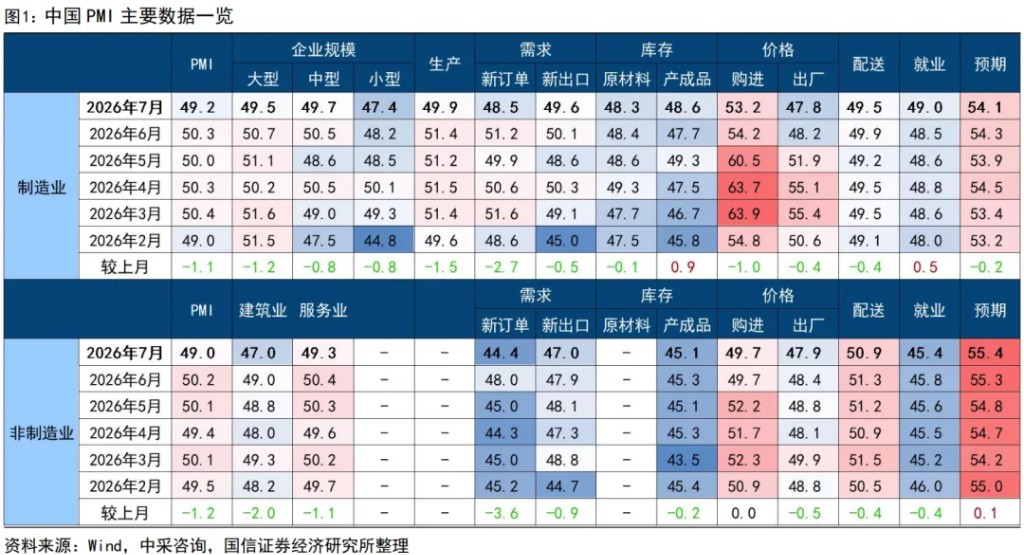
In July, the Manufacturing PMI and Non-Manufacturing PMI were 49.2% and 49.0%, respectively, representing month-on-month declines of 1.1 percentage points and 1.2 percentage points.
Interpretation
The Manufacturing PMI in July fell by 1.1 percentage points to 49.2, returning below the boom-bust threshold, with a decline greater than the seasonal average of the past three years. This was mainly due to weakening demand, with new orders dragging the index down by 0.8 percentage points; production also fell synchronously by 1.5 percentage points to 49.9, returning to contraction territory for the first time in four months. The "production-demand gap" widened by 1.2 percentage points to 1.4, with all three major demand indicators—new orders, new export orders, and backlog of orders—falling below the threshold. Prices continued to weaken, with input prices dropping to 53.2, the lowest this year, and ex-factory prices falling to 47.8, a new low since November 2025. By industry, only 6 out of 17 manufacturing sectors remained in expansion territory, a significant decrease from June (10 sectors). The Non-Manufacturing PMI fell by 1.2 percentage points to 49.0. Among these, the services sector dropped by 1.1 percentage points to 49.3, but resident services, air travel, and information and business services performed relatively well driven by the summer holiday season; the construction sector fell by 2 percentage points to 47.0, marking a 74-month low.
Overall, economic sentiment in July declined significantly, with synchronous weakening in supply and demand, and demand weakening more than production. Prices may continue to fall month-on-month, and the momentum for economic recovery awaits further policy consolidation. As high temperatures and heavy rains subside and existing policies are accelerated, sentiment in the subsequent months of the third quarter is expected to improve marginally.
Manufacturing Sector
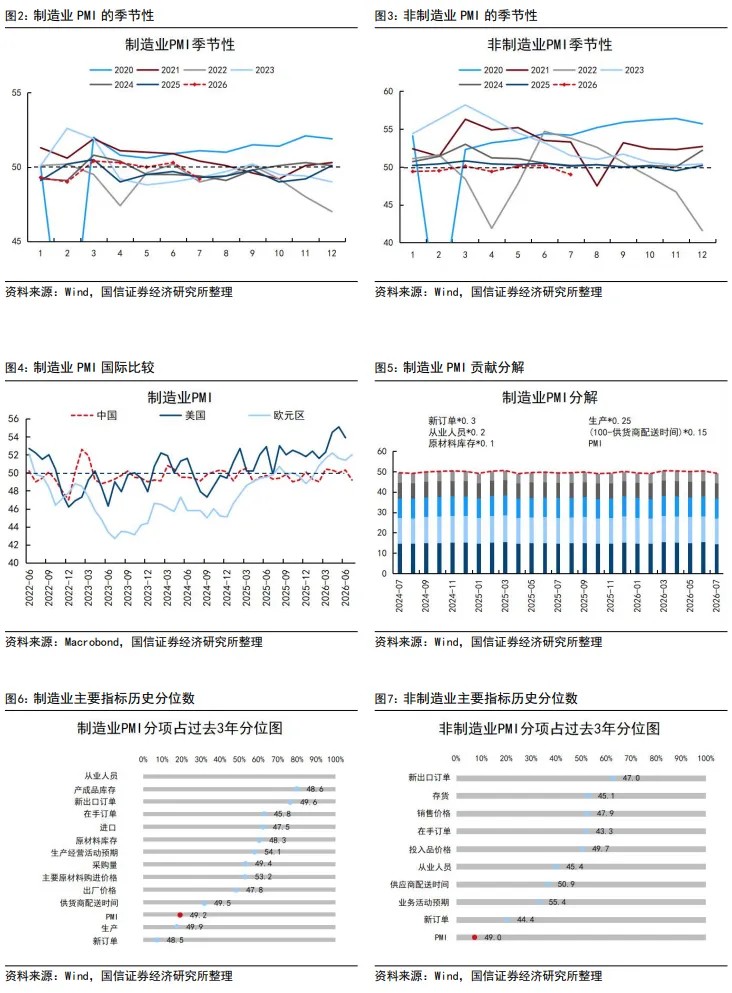
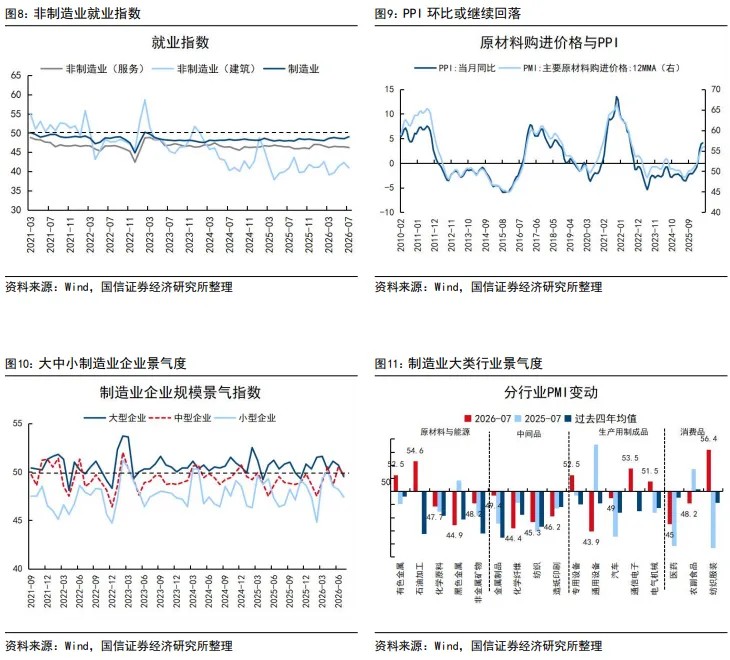
Manufacturing sentiment declined month-on-month in July, falling below the boom-bust threshold. The Manufacturing PMI dropped by 1.1 percentage points to 49.2, which is 0.1 percentage points lower than the same period last year and 0.1 percentage points lower than the average of the same period over the past three years. In terms of month-on-month changes, this month's decline was significantly larger than the seasonal decline of the past three years (average -0.1 percentage points). In terms of contribution, the July PMI was mainly dragged down by new orders. Ranked by contribution size: employees (contributing 0.1 percentage points), supplier deliveries (contributing 0.06 percentage points), raw material inventories (contributing -0.01 percentage points), production (contributing -0.38 percentage points), and new orders (contributing -0.81 percentage points).
Production and demand declined synchronously, with demand falling more than production. In terms of relative changes, the "production-demand gap" widened: the decline in new orders (-2.7 percentage points) was larger than the decline in production (-1.5 percentage points), widening the "production-demand gap" by 1.2 percentage points to 1.4 percentage points. In absolute terms, production fell to 49.9, returning below the boom-bust threshold for the first time in four months; the "three major demands": new orders (-2.7 percentage points to 48.5), new export orders (-0.5 percentage points to 49.6), and backlog of orders (-1.3 percentage points to 45.8) all fell below the boom-bust threshold.
Inventory divergence continued, and prices continued to fall. Regarding inventories, raw material inventories fell by 0.1 percentage points to 48.3, declining for the third consecutive month; finished goods inventories rose by 0.9 percentage points to 48.6, showing some recovery. Meanwhile, both input prices and output prices continued to decline, with input prices falling more. Input prices fell by 1 percentage point to 53.2, the lowest level this year; ex-factory prices fell by 0.4 percentage points to 47.8, a new low since November 2025. Prices weakened across the board, but the smaller decline in ex-factory prices indicates a marginal relief in cost pressure for manufacturing enterprises.
Corporate expectations declined, and sentiment fell for enterprises of all sizes. Manufacturing business activity expectations fell by 0.2 percentage points to 54.1, remaining above the boom-bust threshold, indicating strong medium-to-long-term confidence among enterprises. By size, sentiment declined for large, medium, and small enterprises: large enterprise sentiment fell by 1.2 percentage points to 49.5, entering contraction territory; medium enterprise sentiment fell by 0.8 percentage points to 49.7, and small enterprise sentiment fell by 0.8 percentage points to 47.4. The "large-small enterprise gap" narrowed by 0.4 percentage points to 2.1 percentage points, indicating some convergence in enterprise sentiment divergence. By industry, 6 out of 17 manufacturing sectors were in expansion territory, a significant decrease compared to June (10 sectors). Stronger-performing industries included textiles and apparel, computers/electronics/communications, petroleum processing, and non-ferrous metals; weaker-performing industries included pharmaceuticals, chemical fibers, and general equipment.
Non-Manufacturing Sector
The Non-Manufacturing PMI declined slightly in July. Non-manufacturing sentiment fell by 1.2 percentage points month-on-month to 49.0, with overall performance significantly weaker than the same period in recent years (1.6 percentage points lower than the recent average for the same period), and the month-on-month decline was also larger than the same period in the past three years (-0.8 percentage points). Structurally, new orders in the non-manufacturing sector fell sharply by 3.6 percentage points to 44.4, and employment fell synchronously by 0.4 percentage points to 45.4, indicating marginal weakening in demand and employment sentiment; expectations rose by 0.1 percentage points to 55.4, remaining above the boom-bust threshold.
Non-manufacturing ex-factory prices fell. Among the price indicators for the month, input prices remained unchanged at 49.7, while ex-factory prices fell by 0.5 percentage points to 47.9. The difference between output and input prices decreased by 0.5 percentage points to -1.8 percentage points, indicating a marginal increase in profit margin pressure for non-manufacturing enterprises.
By industry, both services and construction declined. The Services PMI fell by 1.1 percentage points to 49.3, returning below the boom-bust threshold and hitting a 43-month low. Sentiment in resident services rose sharply by 5 percentage points, entering the 50-55 range, mainly because the catering industry benefited from summer holiday traffic, and the culture, sports, and entertainment industries saw a peak-season surge; the transportation industry rose by 1.3 percentage points, with sentiment remaining in the 45-50 contraction range, showing internal divergence, with aviation boosted by summer travel; information and business services maintained high sentiment, rising by 1.5 percentage points month-on-month and continuing in the 50-55 range. The Construction PMI fell by 2 percentage points to 47.0, a 74-month low, indicating continued contraction. Within this, residential building construction continued to decline (-0.4 percentage points, remaining in the 45-50 range). Civil engineering fell by 6 percentage points from the previous month, mainly because high temperatures and rainfall hindered infrastructure progress.
Source: Guosen Macro: Tian Di, Wang Yiqun, Dong Dezhi
Risk Warning and Disclaimer
The market involves risks, and investment should be approached with caution. This article does not constitute personal investment advice, nor does it take into account the specific investment objectives, financial status, or needs of individual users. Users should consider whether any opinions, views, or conclusions in this article are suitable for their specific circumstances. Investors bear full responsibility for their own investment decisions.