
 I'm LongbridgeAI, I can summarize articles.
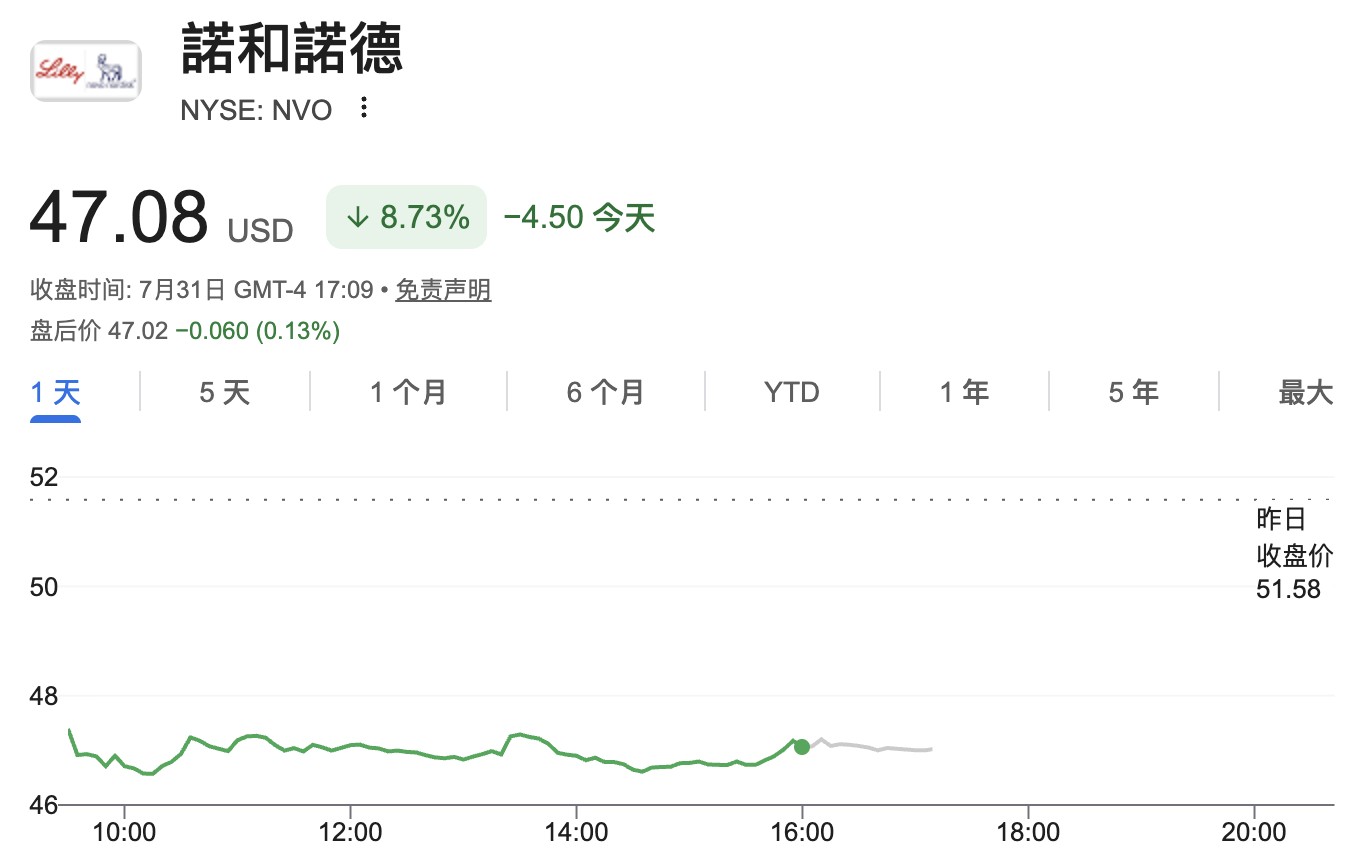
Novo Nordisk announced on Friday that its cardiovascular drug ziltivekimab failed in a Phase III clinical trial involving 6,300 patients, as it did not reduce the risk of major cardiovascular events, causing its stock to plummet 8.7% in a single day. The market had high expectations for ziltivekimab, hoping it would establish a second growth curve beyond diabetes and weight-loss medications
Danish pharmaceutical giant Novo Nordisk AS has suffered a significant setback in research and development. On Friday, the company announced that its investigational cardiovascular drug, ziltivekimab, failed to meet the primary endpoint in a large-scale late-stage clinical trial, failing to demonstrate a reduction in the risk of major cardiovascular events in patients.
This failure further highlights the company's heavy reliance on its GLP-1 weight-loss drug business and increases uncertainty regarding future growth. Affected by this news, Novo Nordisk's American Depositary Receipts (ADR) closed down 8.7%.
This trial failure is part of a series of recent R&D setbacks for Novo Nordisk. Previously, the company's experimental drug CagriSema, intended to challenge Eli Lilly's dominance in the weight-loss drug market, failed to prove superior to its competitor Zepbound; furthermore, earlier studies related to the oral version of Ozempic also failed to meet the goal of slowing the progression of Alzheimer's disease.
IL-6 Targeted Drug Fails to Reduce Cardiovascular Risk, Large-Scale Trial with 6,300 Participants Falters
The failed drug, ziltivekimab, is a monoclonal antibody targeting the IL-6 (Interleukin-6) pathway. IL-6 is a key protein involved in immune regulation and inflammatory responses. Novo Nordisk had previously hoped that inhibiting this inflammatory pathway would reduce the risk of cardiovascular events in patients with atherosclerosis.
The Phase III clinical trial, named ZEUS, enrolled approximately 6,300 patients. The study subjects included: patients with atherosclerotic cardiovascular disease (ASCVD); patients with comorbid chronic kidney disease; and individuals with higher levels of inflammation.
The trial aimed to assess whether monthly injections of ziltivekimab, in addition to standard care, could further reduce the incidence of Major Adverse Cardiovascular Events (MACE), including: cardiovascular death; non-fatal myocardial infarction; and non-fatal stroke.
However, final data showed that although ziltivekimab successfully bound to the IL-6 target and produced the expected biological effects, it did not reduce the risk of major cardiovascular events in patients.
Martin Holst Lange, Chief Scientific Officer and Head of Research and Development at Novo Nordisk, stated:
“The ZEUS trial was designed to verify whether inhibiting the IL-6 pathway could translate reduced inflammation into fewer major cardiovascular events. Although ziltivekimab produced the expected biological effects, it did not bring MACE benefits to this patient population.”
Safety Concerns Emerge, Risk of Serious Infections Increases
From a safety data perspective, the overall number of cardiovascular events in the ziltivekimab group and the placebo group was largely comparable.
Novo Nordisk stated that there were no significant differences in the number of deaths between the two groups of patients.
However, the company pointed out that patients receiving ziltivekimab treatment experienced more cases of serious infections, a result consistent with the potential immune impacts of IL-6 inhibition mechanisms.
IL-6 plays an important role in the human immune system. Therefore, while inhibiting this pathway may reduce inflammation, it may also weaken certain immune functions.
This means that even if further exploration of the drug's applications in other disease areas occurs in the future, safety will remain a critical factor of concern for regulators and the market.
Market Size Was Once Promising, Failure Hits Novo Nordisk's Cardiovascular Layout
Prior to the release of the trial results, the market had high expectations for ziltivekimab.
Analysts believed that if successful, the drug could help Novo Nordisk establish a second growth curve beyond diabetes and weight-loss medications.
Jefferies previously estimated that the relevant cardiovascular disease treatment market size exceeds $10 billion annually. The firm believed that if the trial could achieve at least a 20% reduction in cardiovascular risk, it would have commercial potential.
BMO Capital Markets stated that if the drug could achieve approximately a 15% risk reduction while maintaining good safety, it could also be considered a positive result.
Goldman Sachs analysts previously pointed out that if successful, ziltivekimab was expected to become an important pillar of Novo Nordisk's cardiovascular disease business and reduce the company's current dependence on GLP-1 drugs such as Ozempic and Wegovy.
However, the trial failure means that Novo Nordisk's plans to expand its cardiovascular business face challenges.
"Weight-Loss Drug Dependence" Intensifies, Pressure on Novo Nordisk's Growth Rises
In recent years, Novo Nordisk has risen rapidly thanks to the wave of GLP-1 weight-loss drugs.
Its diabetes drug Ozempic and weight-loss drug Wegovy have become among the best-selling drugs globally. The company's market capitalization once exceeded $500 billion, making it one of the most valuable enterprises in Europe.
However, at the same time, the market has begun to worry that the company's growth model is overly dependent on a few star products.
In February this year, Novo Nordisk announced the results of the CagriSema trial. The drug was originally seen as a key product to challenge Eli Lilly's Zepbound, but ultimately failed to prove superior weight-loss effects compared to its competitor.
In addition, studies related to the company's oral version of Ozempic also failed to demonstrate an ability to slow the progression of Alzheimer's disease.
Consecutive R&D failures have led investors to begin reassessing Novo Nordisk's future growth path.
Limited Financial Impact, But R&D Confidence Tested
Novo Nordisk stated that the failure of the ZEUS trial will not affect the company's current forecast for full-year operating profit.
The company expects operating profit calculated at fixed exchange rates to decline by 4% to 12% in 2026.
However, the company also stated that the failure of this project will result in a non-cash impairment charge in the current quarter.
Novo Nordisk emphasized that it will continue to advance research on ziltivekimab in other cardiovascular areas, including for patients with heart failure and those post-acute myocardial infarction. Relevant results are expected to be announced in the first half of next year.
Currently, competitors including Novartis and Eli Lilly are also exploring similar inflammatory targets.
For Novo Nordisk, the failure of the ziltivekimab trial will not change its short-term performance, but it once again exposes a core issue: Amid increasingly fierce competition in the GLP-1 weight-loss drug market, can the company find a new long-term growth engine?
This R&D setback may force investors to re-examine the valuation logic of this "weight-loss drug giant."