
 I'm LongbridgeAI, I can summarize articles.
BT Group trades ex-dividend on August 6, with payments of UK£0.0587 per share on September 9. The stock offers a trailing yield of ~4.1%. While the dividend is covered by earnings (76% payout) and free cash flow (43%), both earnings per share and dividends have declined over the past five and ten years respectively. Analysts view the dividend as sustainable but note declining fundamentals, suggesting it is not a standout opportunity despite reasonable payout ratios.
Readers hoping to buy BT Group plc (LON:BT.A) for its dividend will need to make their move shortly, as the stock is about to trade ex-dividend. Typically, the ex-dividend date is two business days before the record date, which is the date on which a company determines the shareholders eligible to receive a dividend. The ex-dividend date is important because any transaction on a stock needs to have been settled before the record date in order to be eligible for a dividend. Thus, you can purchase BT Group's shares before the 6th of August in order to receive the dividend, which the company will pay on the 9th of September.
The company's next dividend payment will be UK£0.0587 per share. Last year, in total, the company distributed UK£0.083 to shareholders. Based on the last year's worth of payments, BT Group stock has a trailing yield of around 4.1% on the current share price of UK£2.013. Dividends are an important source of income to many shareholders, but the health of the business is crucial to maintaining those dividends. We need to see whether the dividend is covered by earnings and if it's growing.
AI is about to change healthcare. These 20 stocks are working on everything from early diagnostics to drug discovery. The best part - they are all under $10bn in marketcap - there is still time to get in early.
Dividends are usually paid out of company profits, so if a company pays out more than it earned then its dividend is usually at greater risk of being cut. It paid out 76% of its earnings as dividends last year, which is not unreasonable, but limits reinvestment in the business and leaves the dividend vulnerable to a business downturn. It could become a concern if earnings started to decline. A useful secondary check can be to evaluate whether BT Group generated enough free cash flow to afford its dividend. It distributed 43% of its free cash flow as dividends, a comfortable payout level for most companies.
It's positive to see that BT Group's dividend is covered by both profits and cash flow, since this is generally a sign that the dividend is sustainable, and a lower payout ratio usually suggests a greater margin of safety before the dividend gets cut.
Check out our latest analysis for BT Group
Click here to see the company's payout ratio, plus analyst estimates of its future dividends.
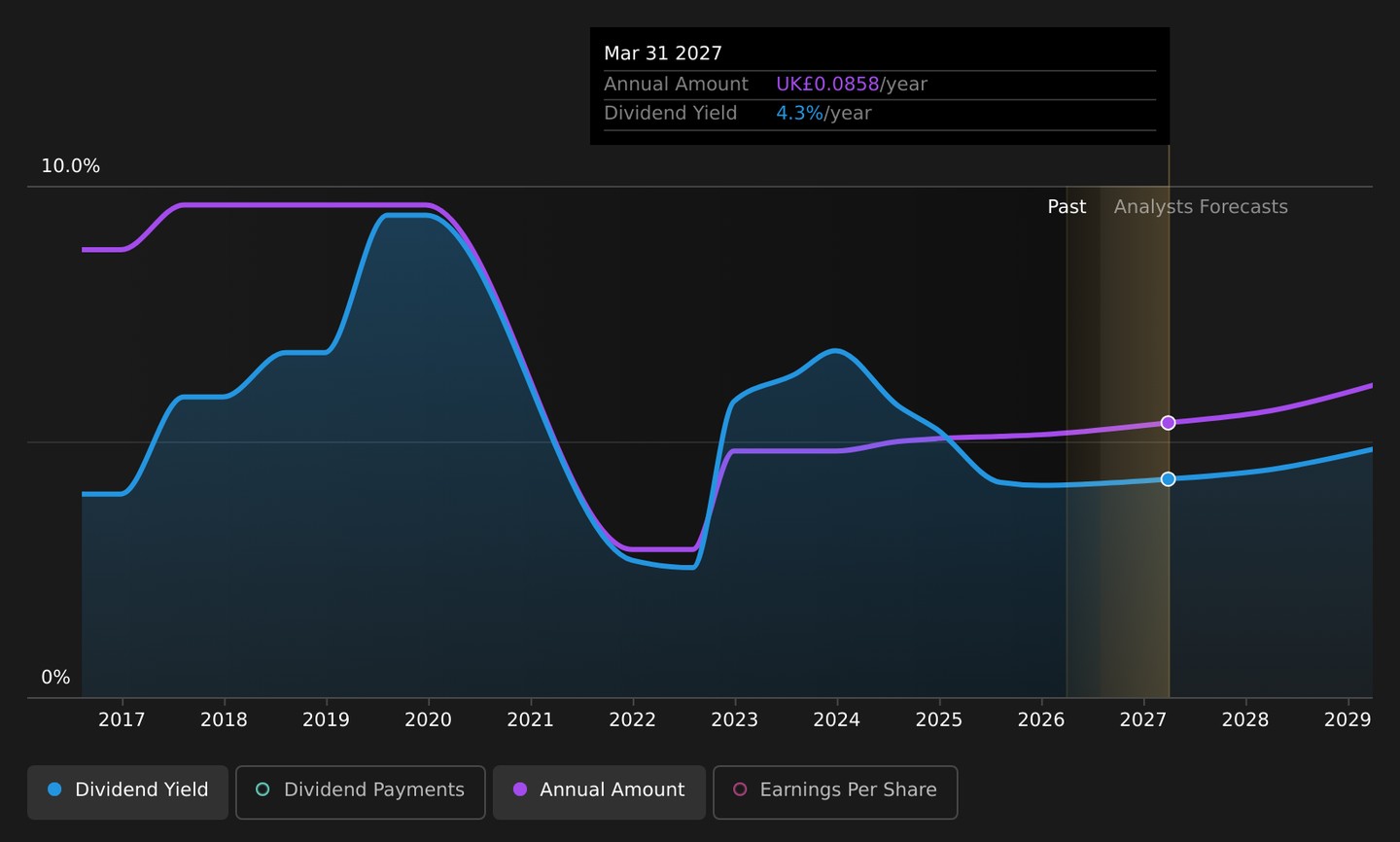
Have Earnings And Dividends Been Growing?
Companies with falling earnings are riskier for dividend shareholders. If earnings fall far enough, the company could be forced to cut its dividend. BT Group's earnings per share have fallen at approximately 6.0% a year over the previous five years. Ultimately, when earnings per share decline, the size of the pie from which dividends can be paid, shrinks.
Many investors will assess a company's dividend performance by evaluating how much the dividend payments have changed over time. BT Group has seen its dividend decline 5.1% per annum on average over the past 10 years, which is not great to see. It's never nice to see earnings and dividends falling, but at least management has cut the dividend rather than potentially risk the company's health in an attempt to maintain it.
The Bottom Line
Should investors buy BT Group for the upcoming dividend? We're not enthused by the declining earnings per share, although at least the company's payout ratio is within a reasonable range, meaning it may not be at imminent risk of a dividend cut. To summarise, BT Group looks okay on this analysis, although it doesn't appear a stand-out opportunity.
With that being said, if dividends aren't your biggest concern with BT Group, you should know about the other risks facing this business. In terms of investment risks, we've identified 3 warning signs with BT Group and understanding them should be part of your investment process.
A common investing mistake is buying the first interesting stock you see. Here you can find a full list of high-yield dividend stocks.
Valuation is complex, but we're here to simplify it.
Discover if BT Group might be undervalued or overvalued with our detailed analysis, featuring fair value estimates, potential risks, dividends, insider trades, and its financial condition.
Access Free Analysis