
 I'm LongbridgeAI, I can summarize articles.
OpenAI is preparing a new multi-agent model, Astra, which has unprecedentedly solved ten top-tier mathematical problems that had remained unsolved for over a decade, using only $2,000 in computing power. The model is currently being demonstrated in Washington and is poised to face the first major tests under the Trump administration's new AI regulatory framework
OpenAI is preparing to launch a new model family named "Astra," whose core capability lies in driving multiple AI agents to collaborate over extended periods to solve highly complex problems. This progress marks a substantive step for the company on its path toward artificial general intelligence (AGI) and will also serve as one of the first test cases for the implementation of the Trump administration's new AI regulatory framework.
Tech media outlet The Information, citing three individuals familiar with the matter, reported that OpenAI CEO Sam Altman personally traveled to Washington, D.C., this week to demonstrate the Astra model to policymakers and regulators. OpenAI highlighted the model's ability to enable multiple agents to work collaboratively and handle complex tasks over long durations, with application scenarios ranging from project management to solving advanced mathematical problems.
Meanwhile, OpenAI released a report (click here to download the report), detailing how its most advanced AI successfully solved ten mathematical problems that had previously remained unsolved. These problems span multiple frontier fields, including high-dimensional geometry, coding theory, group theory, quantum complexity, and extremal combinatorics. Each problem had been academically stagnant for over a decade, yet the total computing cost to solve all of them was only approximately $2,000.
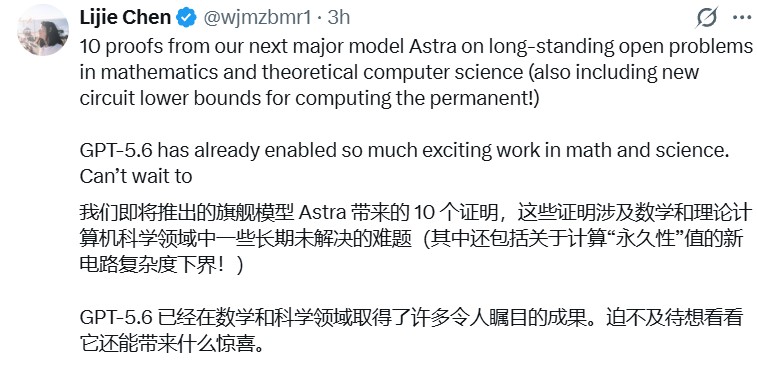
Lijie Chen, a graduate of Tsinghua University's Yao Class who joined OpenAI in January this year, confirmed on social media today that these ten proofs were generated by its flagship model, Astra.
Astra Positioning: A New Model Family with Undetermined Release Date
According to the aforementioned sources, Astra will exist as an independent model category, alongside OpenAI's existing Sol, Terra, and Luna models. It remains unclear when OpenAI plans to officially release Astra, and the company has not yet decided whether the model will be labeled as GPT-6 or as a sub-version within the GPT-5 series (such as GPT-5.7).
Although the relevant models have entered the testing phase, their official release schedule will be constrained by external factors. According to one source, the Astra series of models is expected to be among the first products subject to review under the Trump administration's new AI framework. This framework requires AI companies to file with the federal government before releasing models to the public. The Trump administration has set the final deadline for this framework for this weekend.
Ten Mathematical Breakthroughs: AI Systematically Conquers Frontier Unsolved Problems for the First Time
The report published by OpenAI shows that the Astra model achieved ten major breakthroughs in mathematics and theoretical computer science. These include establishing upper bounds for high-dimensional sphere packing density, improving bounds for binary and spherical codes, proving the existence of non-pure Sophie groups, disproving Connes' rigidity conjecture, establishing new lower bounds for arithmetic circuit complexity, proving the quantum parallel repetition theorem, demonstrating the polynomial factor approximation hardness of the closest vector problem, addressing the Ehrhart volume conjecture, establishing super-exponential lower bounds for multicolor Ramsey numbers, and tackling the extremal number conjecture. Several of these results directly solved classic open problems left by mathematician Paul Erdős.
In terms of research workflow, the Astra model is responsible for generating mathematical arguments. Human researchers use the same model to assist in organizing draft papers, after which the arguments are converted into Lean code for formal verification. OpenAI emphasized that all mathematical arguments in the aforementioned ten breakthroughs were generated by the AI system. The role of humans was to assist in preparing manuscripts, completing formal verification, and taking responsibility for the correctness of the final results.
Academic Impact and Attribution Controversy
This is not the first time OpenAI has achieved breakthrough results in the field of mathematics. In May of this year, while evaluating an unreleased model, OpenAI had AI successfully disprove the Erdős unit distance conjecture, after which the academic community followed up with several related papers.
As AI systems play an increasingly central role in scientific research, the issue of attribution has drawn attention. OpenAI stated that it respects and understands the concerns of the signatories of the Leiden Manifesto on AI and Mathematics, clearly pointing out that labeling proofs generated entirely by AI as human works distorts the contribution of AI systems and blurs the essential boundaries of human intellectual work.
Notably, OpenAI recently launched a specialized ChatGPT program for academic researchers, providing free access to its most powerful models for 100,000 scientists and mathematicians, and continuously using open research questions as benchmarks during the model development process.