South Korea Memory Survey: Samsung's Long-Term Agreements "Cap Declines, Not Gains"; Spot Prices Continue to Rebound Ahead of Q4 Peak Season
 Complete. Here is the key summary
A survey by Bank of America Merrill Lynch shows that Samsung Electronics has included 60%-70% of its memory sales in long-term agreements (LTAs), with terms clearly favoring the supply side: price cuts are limited (no more than 5% per quarter), while there is virtually no cap on price increases. Against the backdrop of surging AI computing demand and constrained capacity expansion, Samsung is using LTAs to lock in major customers while retaining pricing flexibility. DRAM and NAND spot prices continue to rebound ahead of the Q4 peak season, with AI capital expenditure and restocking cycles jointly supporting higher memory prices
AI server demand continues to grow, sustaining the upward trend in memory prices and significantly enhancing the pricing power of leading memory manufacturers.
According to a research report released by Bank of America Merrill Lynch on August 1, Samsung Electronics has incorporated 60% to 70% of its memory sales into a Long-Term Agreement (LTA) system. The contract terms clearly favor the supply side: price declines are capped, while upside potential is virtually unlimited. With AI computing infrastructure driving growth in high-end memory demand and supply expansion still constrained, Samsung is using long-term agreements to secure demand from major customers while retaining flexibility for price increases.
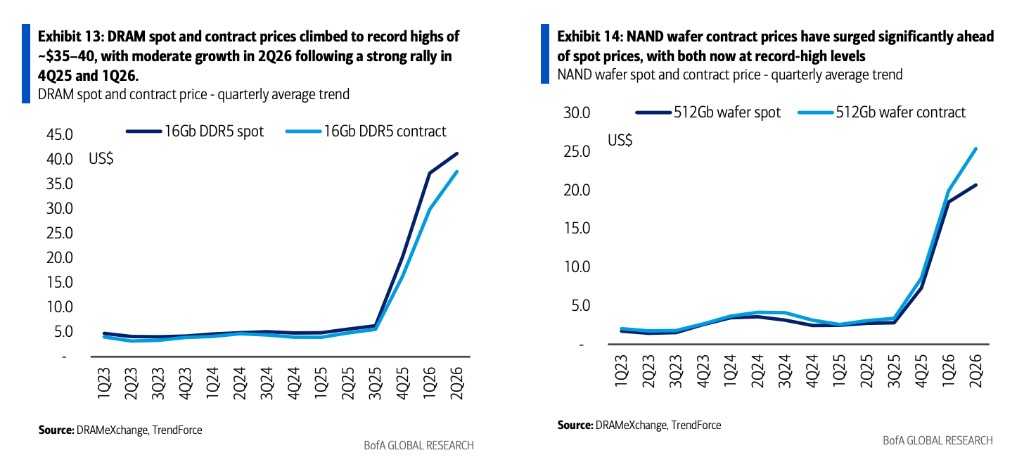
The report forecasts that DRAM and NAND spot prices will continue to rebound ahead of the peak season in the fourth quarter. Data from TrendForce shows that DRAM contract prices rose about 10% month-over-month in July, with quarterly percentage gains reaching 30% to 50%; server DRAM prices continue to hit record highs. The report believes that growth in AI server demand, customer restocking, and preparations for new end-product launches will continue to support rising memory prices.
Samsung Increases LTA Share to Lock in Long-Term AI Customer Demand
Currently, about 60% to 70% of Samsung Electronics' memory sales are conducted through LTAs, with the contract structure clearly favoring the supply side.
According to the Bank of America Merrill Lynch survey, Samsung's LTA terms limit the magnitude of price reductions, with quarterly cuts typically not exceeding 5%; however, price increases can reach 10% to 20% or even higher, with no clear upper limit set.
Notably, the LTAs signed by Samsung with large US technology companies mainly adopt a five-year rolling model, where the next cycle can be renewed around the time the first year's contract expires, forming a long-term binding relationship.
The report believes that this model enhances the revenue certainty of Samsung's memory business while preserving its pricing flexibility during periods of tight supply and demand. As demand for AI servers continues to grow, memory manufacturers are locking in demand through long-term agreements while strengthening their price control capabilities.
DRAM and NAND Prices Rise Together, with AI and Restocking Demand Driving August Market Performance
The memory spot market has remained strong recently.
According to data from DRAMeXchange, as of the report's release, the Spot Price for 16Gb DDR5 reached $51, up 733% year-over-year; the Spot Price for 16Gb DDR4 reached $85.2, up 896% year-over-year; and the price for 8Gb DDR4 reached $42.1, up 722% year-over-year. On the NAND side, the Spot Price for 1Tb wafers was quoted at $26.4, up 3% week-over-week and 415% year-over-year.
The report believes that the factors supporting further memory price increases in August mainly include three aspects: First, downstream customer orders are increasing, and restocking demand is strengthening; second, despite rising memory costs, many OEMs still plan to proceed with new product launches in September and the fourth quarter, driving procurement demand; third, end-user inventory levels have dropped significantly, and the channel restocking cycle is underway.
Furthermore, supply in the spot market remains tight. As it takes time for memory manufacturers to ramp up capacity, new market supply cannot quickly match the growing demand from AI servers, high-end PCs, and smart devices.
In the server DRAM segment, the contract price for 64GB DDR5 memory modules has exceeded $1,480, and the contract price for DDR4 modules has reached $1,300, both hitting record highs. Client SSD prices have doubled compared to the end of 2025, whereas the total increase for the full year of 2025 was only about 35% to 40%.
Hyperscale Cloud Providers Continue to Boost AI Investment, Providing Long-Term Support for Memory Demand
The core driver behind rising memory prices remains the wave of investment in AI infrastructure.
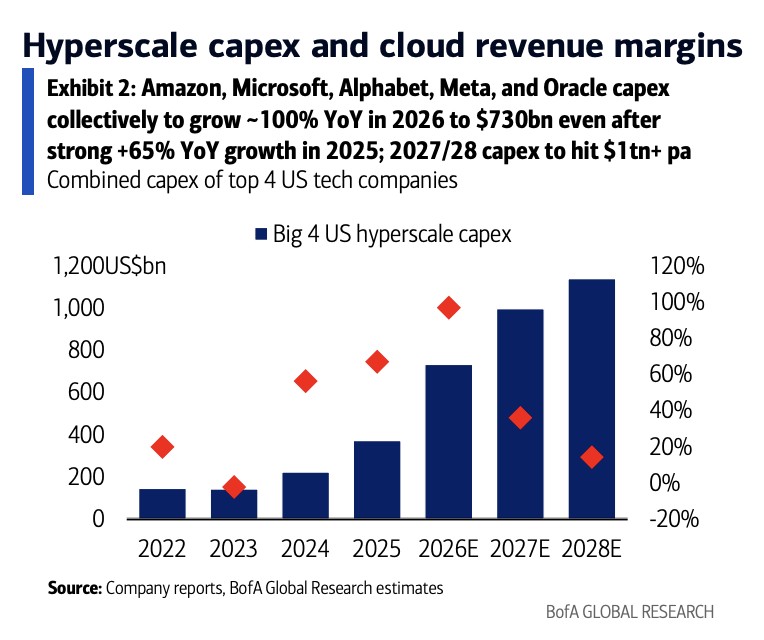
Data from Bank of America Merrill Lynch shows that the combined capital expenditure of the five major hyperscale cloud providers—Amazon, Microsoft, Alphabet, Meta, and Oracle—is expected to reach $730 billion in 2026, a year-over-year increase of approximately 100%; from 2027 to 2028, related capital expenditure is expected to exceed $1 trillion annually.
Meanwhile, AWS, Azure, and Google Cloud are expected to maintain revenue growth of 35% to 45% in the coming years, continuing to support investment in AI computing infrastructure.
Although some cloud providers may face temporary free cash flow pressures between 2026 and 2027, Bank of America Merrill Lynch believes that this reflects the tech giants' long-term commitment to AI infrastructure construction and will continue to drive demand across the memory, advanced packaging, and server supply chains.
As the AI capital expenditure cycle continues to advance, this round of the memory upcycle is supported by the triple factors of AI computing power, long-term supply agreements, and persistently tight supply and demand.