
 I'm LongbridgeAI, I can summarize articles.
Deleveraging in South Korea's memory sector has triggered a repricing of risks across the global computing power chain. However, CSC points out that this is not a reversal in AI demand, but rather a market reassessment of the sustainability of price hikes and high profit margins. The Chairman of SK stated that AI semiconductor prices are at "abnormally high levels." The three major manufacturers are increasing long-term contracts, expanding production, and pursuing localization, shifting from "supply discipline" to "stabilizing prices and expanding volume." In the second half of the year, the logic for computing power is being rearranged: the slope of price increases is marginally slowing, while the pricing weight of order fulfillment and capacity release is rising
In the first half of the year, the main theme of the computing power industry chain was price increases. HBM squeezed advanced DRAM capacity, tightening memory supply and demand. Price rises spread from memory to copper-clad laminates (CCL), electronic cloth, and passive components... releasing the profit elasticity of the entire industry chain.
But entering July, this logic faced a stress test.
The South Korean memory sector bore the brunt first, with adjustments spreading outward along the industry chain. In a research report released on July 31, Huang Wentao, Chief Economist at CSC Securities, and Strategy Analyst He Sheng pointed out that this adjustment was "not a comprehensive reversal of the AI demand logic, but a structural risk release starting from the South Korean memory sector."
So, has the core logic of computing power actually changed? The analysts wrote:
As price-sensitive assets such as memory undergo deleveraging and risk repricing, the market is beginning to re-evaluate the slope of price increases and the sustainability of high profit margins. We believe that the second half of 2026 will not see a complete switch from price hikes to volume expansion; rather, price increases will persist, though the slope may marginally slow down, and market pricing will gradually increase its focus on orders, capacity, and delivery fulfillment.
Six Months of Price Hikes: From Memory to the Entire Industry Chain
How high was the prosperity of the computing power industry chain in the first half of 2026? Let's look at the demand side first.
According to company financial reports, the combined capital expenditures of four cloud providers—Meta, Alphabet, Amazon, and Microsoft—reached $130.6 billion in Q1 2026, a year-on-year increase of approximately 84%, significantly higher than the growth rates in each quarter of 2025. Over two years, the quarterly capital expenditure scale of these four cloud providers grew by about 180%.
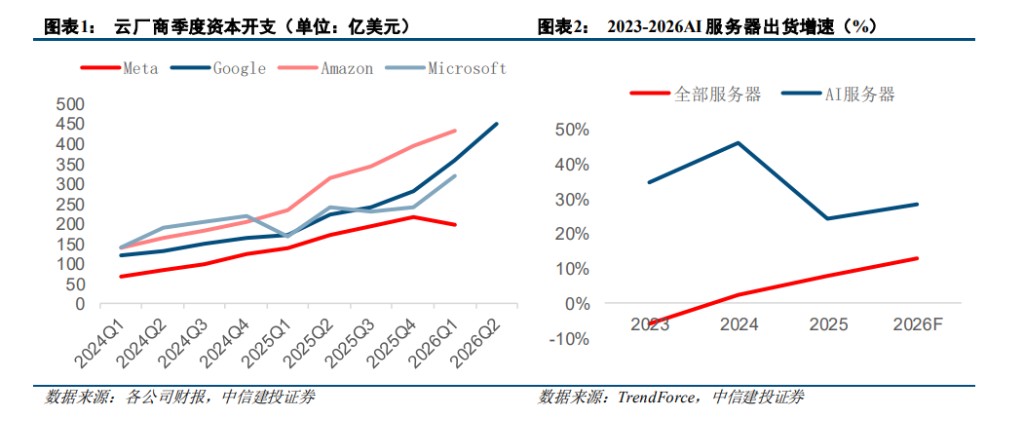
More notably, cloud providers continue to revise their full-year plans upward. Alphabet gradually raised its 2026 capital expenditure guidance from $175–185 billion at the beginning of the year to $195–205 billion; Meta raised the midpoint of its guidance by 8% to $125–145 billion. Based on the latest midpoints, the total for the four companies is approximately $725 billion, an increase of about $30 billion from the beginning of the year.

Demand was strong, but structural bottlenecks emerged on the supply side.
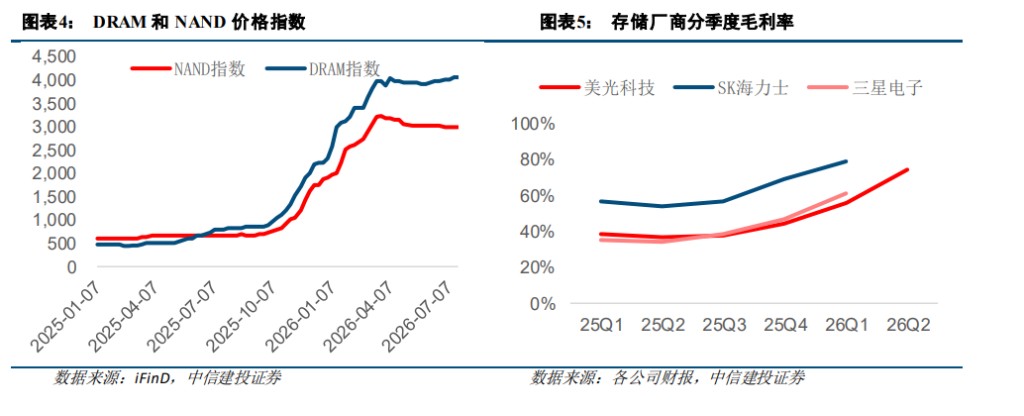
Rapid growth in HBM demand led memory manufacturers to allocate more advanced process capacity to HBM and server memory, squeezing the effective supply of standard DRAM and NAND. Amid tightening supply and demand, prices accelerated upward.
Profitability data directly illustrates the issue: From Q1 2025 to Q1 2026, Micron Technology's gross margin rose from 38.44% to 56.04%, SK Hynix from 57% to 79%, and Samsung Electronics from 35.5% to 61.2%. Micron's gross margin further rose to 74.41% in Q2 2026.
Price hikes subsequently spread to upstream materials. Kingboard Laminates implemented multiple rounds of price increases from December 2025 to July 2026, with single increases ranging from 10% to 20%; Resonac raised prices for high-end CCL and adhesive films by over 30%; some of Taeyoung's CCL products saw price increases of 20%–40%. The price of standard 7628 electronic cloth rose by about 54% compared to the fourth quarter of 2025. In March 2026, the import price of CCL in South Korea reached $20,728 per ton, a year-on-year increase of 74.5%.

These price increases have genuinely translated into performance. In Q1 2026, WUS Printed Circuit's revenue increased by 53.91% year-on-year, Shennan Circuits by 37.90%, and TTM Technologies by 30.42%; the gross margin of packaging substrate company Nanya Technology rose from 5.09% in Q1 2025 to 15.85%.

Deleveraging Shock: Triggers and Transmission Paths
In July, the South Korean memory sector began to fluctuate violently. SK Hynix fell 47.13% for the month, Samsung Electronics dropped 37.57%, Murata Manufacturing fell 46.44%, Taiyo Yuden dropped 56.11%, and Kingboard Laminates plummeted by 65.97%.

Why did South Korea erupt first?
CSC's research report pointed out that "South Korean individual investors not only bought stocks through credit loans and broker financing but also widely participated in leveraged ETFs for individual stocks such as Samsung Electronics and SK Hynix, forming a leveraged structure where 'off-exchange borrowing—margin trading—leveraged products' overlapped."
The danger of this structure lies in the fact that the combined weight of SK Hynix and Samsung Electronics in the KOSPI climbed from about one-third in early March 2026 to about 60% on June 29, hitting a record high. Moreover, the two companies contributed about 70% of the KOSPI's gains in 2026 (according to The Wall Street Journal). The higher the weight, the more passive selling is triggered during declines, creating a stronger negative feedback loop.

The adjustment transmitted along two layers: The first layer was within the memory industry chain, where South Korean leaders drove synchronous adjustments in memory-related assets in the US, Japan, and China; the second layer spread to upstream computing power sectors with significant prior gains and concentrated holdings, such as optical modules, PCBs, and semiconductor equipment. Mid-to-downstream technology and internet platform companies remained relatively stable.
CSC's judgment is: "Valuation and leverage clearing constituted the direct cause of this round of adjustment, while South Korea's unique holding and trading structure significantly amplified market volatility."
However, deleveraging was merely the trigger; more deeply, the market began to reprice the sustainability of price hikes. The analysts pointed out that "the market no longer simply extrapolates continuous upward trends in product prices and profitability, but focuses more on whether price increases can continue after supply is released, and whether high profit margins can be maintained."
Strategic Shifts by Memory Manufacturers
Just as the market debated whether price hikes could continue, management at memory manufacturers began to actively voice their positions.
This is a key signal.
Citing a report from The Kyunghyang Shinmun, CSC noted that SK Group Chairman Chey Tae-won explicitly stated that current AI semiconductor prices are at "abnormally high levels," and that continued price increases could trigger "chip inflation" and compress downstream markets. "Therefore, even if it means lowering profit margins, it is necessary to stabilize prices by expanding production scale and increasing supply."
What does this statement imply? The operational goals of memory manufacturers are shifting from "emphasizing supply discipline and short-term profit margins" to "stabilizing prices, signing long-term contracts, expanding capacity, and boosting long-term sales volume."
Actions are following suit. SK Hynix has established a multi-year cooperation with NVIDIA covering joint development and supply support for next-generation AI memory. The SK Group signed a letter of intent with NVIDIA for over $500 billion in AI infrastructure cooperation, including long-term AI memory supply; Samsung reached a five-year cooperation framework with Broadcom covering memory, foundry, and advanced packaging; and Micron had signed 16 strategic customer agreements by FY2026 Q3, most adopting binding take-or-pay mechanisms.

Capital expenditures were simultaneously raised: SK Hynix stated that its 2026 investment scale would grow significantly compared to the previous year and plans to double wafer capacity over the next five years; Micron continuously raised its FY2026 capital expenditure from an initial ~$18 billion to ~$27 billion.
However, new capacity release takes time. The construction of wafer fabs and advanced packaging lines involves equipment delivery, customer validation, yield improvement, and capacity ramp-up. The research report judges that "the second half of the year is more likely to present a combination of 'prices still supported, slowing slope of price increases, and gradual production expansion,'" rather than a rapid loosening of supply or a quick drop in prices in the short term.
Second Half of the Year: Logic Rearrangement, What to Focus On
CSC believes that the second half of 2026 does not mean the "disappearance of the price hike logic," but rather a "rebalancing of the relative weights between price elasticity and volume realization."
Specifically, there are two volume expansion paths worth close attention:
First: Marginal relief in procurement pressure for cloud providers. If the slope of price increases for key components like memory slows down, the same capital expenditure can buy more GPUs, servers, network equipment, and supporting infrastructure. Beneficiaries include GPUs and AI ASICs, high-speed optical modules, AI switches, high-end PCBs, as well as power and liquid cooling systems—these segments' revenue growth relies more on project construction and product delivery than on price elasticity.
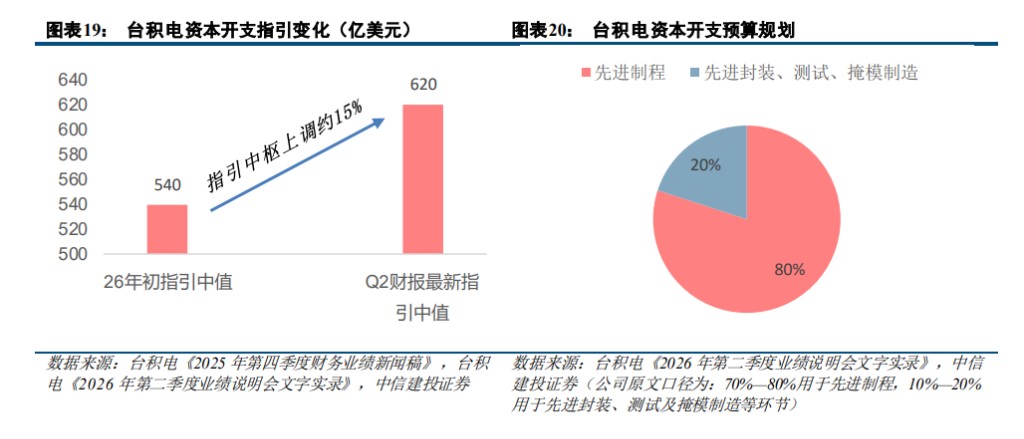
Second: Upstream supplier expansion driving demand for equipment and materials. TSMC raised the midpoint of its 2026 capital expenditure guidance from $54 billion to $62 billion, with 80% allocated to advanced processes and 20% to advanced packaging, testing, and mask manufacturing. Expansion by foundries, HBM, and advanced packaging manufacturers will directly drive demand for semiconductor equipment, components, and materials.
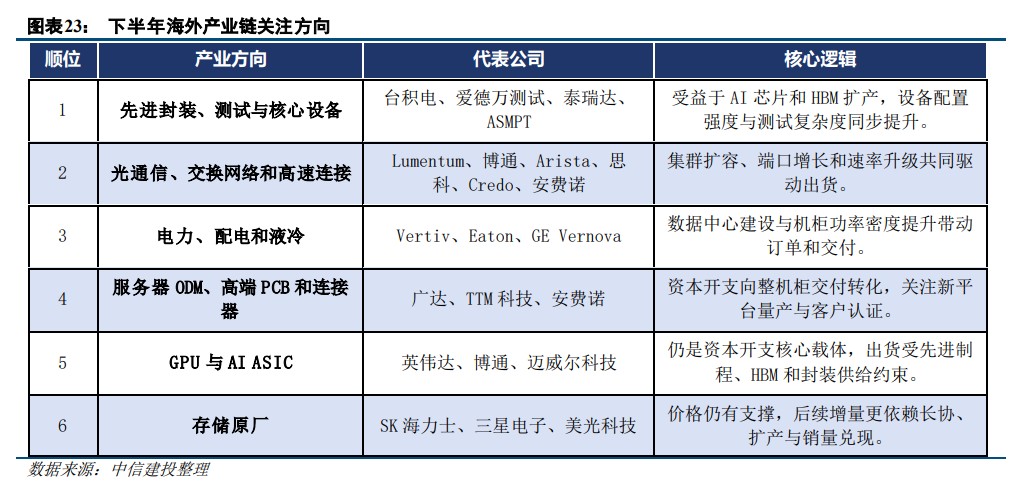
Overseas Allocation Order: CSC's priority list is—Advanced packaging, testing, and core equipment (TSMC, Advantest, Teradyne) → Optical communication, switching networks, and high-speed connectivity (Lumentum, Broadcom, Arista) → Power, distribution, and liquid cooling (Vertiv, GE Vernova) → Server ODMs, high-end PCBs, and connectors → GPUs and AI ASICs → Original memory manufacturers.
Two Main Domestic Lines: One is optical modules, high-end PCBs, and high-speed copper connections (Zhongji Innolight, WUS Printed Circuit, Shennan Circuits) that have entered the global AI supply chain, directly undertaking demand from overseas cloud providers; the other is domestic semiconductor equipment (AMEC, Changchuan Technology), benefiting from the expansion of domestic wafer manufacturing, memory, and advanced packaging, coupled with an increase in domestic market share.

For purely price-driven sectors such as standard CCL, MLCC, and memory modules, analysts warn that "previous gains largely came from price and inventory elasticity, and subsequent performance still needs to verify real demand absorption and profit sustainability," suggesting a lower priority for these sectors.