Earnings Preview | The battle between the AI chip duopoly escalates! AMD (AMD.US) earnings report will test the strength of NVIDIA's "challenger"
 I'm LongbridgeAI, I can summarize articles.
AMD will release its Q2 financial report after the market closes on August 4, with market expectations of revenue of $11.32 billion and earnings per share of $1.61. As a major challenger to NVIDIA, its data center business and AI chip performance will test the health of global AI computing power demand. If the results exceed expectations, it may boost the semiconductor sector; conversely, it could intensify concerns about the return on AI capital expenditures
According to the Zhitong Finance APP, AMD (AMD.US) will announce its second-quarter earnings report after the U.S. stock market closes on August 4 (Tuesday). Against the backdrop of technology giants increasing their investments in AI infrastructure, the market is closely watching whether AMD can continue to secure AI chip orders and further narrow the gap with industry leaders. As a core challenger to NVIDIA's computing power, AMD's earnings report will also serve as a key barometer for the market's assessment of the sustainability of global AI computing power demand.
The market generally expects AMD's second-quarter revenue to be $11.32 billion, a year-on-year increase of 47.3%; earnings per share are expected to be $1.61, a year-on-year increase of 235.42%.
Data from Zacks shows that AMD's earnings have exceeded market expectations in the past four quarters, averaging 6.5% higher than market expectations.
AMD's stock price has doubled this year, driven primarily by explosive growth in its data center business; however, affected by an overall pullback in the AI sector, the stock has retreated nearly 19% from its June peak. According to recent option prices, traders are betting on a price fluctuation of up to 10% for AMD this week.
If AI chip revenue and guidance for the second half of the year exceed market expectations, AMD's earnings report could boost the entire semiconductor sector; if order growth, product delivery, or gross margin performance falls short of expectations, it may exacerbate investors' concerns about the return on AI capital expenditures.
What are the highlights of AMD's Q2 earnings report?
Data center business remains the core growth driver
The market generally expects that the data center business will remain the core growth driver for AMD's Q2 performance. Strong demand for EPYC server CPUs and Instinct AI accelerators is expected to drive revenue growth for AMD. The robust demand for AI inference, accelerated enterprise AI implementation, and the continued investment in AI infrastructure by major cloud providers are expected to boost Instinct GPU shipments. Meanwhile, the widespread adoption of the fifth-generation EPYC processors in hyperscale data centers and enterprise customers is expected to support revenue from server CPUs.
It is noteworthy that the market attention on AMD's next-generation hardware products continues to rise. AMD CEO Lisa Su recently stated that customer demand for MI450 and Helios is overall higher than initially expected, even exceeding the company's internal plans set for 2027. The phenomenon of customers queuing to deploy shows strong market interest in its platform.
According to AMD's forecast, by 2030, the AI accelerator market size will reach $1.4 trillion, the data center CPU market size will reach $220 billion, and the overall computing market size will reach $2 trillion. The core logic behind this judgment is that the demand for AI infrastructure is no longer limited to training large models. As inference and intelligent agent AI bring new computing demands, AMD expects further acceleration in server business growth.
The joys and worries of deeply binding AI giant customers
An important incremental contribution to AMD's performance in Q2 comes from the large-scale procurement by leading global cloud providers. Mainstream cloud platforms such as AWS, Microsoft Azure, and Google Cloud continue to deploy EPYC processors, and collaborations with Meta, Samsung, Tata Consultancy Services, NAVER Cloud, and Upstage are expected to drive growth in AMD's AI infrastructure revenue Among them, Meta has clearly stated its plan to deploy AMD Instinct GPUs and adopt the next-generation EPYC processors. Coupled with the continuous implementation of global sovereign AI projects and AMD's excellent performance in MLPerf benchmark tests, this has further boosted industry customer confidence and helped AMD secure more orders.
From a positive perspective, a deep binding with leading AI giants is the most core support for AMD's medium to long-term computing power business growth. Last year, AMD finalized a significant strategic partnership, binding OpenAI through a multi-billion dollar warrant cooperation in exchange for large-scale procurement of its MI350X chips. OpenAI's latest operational data further strengthens optimistic expectations. OpenAI recently disclosed that its annualized revenue in July has exceeded the total for the second quarter.
On the risk side, the iteration of open-source models is quietly changing the logic of industry computing power demand. The market is concerned that the rapid iteration and popularization of open-source models will impact the pricing and customer base of closed-source vendors like OpenAI and Anthropic. More critically, open-source models are lightweight and highly efficient, significantly reducing the GPU computing power required to complete equivalent AI tasks, which may substantially lower the overall computing power procurement demand in the industry. The continuous loss of customers by closed-source vendors, combined with a significant shrinkage in model computing power demand, will directly compress the market space for AMD's AI chips in the long term, weakening the high growth logic.
PC and Embedded Business Expected to Perform Steadily
In addition to the high-demand data center business, AMD's traditional business segments are expected to perform steadily.
Among them, the client business is expected to benefit from stable demand for Ryzen processors and the continuous increase in AI PC industry penetration. The upgrade and iteration of enterprise devices, the large-scale rollout of commercial Ryzen AI PRO processors, and the intensive launch of Copilot+ AI PC new products are expected to boost AMD's desktop and laptop processor shipments.
At the same time, AMD's market share in the high-end consumer PC market continues to expand, with strong demand for high-end Ryzen X3D processors aimed at gaming and creative design scenarios, which also helps drive overall revenue growth in the second quarter.
Additionally, as demand in industrial automation and edge AI scenarios continues to improve, AMD's embedded business revenue may remain stable.
Industry Competition Continues to Heat Up, Restricting Revenue Growth and Gross Margin Recovery
Currently, AMD faces fierce competition from NVIDIA, Broadcom, and Intel in its core track.
In the AI accelerator field, NVIDIA dominates with an absolute market share of up to 80% thanks to its CUDA ecosystem, but AMD is becoming an unignorable challenger through full-stack solutions, cost-effective hardware, and breakthroughs with key large customers.
Notably, on July 23, AMD announced a series of new products at the Advancing AI conference, attempting to challenge NVIDIA comprehensively through a "full-stack" product layout from chips to complete systems.
AMD claims that its Helios platform, based on the new generation MI450 series accelerators, can outperform NVIDIA's next-generation Vera Rubin platform in some key metrics; the performance of the new generation EPYC "Venice" server CPU is about 20% higher than NVIDIA's competing products AMD also stated that Helios is "in full production," and "customer demand for Helios is extremely strong," with shipments expected to begin at the end of the third quarter. Server systems based on Venice are anticipated to be shipped gradually in the fourth quarter of this year.
In addition, Intel is actively competing for server market share through its continuously expanding Xeon processor product line, wafer foundry business, and advanced packaging technology. Broadcom continues to deepen its presence in the hyperscale cloud customer market, consolidating its competitive advantages in custom AI accelerators and high-performance networking equipment, further squeezing AMD's market space.
The intensifying industry competition may impact AMD's revenue growth and profit margin expansion prospects in the second quarter of 2026.
Wall Street Analysts Bullish Before Earnings
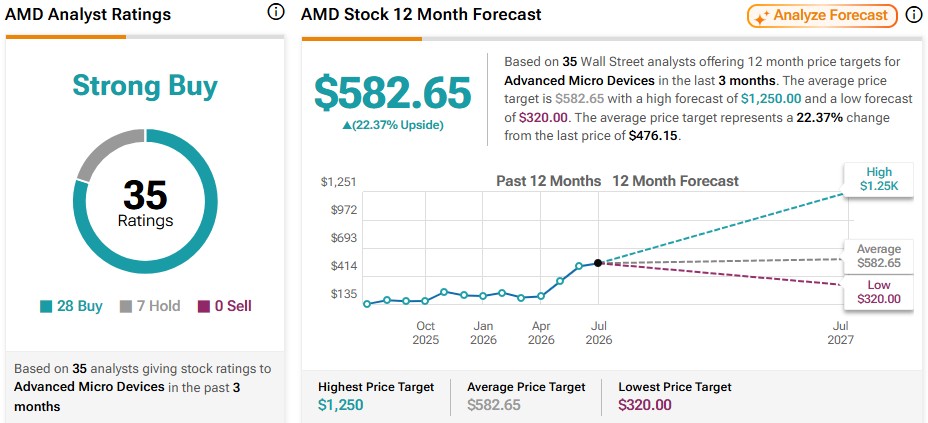
Wall Street analysts are generally optimistic about AMD. Among the 35 analysts tracked by Tipranks, 28 recommend buying AMD, 7 give a "neutral" rating, with a consensus rating of "strong buy" and an average target price of $582.65, which is 22% higher than last Friday's closing price.
The iterative upgrade of AMD's next-generation AI hardware products is the core logic behind analysts' optimism for the company's future growth and is also a key observation direction for this earnings report.
AMD launched a series of new products at the "Advancing AI" event held in July. Subsequently, analysts from UBS and Bank of America raised AMD's target prices from $700 and $560 to $730 and $620, respectively. William Blair analysts stated after the event that AMD "is now actively taking action to capture market share, and with a robust product roadmap and emphasis on open standards, it is expected to win a large number of orders from hyperscale data centers and AI lab customers."