
On the Eve of Its First Earnings Report, Deutsche Bank Backs SpaceX: Zero Valuation for AI Business Is an "Excessive Penalty"
 I'm LongbridgeAI, I can summarize articles.
Deutsche Bank maintains its "Buy" rating and $255 price target for SpaceX. Despite share prices halving due to lock-up expiration selling pressure and controversies over AI prospects, SOTP stress tests indicate that its space and Starlink businesses alone can support the current $1.4 trillion market capitalization, suggesting the market's "zero pricing" of the AI business is an excessive penalty. Q2 revenue is expected to reach $6.671 billion, with surging AI-related income and user growth emerging as core highlights
SpaceX is set to release its first earnings report since going public. Although its stock price has fallen significantly from its highs, major Wall Street institutions continue to support its long-term investment thesis.
According to Zhuifeng Trading Desk, Deutsche Bank issued an updated report on the eve of the earnings release, maintaining its "Buy" rating and $255 price target for SpaceX. The report pointed out that recent pressure on the stock price mainly stems from expectations surrounding the IPO lock-up expiration, uncertainty regarding the prospects of the AI business, the complexity of a potential merger with Tesla, and passive index buying falling short of expectations. As of August 3, SpaceX shares were trading at $115, nearly half of their 52-week high of $201.80.
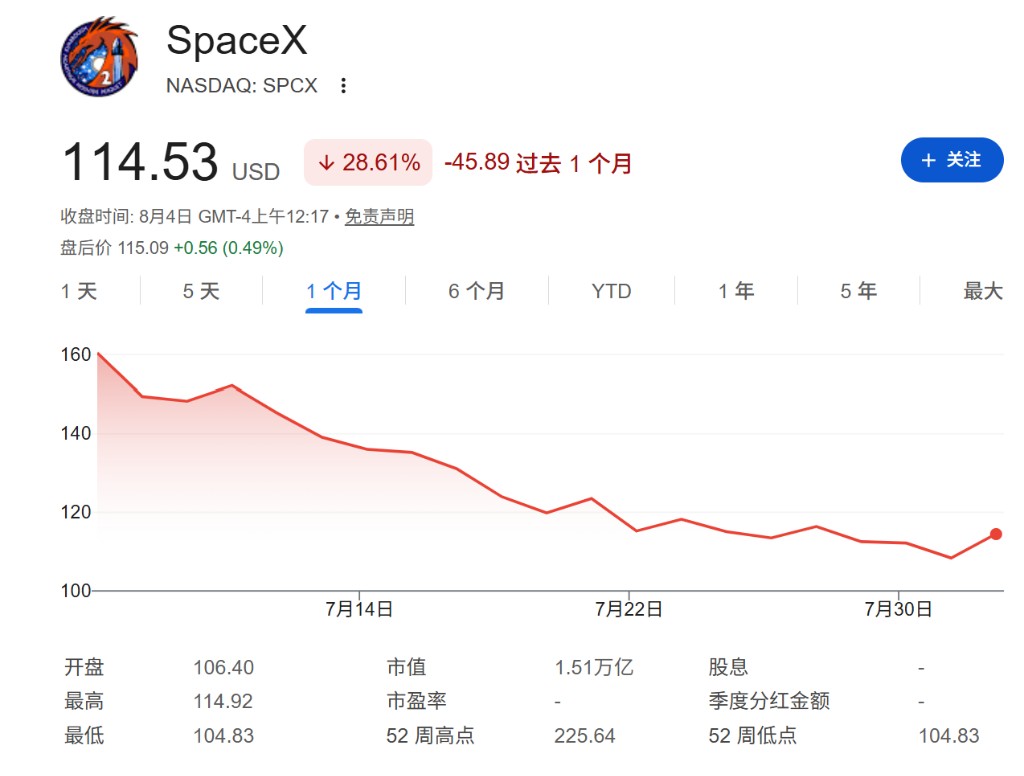
Through a Sum-of-the-Parts (SOTP) stress test, Deutsche Bank noted that at the current market capitalization of approximately $1.4 trillion, the space and connectivity businesses basically cover the entire stock price, implying that the market has assigned a value close to zero to the AI business—a situation Deutsche Bank considers "excessively punitive."
Meanwhile, JPMorgan had previously initiated coverage with an "Overweight" rating and a $225 price target, predicting that SpaceX's revenue will achieve a compound annual growth rate (CAGR) of 91% from 2025 to 2030, expanding from $19 billion to $470 billion.
Q2 Performance Expectations: AI Business Becomes the Largest Growth Driver
Deutsche Bank expects SpaceX's Q2 revenue to reach $6.671 billion, a year-on-year increase of 64%, with a gross margin of approximately 58% and adjusted EBITDA exceeding $2.1 billion.
The AI segment is the most significant source of incremental growth this quarter. Deutsche Bank expects AI business revenue to more than double quarter-over-quarter, reaching $1.876 billion, primarily benefiting from partial quarterly contributions from a new cloud services agreement signed with Anthropic. In comparison, the consensus market expectation for AI segment revenue is approximately $2.084 billion.
The connectivity business also maintains strong momentum. Deutsche Bank forecasts broadband subscribers will reach 12.5 million by the end of the quarter (up from 10.3 million in Q1), while Average Revenue Per User (ARPU) will decrease slightly by $3 to $63 compared to the previous quarter, driving connectivity business revenue to grow over 50% year-on-year, approaching $4 billion.
In terms of the space business, there were 9 external Falcon 9 commercial launches in Q2, more than the 7 in Q1 but fewer than the 11 in the same period last year. Regarding capital expenditures, Deutsche Bank estimates approximately $17 billion, mainly used for AI computing power expansion, increasing capacity to 1.3–1.4 gigawatts, with net free cash flow consumption expected to exceed $10 billion.
Key Focus Areas for the Earnings Report: Launch Cadence, Mobile Network, and AI Progress
Deutsche Bank outlined four key areas of investor focus for the earnings conference call.
Launch and Starship Progress: Following progress in Starship's 13th test flight, the market will focus on the timeline for subsequent launches, particularly whether tower catch recovery of the second-stage spacecraft can be achieved.
Connectivity Business: Beyond subscriber numbers and ARPU trends, management's latest statements on the roadmap for the U.S. ground mobile network are drawing significant attention—specifically, whether they will choose self-construction, Mobile Virtual Network Operator (MVNO) models, or acquisition.
AI Business: Several variables exist, including the accelerated iteration of the Grok model and the competitive pressure it faces from open-source alternatives, the integration of the Cursor acquisition, and developments in new cloud services (Google reportedly views SpaceX's computing capacity only as a transitional bridge during constrained periods, while the U.S. government is reportedly negotiating cooperation agreements). Deutsche Bank expects SpaceX's computing capacity to approach 2 gigawatts by the end of the year.
Tesla Merger: When asked about this matter during Tesla's earnings call, Musk stated that as cooperation between the two companies deepens on multiple levels, especially with the large scale of the Terafab project, business overlap is increasing; however, he emphasized that matters such as a merger must proceed through appropriate procedures and cannot be discussed during an earnings call.
Lock-up Expiration Pressure Is the Core Factor Behind Recent Declines
Deutsche Bank believes that lock-up expiration pressure is the primary tactical factor weighing on the stock price recently.
Currently, SpaceX has approximately 639 million shares outstanding (with total shares exceeding 13 billion). According to data from S3 Partners, as of July 29, the number of shares sold short reported by exchanges reached 219 million.
The lock-up expiration will proceed in stages: Starting August 6, the first batch of approximately 912 million shares will be unlocked; thereafter, approximately 300 million shares will be unlocked every 15 to 20 days, until another approximately 1.3 billion shares are released simultaneously with the Q3 earnings report. Deutsche Bank stated that after the lock-up period ends, the stock price is expected to stabilize at a certain level. If the company announces large-scale government or sovereign AI cooperation agreements at that time, it could serve as a positive catalyst for the stock price.
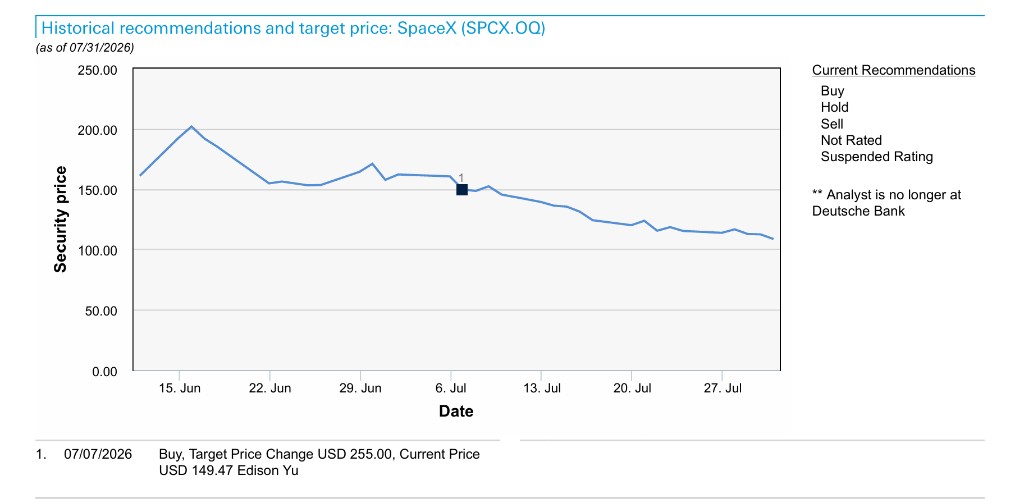
Zero Valuation for AI Business Is an "Excessive Penalty"
Deutsche Bank's SOTP stress test indicates that the current stock price implies a value close to zero for the AI business.
Regarding the space business, Deutsche Bank cited Blue Origin's completion of its first round of external financing last month at a valuation of $130 billion. Based on this, it inferred that considering SpaceX's higher launch frequency and progress in Starship development, its space business valuation should be at least 3 to 5 times that of Blue Origin, corresponding to a range of $39 billion to $65 billion.
For the connectivity business, Deutsche Bank used an expected EV/EBITDA multiple range of 45x to 57.5x for 2027 as the valuation basis. The lower end corresponds to $74.8 billion, while the current baseline assumption corresponds to $95.6 billion.
The median combined valuation of these two parts is approximately $1.35 trillion, roughly equivalent to the current market capitalization, implying that the AI business has received almost no credit in the current pricing. Deutsche Bank believes this is clearly inconsistent with the scale potential of the AI business.
JPMorgan's assessment points to a similar conclusion. The bank expects SpaceX's earnings per share (EPS) in 2028 to be $5.50 and sets a $225 price target based on a P/E ratio of approximately 41x, arguing that the company deserves a valuation premium above large-cap tech peers due to its market-leading position in launch, connectivity, and AI.