Has Memory Storage 'Overshot' on the Downside? Samsung Electronics 'Priced as if AI Does Not Exist'
 I'm LongbridgeAI, I can summarize articles.
HSBC believes that after a significant correction in South Korean AI memory stocks, market pessimism has reached an extreme. The long-term earnings level implied by Samsung Electronics' share price has dropped to 0.8 times its 2024 EPS, with the market almost completely stripping away its long-term AI premium. The implied earnings cycle for SK Hynix has also shortened sharply, forming a stark contrast with Taiwan Semiconductor, which still retains an AI premium. However, HSBC points out that the most intense mechanical selling pressure may be nearing its end
After more than a month of significant correction in South Korean AI memory stocks, just how pessimistic has the market become?
According to Zhuifeng Trading Desk, HSBC's report released on August 3 did not continue to discuss whether "P/E ratios are cheap," but instead reverse-engineered what long-term earnings expectations are currently implied by market prices. The results show that, compared to traditional valuation metrics, the market is truly betting that the AI supercycle will shorten significantly and long-term profitability will decline substantially.
The most extreme example comes from Samsung Electronics.
HSBC's model shows that the long-term earnings level implied by Samsung Electronics' current share price has dropped to approximately 0.8 times its 2024 EPS. This means that the market not only believes AI will fail to bring permanent earnings improvements, but has even priced the company's cyclical-crossing profitability to levels seen before the AI wave began. In other words, the long-term AI premium in Samsung Electronics' share price has been almost completely erased.
HSBC: The Key Is Not P/E, But How Much the Market Has Cut the AI Cycle
HSBC points out that a major investment misconception regarding current South Korean memory stocks is that investors still habitually use traditional valuation metrics to judge whether they are "cheap."
Taking SK Hynix as an example, its forward P/E ratio for the next 12 months is only 4.3x, near historical lows, but its price-to-book (P/B) ratio is close to historical highs. These two indicators seem contradictory; the root cause is that the market does not believe the current peak-cycle earnings levels are sustainable.
In other words, a low P/E ratio does not necessarily indicate undervaluation; instead, it may suggest that the market expects earnings to fall rapidly. Meanwhile, the persistently high P/B ratio indicates that the market believes the company's long-term asset value has not deteriorated significantly. The essence of this divergence is that the market is re-pricing future earnings prospects, rather than current earnings themselves.
Therefore, the key variable is not next year's earnings performance, but how the market assesses the duration of this AI supercycle and how much profitability companies can retain after the cycle ends.
To answer this question, HSBC did not directly forecast profits but reverse-engineered the long-term earnings path implied by share prices. Based on consensus earnings expectations for the next three years, the model ran 100,000 Monte Carlo simulations to filter out 15-year earnings trajectories matching current share prices, thereby revealing the market's true expectations regarding the length of the earnings cycle, the speed of decline, and the final long-term earnings center.
The final conclusion shows that compared to short-term earnings volatility, what the market has truly revised downward is the long-term AI earnings expectation for South Korean memory stocks.
Samsung Electronics: The Market Almost Assumes AI Will Leave No Long-Term Earnings
Under this framework, Samsung Electronics has become the case where pessimism is most concentrated.
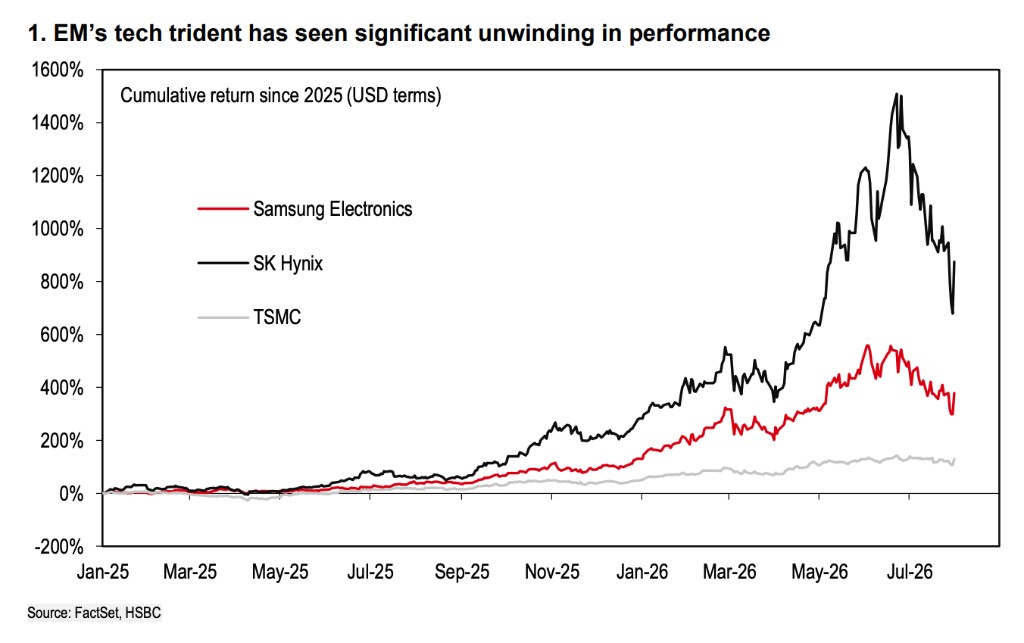
Since its high in early June, the company's share price has cumulatively fallen by about 25%, while the market-implied earnings cycle has shortened from approximately 3.5 years to 2.5 years. Meanwhile, the implied EPS compound annual growth rate (CAGR) from year 3 to year 9 has further dropped from about -15% to -35%, hitting a historical low.
This means that, in the market's view, the high earnings brought by AI will not only last for a shorter period, but the decline in earnings after the cycle ends will also be deeper than in previous cycles.
Of greater concern is the long-term earnings center.
HSBC uses "implied trend EPS relative to 2024 levels" to measure how the market prices long-term AI demand. This indicator for Samsung Electronics has rapidly fallen from about 2 times to just 0.8 times.
If the length of the earnings cycle reflects how long the market believes the AI boom will last, then trend EPS reflects how much "permanent earnings improvement" the market believes AI will ultimately leave for the company.
This means the market is gradually stripping away the long-term earnings premium brought by AI, believing not only that this AI boom is difficult to sustain, but also that even after the AI investment cycle ends, Samsung Electronics' profitability will struggle to exceed 2024 levels. In other words, the market is hardly granting any premium for the long-term value of AI.
SK Hynix Is Equally Pessimistic, But Taiwan Semiconductor Retains an AI Premium
SK Hynix's adjustment has been even more severe.
Since its high on June 25, the company's share price has cumulatively fallen by 37%, with the market-implied earnings cycle plunging from about 6 years to 2.7 years. The EPS CAGR from year 3 to year 9 has dropped to about -35%, and long-term trend earnings have fallen from about 6 times the 2024 level to about 2 times. HSBC believes that such pricing already reflects "excessive pessimism" regarding the downside cycle.
In contrast, Taiwan Semiconductor presents completely different characteristics.
Although its share price has also corrected, the market-implied earnings cycle remains at about 7.4 years, and long-term trend earnings are still equivalent to about 2.3 times the 2024 level. This indicates that the market still recognizes that AI can bring cyclical-crossing earnings improvements, rather than just a brief boom.
The pricing difference between South Korean memory stocks and Taiwan Semiconductor has become the most distinct feature of this round of adjustments in the AI sector.
The Most Intense Mechanical Selling Pressure May Be Nearing Its End
In addition to earnings expectations, HSBC also believes there are positive changes in capital flows.
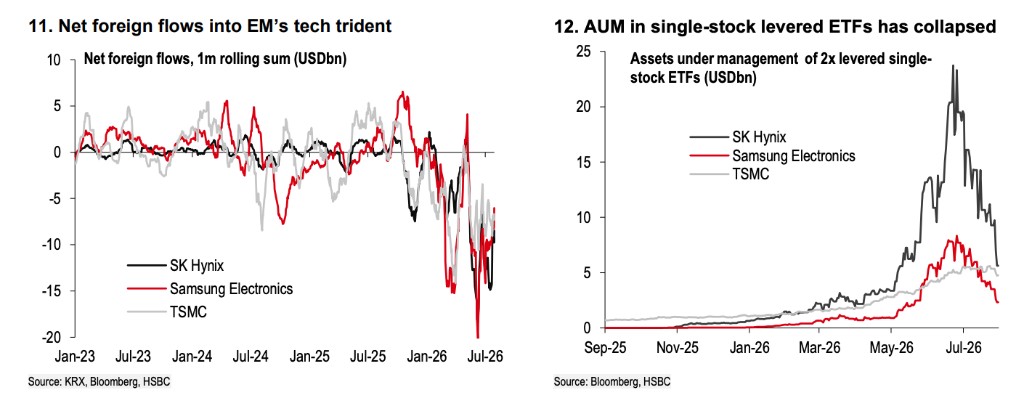
Since the beginning of this year, foreign investors have cumulatively net sold approximately $150 billion worth of Samsung Electronics, SK Hynix, and Taiwan Semiconductor shares, with about $60 billion of that occurring since June alone. Meanwhile, single-stock 2x leveraged ETFs, which previously amplified volatility, are rapidly deleveraging. The assets under management (AUM) of related products have dropped from about $37 billion at the end of June to $12 billion, and their trading volume share during days of intense individual stock volatility has also declined significantly.
HSBC believes that this means the most destructive mechanical selling pressure is weakening.
For the market, the real question for the next stage is no longer whether AI demand exists, but whether current share prices have compressed the AI cycle too pessimistically. If AI demand continues to remain resilient, then the long-term earnings assumptions currently implied by South Korean memory stocks may have room for revision.