
The Two Sides of SpaceX: Starlink Earns $18 Million Daily, AI Burns $170 Million Daily
 I'm LongbridgeAI, I can summarize articles.
SpaceX's first quarterly report reveals an extreme divergence: revenue surged 92% year-over-year to $7.8 billion, while AI capital expenditures for the single quarter reached $15.8 billion, exceeding NVIDIA's annual R&D budget. Elon Musk is attempting to maintain balance amidst three distinct business tensions: Starlink's rapid profitability, AI's aggressive expansion, and Starship's long-term R&D. However, the market is still waiting for a clear answer on whether one company can win all three wars simultaneously
SpaceX's first quarterly financial report since its listing presents a sense of extreme divergence.
Financial data shows that SpaceX generated $7.8 billion in revenue in the second quarter, a 92% increase from $4.1 billion in the same period last year; adjusted EBITDA reached $3.5 billion, significantly higher than $1.2 billion in the same period last year. However, SpaceX's capital expenditures in the second quarter amounted to a staggering $18.4 billion, 2.4 times its revenue for the period. Of this, AI-related capital expenditures alone totaled $15.8 billion, equivalent to an average daily expenditure of over $170 million.
During the earnings conference call, Musk and CFO Bret Johnsen spent over an hour attempting to soothe the market, detailing the allocation of the $18.4 billion in single-quarter capital expenditures and their potential returns. Although management emphasized that the massive current investment in AI computing power could recoup costs in a short time, the market was clearly not convinced by this long-term promise, as the huge expenditures have not yet translated into actual profits on the income statement. SpaceX's stock price plummeted more than 7% in after-hours trading.
Another key factor exacerbating market risk aversion is the impending wave of massive share unlocks. On August 6, 910 million shares of internal holdings at SpaceX will be unlocked, a scale equivalent to 1.4 times the current float. Management lacked proactive communication regarding this liquidity shock during the conference call, offering only brief responses during the Q&A session, which further deepened investor uncertainty.
Side A: Starlink, Netting $18 Million Daily
Starlink business revenue in the second quarter was $4.29 billion, a 66% year-over-year increase. Operating profit was $1.66 billion, up 79% year-over-year, with a profit margin of 38.6%. Net user additions reached 1.7 million, bringing the total to 12 million, covering 167 countries. Enterprise and government revenue totaled $1.8 billion, more than doubling year-over-year.
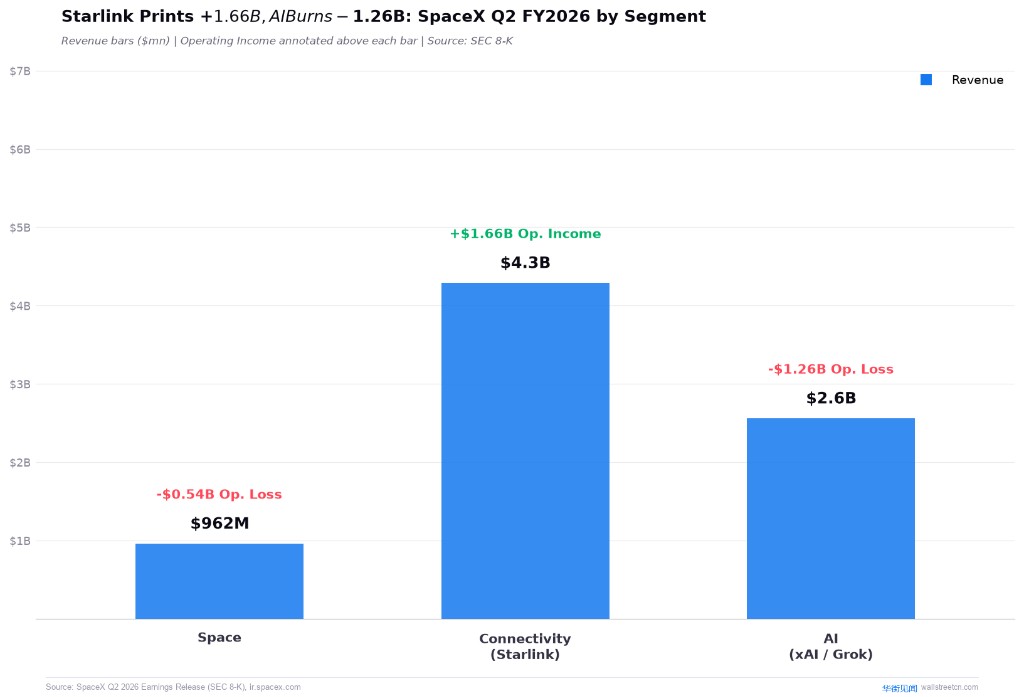
Figure 1: Comparison of Revenue and Operating Profit for SpaceX's Three Major Segments in Q2 FY2026 (Source: SpaceX SEC 8-K)
The U.S. government awarded over $6 billion in contracts in the second quarter. American Airlines signed an in-flight Wi-Fi agreement. President Gwynne Shotwell stated on the conference call that Starlink's goal is to become the fourth-largest carrier in the United States—ranking after AT&T, Verizon, and T-Mobile. The combined annual revenue of these three companies is approximately $600 billion.
ARPU stabilized at $66. This figure was $85 in the second quarter of last year and also $66 in the first quarter of this year. The fastest-growing regions for users are Latin America, Africa, and Southeast Asia, where pricing is far lower than in North America, dragging down the average. However, a significant portion of the 1.7 million new users came from aviation, maritime, and government clients, whose contract values per user are much higher than those of individual consumers.
Starlink's profit growth rate (79%) exceeded its revenue growth rate (66%), reflecting the effect of spreading fixed costs. Currently, there are over 10,200 satellites in orbit. The V3 broadband satellite has a downlink capacity of 1 Tbps, ten times that of the V2. Shotwell said that mass launches of V3 satellites will not ramp up until mid-next year, at which point bandwidth will see an order-of-magnitude leap.
If Starlink were viewed independently, annualized based on the second quarter, it would be a telecommunications company with annual revenue of $17.2 billion and operating profit of $660 million. T-Mobile, the fourth-largest operator in the U.S., had revenue of $81 billion and profit of $13 billion last year. Starlink is still far from that scale, but its growth rate is not in the same order of magnitude.
Side B: AI, Burning $170 Million Daily
AI business revenue was $2.56 billion, up 247% year-over-year and 213% quarter-over-quarter. Cloud service agreements contributed approximately $1.6 billion, while AI solutions revenue jumped from $475 million in the first quarter to $2.194 billion.
Adjusted EBITDA turned positive for the first time, rising from a negative $609 million in the first quarter to a positive $1.146 billion. However, the operating loss remained at $1.257 billion—excluding depreciation and amortization.
What truly made the market nervous was capital expenditure. The AI segment spent $15.8 billion in the second quarter. Comparing this with NVIDIA's full-year R&D budget last year ($12.9 billion) and Meta's full-year capital expenditures last year ($27.2 billion, including all businesses), SpaceX's single-quarter investment in AI exceeded NVIDIA's full-year R&D spending and approached 60% of Meta's total annual expenditure.
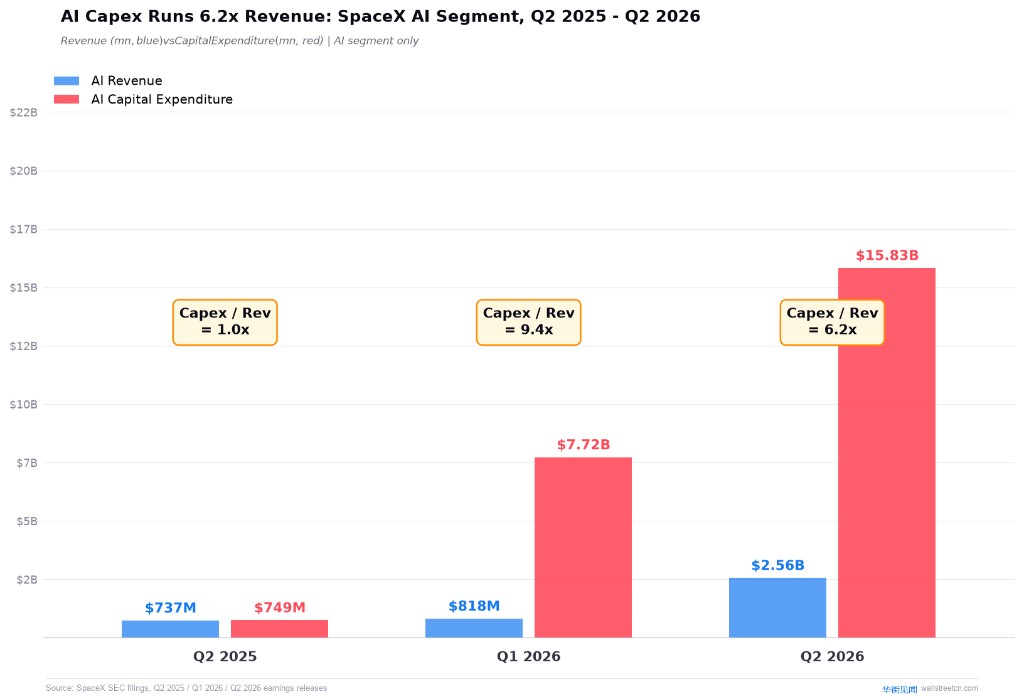
Figure 2: SpaceX AI Segment Capital Expenditures vs. Revenue Trend (Source: SpaceX SEC filings)
These funds were primarily invested in the Colossus data center in Memphis, Tennessee. The nominal computing power capacity reached 1.4 gigawatts by the end of the second quarter, with a year-end target of 2 gigawatts. When asked about long-term plans on the conference call, Musk said the internal tentative target is to reach 20 gigawatts in terms of power and cooling by the end of 2027, though he personally believes the actual implementation will be around 15 gigawatts. This represents roughly a 10-fold increase from 1.4 to 15.
CFO Johnsen provided a figure on the conference call: the payback period for current new computing power investments is less than one year. He stated that capital expenditures could almost be treated as operating expenses—meaning that based on current customer contract prices and scales, the money invested today can be recouped within 12 months.
In the first three weeks of Q3, the company signed an additional $6.7 billion in cloud contracts, with a service period of about six months, billing to start in October.
However, the $15.8 billion is money already spent. The $6.7 billion is merely contractual. More than one analyst pressed the same logic on the conference call: You say the payback period is less than a year, but you spent $7.7 billion last quarter, totaling $23.5 billion over two quarters. When will we see the corresponding returns on the income statement?
Management did not provide a specific timeline. Musk only stated that by December, the company's recurring revenue, annualized based on that month's income, would reach $100 billion. He added that the actual figure might be higher. The internal target for trillion-dollar revenue was also pulled forward from 2031 to 2030, with a "non-zero probability" for 2029—his exact words.
The market showed little interest in the long-term "non-zero probability." The immediate issue is more concrete: tomorrow (August 6), 910 million shares of internal holdings will be unlocked, equivalent to 1.4 times the current float. Management did not proactively mention this throughout the conference call, offering only brief responses when pressed during the Q&A session.
Starship Is Also Burning Cash
Launch business revenue was $962 million, a 29% year-over-year increase, but with an operating loss of $542 million. The company completed 38 launches in the second quarter. The primary driver of the loss was Starship.
In the past 90 days, Starship V3 completed two successful flights. The 13th flight validated core capabilities for orbital missions and returning to catch the launch tower, while the 14th flight successfully placed Starlink V3 satellites into operational orbit for the first time.
The heat shield issue—described by Musk himself as Starship's biggest technical hurdle—he said has been resolved. The next step is to attempt catching and recovering both the first-stage booster and the spacecraft simultaneously during the next test flight at the end of this month.
R&D expenses increased by $389 million year-over-year, and the aerospace segment's adjusted EBITDA was negative $200 million. Musk's goal is to achieve at least one Starship launch per day within a year, reducing orbital insertion costs to less than 1% of traditional methods. His exact words were that if you drew a bar chart of global orbital tonnage, competitors' bars would be only one pixel high—provided the chart could fit SpaceX itself.
Can Musk Fight Three Wars Simultaneously?
This quarterly report reveals three completely different tensions pulling against each other.
Starlink is making money, and making it quickly. The $1.66 billion in operating profit corresponds to 12 million users. Shotwell aims to become the fourth-largest carrier, ARPU has stabilized, V3 satellites have not yet begun to produce qualitative changes, and enterprise growth is nearly twice that of the consumer side. This is a good business that can be valued independently.
AI is spending aggressively. $15.8 billion in a single quarter, with a theoretical payback period of less than a year. Q3 saw new contracts worth $6.7 billion, token consumption tripled after the release of Grok 4.5, and there is a compute leasing agreement with Anthropic worth $1.25 billion monthly until 2029. These signals all point in the same direction: demand is real. But accounting-wise, the $15.8 billion has already left the books, while the income statement hasn't caught up. This is the gap between what Johnsen calls "like operating expenses" and what investors see as "like a bottomless pit."
Aerospace is stuck in the middle. Starship's technical progress is tangible—the heat shield issue is resolved, two successful flights, V3 satellites placed in orbit—but the R&D bill is also tangible. The return logic for this segment is the longest-term: everything will improve only when orbital insertion costs drop to 1%.
Relying on his control of over 82% of the voting rights, Musk is attempting to maintain balance amidst three distinct business tensions: Starlink's rapid profitability, AI's aggressive expansion, and Starship's long-term R&D. However, the market is still waiting for a clear answer on whether one company can win all three wars simultaneously.