
AMD's Best-Ever Earnings Report Leads to a 9% Plunge: The Market Demands Acceleration, Not Just Good Results
 I'm LongbridgeAI, I can summarize articles.
This earnings report does not negate AMD's growth story; it refutes the pricing assumption that "the story needs no new evidence." With the market having prepaid a 130% surge in anticipation of doubling data center revenue by 2027, AMD must deliver execution that exceeds expectations every subsequent quarter to sustain this premium
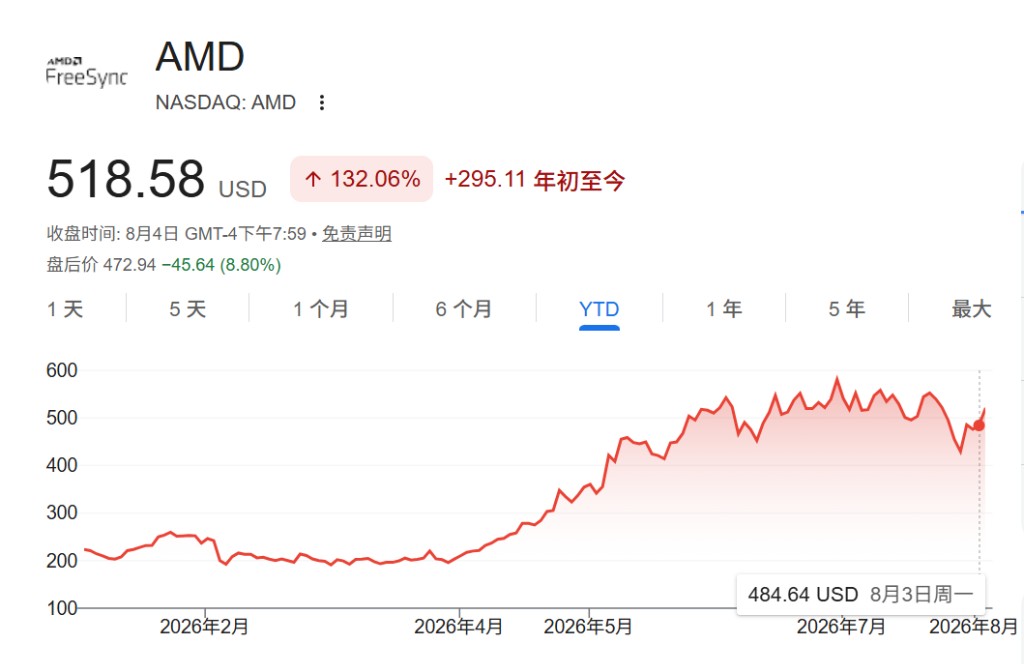
After hours on August 4, AMD delivered a nearly flawless earnings report: revenue reached $11.536 billion, a 50% year-over-year increase and a new historical high; non-GAAP earnings per share (EPS) were $1.66, beating the market expectation of $1.62; data center revenue hit $6.718 billion, doubling year-over-year and accounting for 58% of total company revenue. However, the stock price plummeted by as much as 10% in after-hours trading, closing down 8.8%.
Why did beating expectations become negative news? The market is not pricing in performance, but acceleration. AMD's stock has risen over 130% this year, with its 52-week range spanning from $149 to $584. This gain reflects the expectation of "catching up to Nvidia." The Q3 guidance of approximately $13 billion was higher than the consensus of $12.5 billion, but the quarter-over-quarter growth was only 13%—maintaining the current slope rather than shifting gears. The market wanted acceleration, which the earnings report failed to provide.
The cost of investment was also evident in the financial statements: While the gross margin of 56% hit a new high, the gross margin for AI data centers was below the company average. The growing business segment, accounting for 58% of revenue, is actually diluting profit margins. To secure capacity for the Helios rack system, capital expenditures amounted to $808 million, nearly three times analysts' expectations, causing free cash flow to halve from $2.57 billion to $1.56 billion. For the first time, the cost of growth has become visible on the balance sheet.
The Market Wanted Acceleration, But Q3 Guidance Did Not Deliver
Q3 guidance is around $13 billion, representing a 41% year-over-year increase and a 13% quarter-over-quarter increase, with the midpoint exceeding the consensus of $12.52 billion. This guidance is hardly poor; the issue lies in its trajectory: a mere 13% quarter-over-quarter growth simply continues the current slope.
Dolphin Research crunched the numbers: Based on the guidance, the sequential incremental revenue for the data center segment in Q3 is approximately $1.2 billion to $1.8 billion. Since the MI455X has only just begun shipping, this step-up is not particularly strong. The market had previously bet that AI demand would push AMD to the next level, but the guidance did not signal this.
AMD's stock has risen over 130% this year as the market bought into a narrative: Nvidia's capacity is constrained, customers need a second supplier, and AMD is transitioning from an alternative to a mandatory choice for AI chips. The earnings report needed to prove that this story is accelerating.
In July, Anthropic announced the deployment of 2 gigawatts of MI450 GPUs on Helios, causing the stock to rise about 10% on the day. In early June, Broadcom's earnings briefly triggered a pullback in the semiconductor sector, but AMD subsequently recovered to above $518 driven by expectations for Helios orders. Each rally has raised the bar for the next earnings report.
When AMD delivers only "good results that meet expectations," the 130% year-to-date gain loses its justification for further upward movement. The after-hours sell-off represents the realization of these expectations.
A 107% Doubling, Half of Which Is Due to a Low Base
The 107% year-over-year growth in the data center segment is the most eye-catching figure, but its quality is questionable.
In the second quarter of 2025, U.S. export controls led AMD to take an $800 million charge for MI308 inventory and related expenses, creating a low base. Part of this year's doubling is simply filling that hole.
Dolphin Research broke down the figures: Instinct AI GPU revenue this quarter was approximately $2.7 billion, compared to about $1.1 billion in the same period last year, still shadowed by the base effect. In contrast, EPYC is cleaner: cloud and enterprise sales both grew over 70% year-over-year, server CPU revenue hit records for the fifth consecutive quarter, and the sixth-generation EPYC Venice is already in production. Acceleration without the filter of a low base is the most solid part of this earnings report.
Lisa Su provided anchors during the conference call: Data center revenue will "more than double" by 2027; server revenue will grow over 80% year-over-year in the second half of 2026; and it will still grow over 70% in 2027 on a higher base.
The Hidden Thread in Gross Margin: The Bigger AI Gets, the Thinner the Margin
The 56% non-GAAP gross margin is a new high, but the number contains some noise. The 13 percentage point year-over-year jump is largely due to the $800 million export control charge taken in the same period last year.
Management confirmed on the conference call: The gross margin for AI data centers is slightly below the company average. Yet, the data center segment is the fastest-growing and largest part of the business, rising from 42% a year ago to 58% now. The most growth-oriented part of revenue is a structural diluter of gross margin.
Compared to Nvidia's 75% non-GAAP gross margin, the gap is nearly 20 percentage points. Nvidia earns excess profits through monopoly pricing, while AMD gains share through price competition. Lisa Su was straightforward: AMD sells a complete infrastructure suite integrating CPUs, GPUs, and networking chips, leveraging lower unit prices and higher openness to attract customers. The cost of this model is that the proportion of profit embedded in every dollar of revenue is naturally lower than that of its competitor.
As Helios shifts from selling chips to selling complete rack systems, the unit price increases, but the chips, networking, and storage within the rack are all costs. The larger the scale, the more pronounced the dilution effect. Part of the market's disappointment with this earnings report is hidden in this hidden thread of gross margin.
Capital Expenditures Triple Expectations as Growth Begins to Burn Cash
The balance sheet illustrates the situation better than the income statement: Capital expenditures were $808 million, nearly three times analysts' expectations (approximately $299 million, according to Dolphin Research estimates); free cash flow (estimated) dropped from $2.57 billion to $1.56 billion; inventory increased to $8.468 billion, and accounts receivable grew 21% quarter-over-quarter to $7.281 billion.
This is not financial deterioration, but a proactive growth model: investing heavily in capacity and inventory first, then waiting for orders to materialize.
Lisa Su stated that demand for Helios is "very strong, exceeding our initial forecasts." To secure these orders, AMD must lock in capacity and stockpile inventory in advance. The simultaneous rise in cash, inventory, and accounts receivable is the trace of this head start.
The problem is that this model pushes the certainty of performance into the future. If the growth rate of AI capital expenditure slows down, or if delivery schedules for major customers are delayed, these figures could transform from offensive ammunition into an inventory burden.
The Real Bottleneck Is Capacity, Not Demand
Helios is the most critical signal in this earnings report.
This is AMD's first full-rack AI system, packaging CPUs, GPUs, and networking chips into complete racks for delivery. The first batches have been delivered to Meta, OpenAI, and Oracle this quarter. The 2-gigawatt partnership with Anthropic announced in July will begin deploying the first 1 gigawatt in the first half of 2027. Microsoft will also deploy extensively on Azure. The customer list is expanding: Anthropic, Cirrascale, HUMAIN, Meta, Microsoft, OpenAI, Oracle, Tensorwave, and Vultr.
The demand-side story is impeccable. AMD's ceiling is not here, but in TSMC's advanced packaging capacity.
HSBC downgraded AMD to "Hold" in May, citing TSMC capacity constraints. This earnings report somewhat confirms those concerns; otherwise, AMD would not need to triple capital expenditures to secure capacity. The competition in AI chips has shifted from who has the better chip to who can secure TSMC's capacity first. Nvidia's priority remains a constraint AMD cannot bypass.
Helios also hides a deeper meaning: AMD's business model is shifting from selling chips to selling systems. Previously, it sold individual GPUs and CPUs, leaving customers to build their own clusters. Now, with full-rack delivery, both unit price and delivery complexity have stepped up. This is both an offensive and defensive move—Nvidia has long proven with rack-level products that system-layer profits and customer stickiness are much higher than those of single chips. However, this pivot also means heavier capital intensity and greater delivery risk. If a rack has issues, responsibility shifts from a chip manufacturer to a system integrator.
The Valuation of a Chaser Has Already Prepaid for Success
Nvidia holds about 80% of the AI accelerator market, while AMD has roughly 10% to 15%. Nvidia's quarterly data center revenue of $75.2 billion is 11 times that of AMD's entire data center business. However, after a 130% surge this year, AMD's forward P/E ratio is significantly higher than Nvidia's, bringing analyst valuation divergence to the forefront: Morgan Stanley questions the valuation, while Benchmark sets a target price of $685.
There is only one explanation for this spread: The market has prepaid for "successful catching up." AMD's rise is built on the assumption that its market share will grow from 12% to 25%. If the path proves slower than imagined, the valuation must revert to reality. Conversely, if the Helios rack transformation and the 2027 doubling guidance are realized, the current valuation may not seem so expensive. Both sides of the divergence are betting on opposite ends of the same variable.
Nvidia Will Be the Next Hurdle
The 8.8% drop to approximately $473 after hours is just the first round of this pricing adjustment. In the coming days, the market will re-read this earnings report in sequence.
First, watch whether AMD's stock can hold the $470 line: Breaking below $450 could trigger a stampede of year-to-date profit-taking, turning the technical outlook bearish; holding $470 suggests long-term capital is accumulating positions, given that the 2027 doubling guidance remains on the table. The decline in the hour and a half after hours traded on the lack of acceleration in Q3 guidance, not an overturning of the 2027 story.
Next, look at Nvidia. It reports earnings on August 26. In the previous fiscal quarter, its data center revenue was $75.2 billion, up 92% year-over-year. If AMD's comprehensive beat fails to drive gains, how high has the market's expectation threshold for Nvidia been raised? When beating expectations becomes the baseline and only significant beats can drive stock prices, every earnings report in the AI chip sector becomes an increasingly difficult exam.
At the supply chain level, TSMC and the advanced packaging chain are implicit beneficiaries: AMD's capital expenditures, triple the expectation, ultimately flow into TSMC's CoWoS capacity. After the Helios rack integration, the value of the packaging and networking segments is amplified. However, this also means AMD's delivery ceiling is in others' hands. Every guidance that beats expectations must first pass the test of TSMC's capacity allocation.
The Story Needs New Evidence
AMD fell 9% despite comprehensively beating expectations, making the pricing logic for U.S. AI stocks this quarter clear: Stock prices overdraft expectations first, then realize them in earnings. Beating guidance is merely a passing grade; what truly determines the stock price is whether the market's preset acceleration curve is refreshed.
This earnings report does not negate AMD's growth story; it refutes the pricing assumption that "the story needs no new evidence." With the market having prepaid a 130% surge in anticipation of doubling data center revenue by 2027, AMD must deliver execution that exceeds expectations every subsequent quarter to sustain this premium.
In the coming month, the market will focus on three things: Whether AMD's stock can hold $470, whether Nvidia's earnings on August 26 can withstand the raised threshold, and whether the balance of TSMC's capacity allocation will tilt toward AMD. Looking further ahead, the first 1-gigawatt deployment for Anthropic in the first half of 2027, the quarterly shipping slope of the MI455X, and whether AI data center gross margins can improve with scale are the three hard indicators to verify the quality of the "doubling guidance." The arms race in AI chips is not over; it has merely moved from storytelling to the phase of realization.