
Western Digital Plunges! Q4 Revenue Surges 44% to Beat Expectations, Yet Market Still Sells Off
 Complete. Here is the key summary
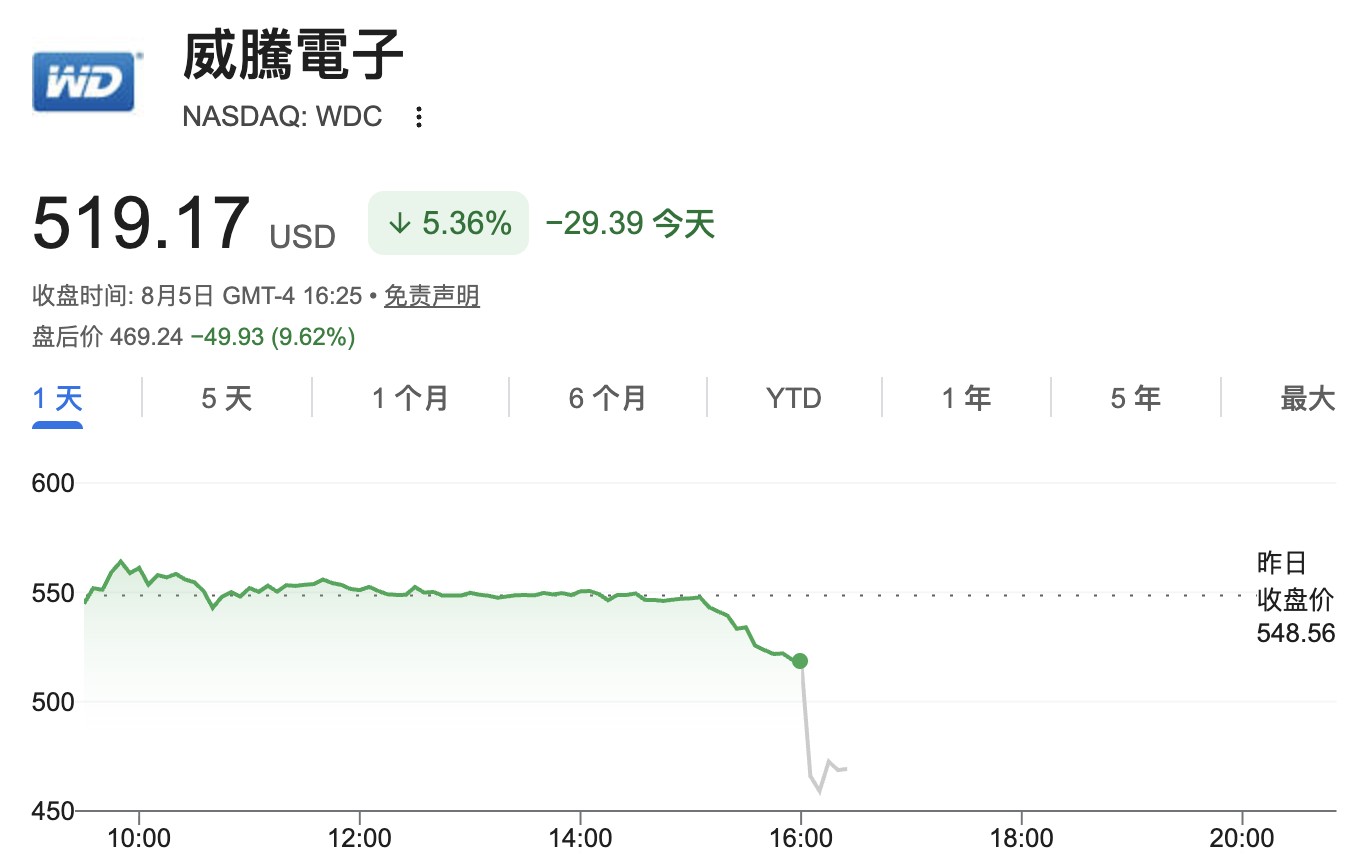
Western Digital reported Q4 revenue of $3.747 billion, a 44% year-over-year increase, with strong growth in profit and cash flow. Despite beating earnings expectations and providing optimistic guidance, its after-hours stock price dropped 10% as it failed to meet the market's high expectations for AI hardware
Western Digital delivered a strong finish to fiscal 2026, with robust demand driving significant simultaneous expansion in revenue and profits. The company expressed full confidence in sustained growth for the new fiscal year.
The financial report released on Tuesday showed that revenue for the fourth quarter ended July 3, 2026, reached $3.747 billion, a 44% year-over-year increase. Non-GAAP diluted earnings per share (EPS) were $3.56, more than doubling from the previous year. Gross margin improved significantly, with non-GAAP gross margin rising to 54.4%, an increase of approximately 13 percentage points compared to the same period last year. CEO Irving Tan stated that this performance reflected the company's innovation and execution in global scaled operations, noting "growing confidence" in the sustainability of demand and business visibility as it enters fiscal 2027.
Looking ahead to the next fiscal quarter, CFO Kris Sennesael provided guidance that exceeded market expectations: the company expects first-quarter fiscal 2027 revenue of approximately $4.1 billion (plus or minus $100 million), representing a year-over-year increase of 42% to 49%. The non-GAAP gross margin is projected to be between 55% and 56%, with non-GAAP diluted EPS expected to be around $4.00, indicating a continued sequential increase. This guidance reinforced investor expectations that the strong recovery cycle in hard drive storage demand has not yet peaked.
Following the earnings release, Western Digital's stock plummeted 10% in after-hours trading, failing to satisfy the market's high expectations for AI hardware.
Q4 Performance: Comprehensive Leap in Profit Margins and Profitability
In the fourth quarter, Western Digital achieved a leapfrog improvement in profitability. GAAP operating income reached $1.563 billion, a 130% year-over-year increase. GAAP operating margin rose to 41.7%, an increase of approximately 15.6 percentage points from 26.1% in the same period last year. Non-GAAP operating margin further expanded to 44.2%.
Operating cash flow reached $1.389 billion, and free cash flow was $1.281 billion, both reaching strong levels. Meanwhile, the board of directors declared a cash dividend of $0.15 per share, payable on September 17, 2026, to shareholders of record as of September 8.
Notably, GAAP diluted EPS for the quarter was as high as $8.21, far exceeding the non-GAAP figure of $3.56. This was primarily due to a one-time non-cash gain of approximately $2.05 billion generated from the mark-to-market valuation of the company's retained equity interest in SanDisk. Excluding this item and other non-recurring items, non-GAAP data better reflects the true operational performance of the company's core business.
Full-Year Summary: Revenue Scale Expands by Over 30%, Debt Significantly Reduced
For the full fiscal year 2026, Western Digital's revenue reached $12.919 billion, a 36% year-over-year increase. Non-GAAP diluted EPS was $10.22, up 104% year-over-year. Non-GAAP operating margin expanded from 24.4% in the previous fiscal year to 37.3%, an increase of approximately 12.9 percentage points. Full-year free cash flow reached $3.511 billion, more than double the $1.432 billion recorded in the previous fiscal year.
On the balance sheet front, the company's financial structure was significantly optimized. As of July 3, 2026, long-term debt was reduced to zero, clearing the $2.485 billion outstanding at the end of the previous fiscal year. Current total debt consists only of $1.052 billion in short-term portions. Shareholders' equity expanded significantly from $5.311 billion to $8.864 billion throughout the year, and convertible preferred shares were fully converted within the fiscal year, leaving no remaining balance.
During the year, the company spent approximately $2.592 billion on stock buybacks and paid $184 million in dividends, returning a total of approximately $2.776 billion to shareholders.
Business Background: Flash Memory Spin-off Completed, Focus on Hard Drive Storage Sector
The performance disclosed in this financial report excludes the impact of the spun-off business. On February 21, 2025, Western Digital completed the spin-off of its flash memory business unit into an independent publicly listed company, SanDisk Corporation. Since then, SanDisk's financial and operating results are no longer consolidated into Western Digital's financial statements. Historical financial data prior to February 21, 2025, has been restated on a continuing operations basis, with the SanDisk segment presented as discontinued operations.
Following the spin-off, Western Digital focuses on disk storage, serving hyperscale cloud service providers, cloud service providers, and enterprise customers. The company positions itself as a builder of storage infrastructure for the "AI-driven data economy," aiming to meet the storage demand driven by the continuous expansion of cloud computing and data-intensive workloads.
In the earnings statement, Irving Tan stated that as global data creation continues to accelerate, the company will leverage its scale advantages, technological leadership, and operational discipline to seize long-term data growth opportunities and create long-term shareholder value.
Risk Warning and Disclaimer
The market carries risks; investment requires caution. This article does not constitute personal investment advice, nor does it take into account the specific investment objectives, financial status, or needs of individual users. Users should consider whether any opinions, views, or conclusions in this article align with their specific circumstances. Investment decisions made based on this content are the sole responsibility of the investor.