
 I'm LongbridgeAI, I can summarize articles.
Google DeepMind founder Demis Hassabis steps down as CEO to become an "AI statesman," while legendary engineer Jeff Dean leaves to start a new venture with four top researchers... As core talent continues to depart and the flagship Gemini model faces months of delays, Alphabet's stock price drops over 4%. From the perspective of structural adjustment logic, this restructuring aims to break down barriers between research and products, accelerating the commercial deployment of AI products
Google is undergoing its most profound restructuring of its artificial intelligence strategy.
According to a Bloomberg report on Thursday, Google DeepMind founder Demis Hassabis has stepped down as CEO to become Chairman and Chief Scientist at Alphabet. Meanwhile, Google's veteran AI leader Jeff Dean announced his departure to start a new business, taking several core researchers with him. This marks the largest personnel shakeup at Google since it merged its AI research teams in 2023.
Following the announcement, Alphabet's stock fell by approximately 4% to 5%. Market concerns point to a single core issue: Amid intensifying competition with OpenAI and Anthropic, Google is losing its most significant AI talent, and the latest version of its flagship large model, Gemini, has been delayed by several months beyond the originally scheduled June release.
The essence of this restructuring is the further integration of DeepMind into Google's broader commercial system. Hassabis's former deputy, Koray Kavukcuoglu, has taken over as Senior Vice President of Google DeepMind, reporting directly to Alphabet CEO Sundar Pichai. DeepMind's research resources will be more closely aligned with the Gemini large model business.
Hassabis's Transition: From Operations to the "Big Picture"
In a blog post, Hassabis stated that he decided to hand over daily operational responsibilities to "focus on the big picture and influence the future direction as much as possible." In a letter to employees, he wrote, "We have arrived at a critical moment in human history. I have spent my life working toward AGI (Artificial General Intelligence), and now I feel it is within reach."
According to insiders, Hassabis's departure was not a hasty decision. He wishes to devote more energy to macro-level issues regarding the impact of AGI, including leading the formulation of future AI regulatory frameworks. Serving as Chairman will provide him with greater space for strategic thinking, rather than being bogged down by daily operational matters.
Hassabis has recently become increasingly active in the field of global AI policy. Last month, he proposed a concept for establishing a self-regulatory AI body led by the United States, modeled after the financial industry regulator FINRA, and has communicated with political figures in multiple countries. Alphabet CEO Pichai stated that he and Hassabis had long been discussing "a role that would allow him to fully focus on actively shaping the future of AGI."
Sebastian Mallaby, author of "The Infinity Machine" and biographer of Hassabis, commented: "Demis has been playing the role of an AI statesman for some time, and Koray has effectively been leading Google DeepMind's research work for quite a while. This adjustment is merely a formal confirmation of the status quo. DeepMind's mission has always been to solve the AGI problem, and then use it to solve everything else. The phase of solving AGI is largely complete, so it is logical for Demis to shift his focus from science to social impact."
Jeff Dean's Departure: An "Earthquake" Within Google
Compared to Hassabis's role transition, Jeff Dean's departure has a more direct impact within Google. Dean joined Google in 1999 and is one of the most legendary engineers in the company's history, enjoying extremely high prestige internally. The new company he is founding upon his departure is named Discovery Loop, focusing on automated machine learning research to enhance its own technical capabilities. Google has provided investment and signed a cloud computing resource supply agreement with the new venture.
Dean posted on the social platform X that at least three heavyweight DeepMind researchers are joining him: Sanjay Ghemawat, Quoc Le, and Oriol Vinyals. "The four of us have worked together for 14 to 30 years, jointly building some of the world's most widely used products, infrastructure, and AI models," Dean wrote. "We are excited to turn our attention to this ambitious new endeavor."
Jeff Dean's departure is not an isolated incident. It is reported that he will take several core researchers with him to start a joint venture, further exacerbating external concerns about Google's AI talent pool. Bloomberg Intelligence analysts pointed out in a research report that Dean's departure could "intensify scrutiny of Google's AI efforts." If Google falls behind in advanced models, it will reduce developers' willingness to build products around Google's technology and pose a long-term threat to its search business.
Talent Drain: A Research Team in Continuous Bleeding
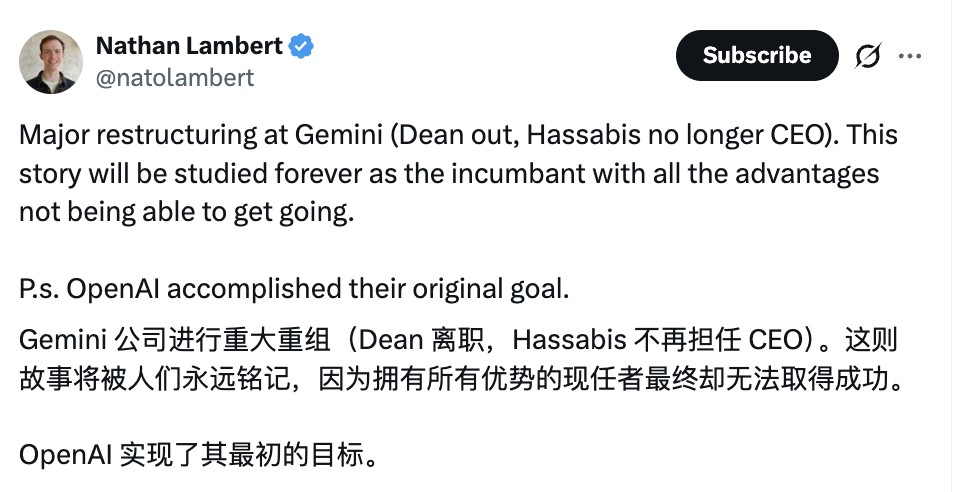
On social media, numerous AI researchers and tech investors shared their views on these changes. AI researcher Nathan Lambert commented on X, "This story will be remembered forever—the incumbent with all the advantages ultimately fails to succeed." He also bluntly stated, "OpenAI achieved its initial goal: defeating Google."
This personnel change is not an isolated event but the latest episode in the continuous bleeding of Google's AI research team. According to Bloomberg, Nobel laureate John Jumper left earlier this year to join Anthropic, while star researcher Noam Shazeer moved to OpenAI. Previously, high-profile researchers such as David Silver and John Jumper also successively left Google DeepMind.
Although Google has invested tens of billions of dollars in AI infrastructure and talent, it faces criticism for being too slow in translating world-leading research results into commercial value, especially in the commercially significant field of AI programming. Google researchers participated in developing the Transformer architecture that powers chatbots like ChatGPT, but OpenAI was the first to bring this technology to market, forcing Google to readjust its AI strategy.
On X, some users criticized Google for being similarly sluggish in its cloud business strategy, stating, "The strategy launched by Databricks is what Google Cloud (GCP) should have; Google keeps sabotaging its own success." Some individual investors have cited this personnel turmoil as a direct reason for reducing their holdings in Alphabet.
DeepMind Integration: Research Genes Yield to Commercial Logic
From the perspective of structural adjustment logic, this restructuring aims to break down the barriers between research and products. Kavukcuoglu's direct reporting line to Pichai means that DeepMind's research direction will serve the commercial deployment of Gemini more directly, rather than following the previously relatively independent path of basic research.
Google acquired DeepMind for £400 million in 2014, betting on the future of AI. This 16-year-old laboratory has been a pioneer in the development of modern AI technologies, with achievements including AlphaGo, the first AI system to defeat human Go masters, and AlphaFold, the protein structure prediction project that won the Nobel Prize in Chemistry.
Notably, Hassabis will continue to serve as the head of Isomorphic Labs, an Alphabet subsidiary focused on drug discovery. Spun off from DeepMind in 2021, this department has established partnerships with several major pharmaceutical companies and recruited numerous DeepMind researchers. This arrangement indicates that Hassabis will retain substantial operational influence within the Alphabet ecosystem, although his focus has shifted from the daily management of AI research to broader strategic and policy directions.