
Deep Dive into Long-Term Storage Agreements: The Bottom of This Cycle Has Been Raised Above Historical Peaks
 Complete. Here is the key summary
The pricing power in the storage industry is undergoing a systemic restructuring. The four major original equipment manufacturers—Samsung Electronics, SK Hynix, Micron Tech, and Sandisk—are simultaneously extending long-term agreement (LTA) durations from one year to five years, increasing capacity lock-in rates from 30% to 60%-70%, with Advance Payments reaching tens of billions of dollars. More critically, some new contracts feature one-sided price protection—capping downside risk while leaving upside potential uncapped. Even if prices fall to the contractual floor, gross margins remain far above the peaks of any previous cycle
The pricing power in the storage industry is undergoing a systemic restructuring.
On August 5, Sandisk released its full-year financial report for FY2026. While the performance was impressive, the stock price fell 8% in after-hours trading. The market's disappointment was simple: the guidance did not exceed expectations. However, another figure hidden in the conference call was far more important than the quarterly results.
Sandisk disclosed that the minimum total revenue from eight signed long-term supply agreements, calculated at floor prices, is $93.9 billion. The weighted average term of these contracts is over four years, averaging about $20 billion annually—while Sandisk's current annualized revenue is around $42 billion. In other words, in the worst-case scenario, Sandisk has locked in nearly half of its revenue for more than four years at a price far below current market levels.
This is not just a Sandisk phenomenon.
On August 4, Goldman Sachs' Giuni Lee team published a research report comparing the long-term agreement terms of the four major OEMs: Samsung Electronics, SK Hynix, Micron Tech, and Sandisk. The core judgment of the report is that LTA terms are shifting in favor of suppliers along four dimensions: longer durations, broader coverage, more favorable pricing structures, and stronger binding force. Each point points in the same direction: pricing power in the storage industry is shifting from buyers to sellers.
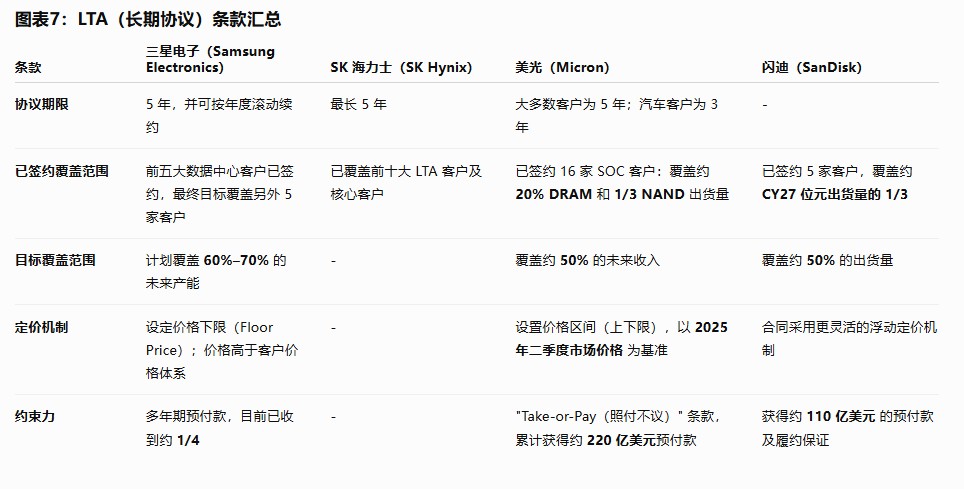
(Translated based on Goldman Sachs table)
This change means that the definition of the "cycle bottom" in the storage industry has been rewritten; the floor of this cycle has been raised above the ceilings of the past.
Duration: From "Annual Negotiations" to "Five-Year Minimum, Possibly Longer"
The standard contract cycle in the storage industry used to be one year. Parties would sit down annually to adjust prices and quantities based on supply and demand. Buyers held the initiative—signing long-term contracts to lock in prices when the market was good, and pressing for lower prices and reduced volumes when the market was poor.
From Goldman Sachs' comparative table, it can be seen that most suppliers stated that contracts are primarily five-year terms, with some customers on three-year terms. In other words, even the "shortest" contracts are three times longer than the previous standard cycle.
Samsung explicitly stated in its recent earnings conference call that its LTAs are based on five-year terms with a rolling annual renewal mechanism. By renewing for one year each year, the contract never expires. Samsung Co-CEO Jun Young-hyun previously put it more bluntly: "Considering the supply and demand uncertainties brought by the expansion of AI investments, we are shifting from traditional short-term agreements to multi-year contracts of three to five years." SK Hynix CEO Kwak No-soo echoed this, stating that customer demand for LTAs is increasing.
Hynix has covered its top ten LTA customers and core clients, with most terms being five years; Micron has signed 16 strategic customer agreements, with most customer contracts lasting five years and automotive customers at three years; Sandisk's eight long-term agreement customers have a weighted average term of over four years, with a maximum of five years.
All four OEMs are simultaneously extending contract cycles, systematically compressing buyer flexibility—once signed, procurement strategies cannot be adjusted according to market changes for five years.
Coverage: From 20% to Over 60%
Signing long contracts is one thing; covering how much capacity is another. If only 10% of volume is locked in, even a long term is harmless. But the numbers tell a different story.
From 2023 to 2025, the industry's standard long-term agreement ratio was between 20% and 30%. By 2026, this number saw a significant jump.
Samsung has signed contracts with the world's top five data center customers and is in final negotiations with another five large clients. Management expects that once the contracts are signed, multi-year order volumes will reach 60% to 70% of planned capacity. The lock-in rate for advanced HBM capacity is even more extreme—over 90% has been covered.
SK Hynix has completed negotiations on about ten long-term agreements, with an LTA ratio of approximately 50% to 60%. Micron has signed 16 strategic customer agreements, covering about 20% of DRAM shipments and one-third of NAND shipments, but management clearly stated that the ultimate goal is for LTA revenue to account for over 50%.
Sandisk's data is more intuitive. Signed agreements cover over 50% of shipments in FY2027, and this figure will rise to about two-thirds in FY2028. Three months ago, the coverage rate for FY2028 was only one-third.
When 60% to 70% of a company's capacity is locked in by multi-year contracts, its pricing logic changes. The remaining 30% to 40% of capacity realizes excess returns in the spot market, but the base has been anchored by contracts. Buyers have lost their previous leverage of "if you don't lower prices, I'll go elsewhere"—because others are also locked in by similar contracts.
Buyers have certainly crunched these numbers. Signing long-term agreements means accepting unfavorable terms, but the premise is that the alternative is worse: without long-term contracts, they cannot secure enough storage chips in the AI computing arms race. When supply tightness is structural, the cost of "being squeezed" is much lower than the cost of "having no supply." This is the confidence behind suppliers pushing terms to the limit.
Pricing: From Fixed Prices to "Protected Price Ranges"
This is the most critical change among the four dimensions.
Previous LTAs were primarily based on fixed prices. One price was signed for one or two years, with both buyers and sellers sharing half the risk—buyers profited if prices rose, and sellers lost if prices fell.
The structure of new contracts is completely different.
Samsung's terms are the most aggressive. A research report from Bank of America Merrill Lynch on August 1 revealed: Samsung's contract terms set clear asymmetric pricing—single-quarter price declines are capped at 5%, but there is no upper limit on increases, which can reach 10% to 20% or even higher. Samsung Memory Business Head Jaejune Kim stated in the conference call that the company adopts different pricing models based on customer groups and product categories, and has set floor prices for general products.
To translate: when the market declines, Samsung's price drop is locked within 5% per quarter. When the market rises, the increase is unlimited. Buyers bear almost all the downside risk, while sellers retain almost all the upside elasticity.
Micron's contract structure is different, but the direction is the same. Its largest contract sets price floors and ceilings, benchmarked against market prices in Q2 2026. The key lies in the floor—management repeatedly emphasized in the conference call that even selling at floor prices, gross margins remain far above the peaks of any historical cycle. Micron's gross margin peak in previous cycles was slightly above 60%.
SK Hynix has taken a more radical path. According to TrendForce citing Korean media reports, Hynix directly canceled the industry-standard price cap in its latest contracts. Even if customers sign long-term agreements, once the market pushes up spot prices due to supply shortages, the contract supply price will be fully adjusted in line with actual market conditions. Goldman Sachs pointed out in its report that compared to peers who have locked in price caps, Hynix has greater exposure to price elasticity in standard DRAM—if prices exceed expectations, the upside space is more significant.
Sandisk's pricing mechanism lies between fixed and floating prices, adopting a customized hybrid model. CFO Luis Visoso revealed in the conference call that the agreements combine "fixed pricing and floating pricing mechanisms," tailored to actual customer needs.
Four players, four structures, but pointing to the same thing: price protection is one-sided, favoring the seller.
Binding Force: From Verbal Commitments to Real Money
Previous LTAs had limited binding force. After signing, buyers could reduce volumes, delay deliveries, or even default without paying a heavy price.
The biggest difference in this cycle is the Advance Payment mechanism.
Micron expects to receive about $22 billion in cash deposits and related financial commitments. Sandisk disclosed financial guarantees exceeding $11 billion, with customer default protection of $16.5 billion. Samsung stated that its contracts include large Advance Payments, and it has currently received about one-quarter of the total contract Advance Payments.
This is not a deposit. This is the cost for buyers to lock in positions early. If a cloud vendor wants to secure enough HBM and DRAM in 2028, it must first place billions of dollars on the OEM's books. This money not only locks in supply but also locks in the buyer—the cost of default is unbearably high.
Goldman Sachs refers to the Advance Payment mechanism as "the biggest highlight distinguishing this round of LTAs from previous cycles."
The Meaning of Floor Prices: The Lower Bound Is Higher Than Historical Peaks
If we look at the changes in these four dimensions together, we arrive at a conclusion: the storage industry is redefining the "cycle bottom" through contracts.
Micron management revealed that even if prices fall to the contract floor, gross margins will remain far above the peaks of any historical cycle. Micron's gross margin peak in previous cycles was slightly above 60%.
Sandisk's $93.9 billion floor price tells the same story—although it did not explicitly disclose the profit margin corresponding to the floor price, the minimum annualized revenue of about $20 billion has been locked in by contracts, and Sandisk's current gross margin is in its highest historical range. Looking at Micron and Sandisk together, we get a directional judgment: the floor of this cycle has likely been raised above the ceilings of the past.
The costs vary. Micron's contracts set clear price floors and ceilings—the floor is protected, but the ceiling is also locked, capping the space for excess returns. Samsung's terms are asymmetric, with a floor for declines but no cap for increases. SK Hynix took another path: canceling the price cap to retain the maximum upside elasticity for standard DRAM—Goldman Sachs specifically noted in its report that compared to peers who locked in caps, Hynix has more significant upside potential. The cost is that the LTA coverage rate is only 50% to 60%, about 10 percentage points less than Samsung in terms of revenue certainty.
Inventory data in the Goldman Sachs report provides another perspective. As of the end of Q2 2026, Samsung and SK Hynix's DRAM and NAND inventories were both between 2 to 4 weeks, lower than the normal level of about 4 to 5 weeks, and far below the 10+ weeks seen before previous downward cycles. With no inventory backlog, OEMs have no motivation to lower prices. The shift in contract terms in favor of suppliers is backed by real supply and demand tightness.
But contracts lock in prices, not capacity. Total NAND capacity is currently about 2.01 million wafers/month. Through existing factories, equipment, and technical improvements, this can be increased to about 2.15 million by the end of this year. True incremental capacity awaits new factories and clean rooms—a cycle of one and a half to two years. Industry sources indicate that release will occur after mid-next year, with a volume accounting for about 17% to 19% of total capacity.
The timing of capacity release is the true test of LTA terms. When supply catches up, will buyers who signed five-year contracts and prepaid billions of dollars find themselves locked into an outdated price? The answer depends on the details of the contract terms—and those details are entirely under the control of the suppliers.