
Earnings Beat and Raised Guidance, Then Stock Plummets: Western Digital and SanDisk Reports Reveal Cracks in the Memory Cycle
 I'm LongbridgeAI, I can summarize articles.
The core "crack" lies here: despite AI-driven demand, the slope of memory price increases is slowing, and a backlash from the consumer sector has sparked concerns about peak pricing. The market's valuation logic has shifted from "any AI exposure leads to gains" to demanding sustainable growth. Under extremely high expectations, "selling on the news" triggers a stampede
After the close on August 5, Western Digital and SanDisk simultaneously released their Q4 FY2026 earnings reports. Both companies beat expectations, with SanDisk also approving a $14 billion share buyback. Then—Western Digital fell 11% in after-hours trading, and SanDisk dropped 7%.
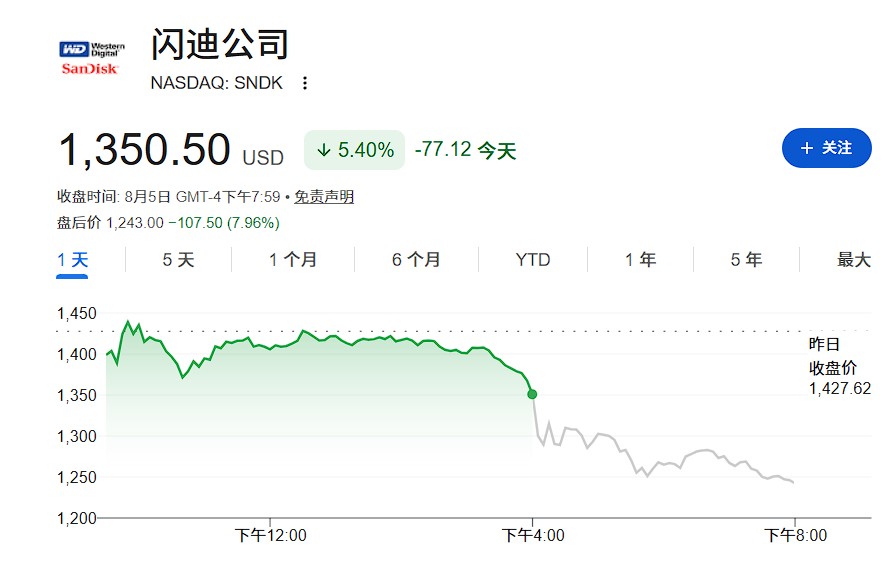
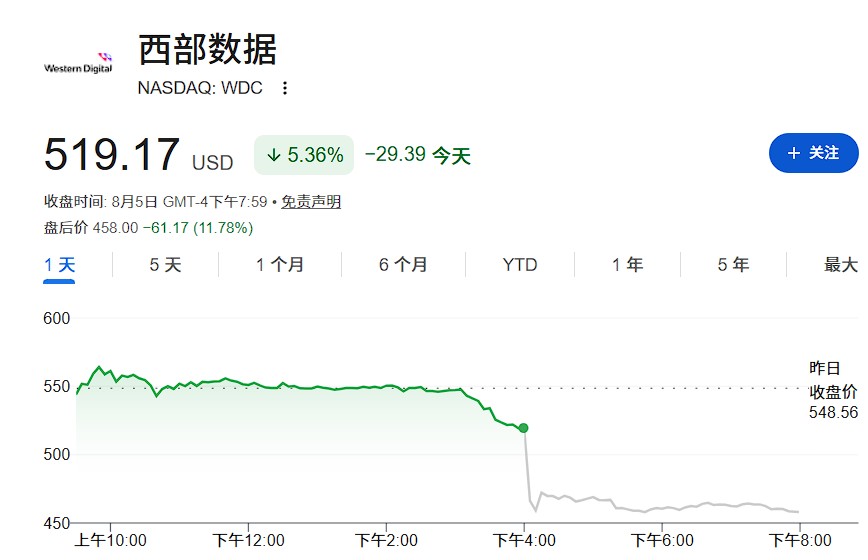
This scene has played out repeatedly this year. Record-high earnings accompanied by record-low stock prices. The memory of SK Hynix’s 30% intraday plunge in July has not yet faded, and selling pressure in the memory sector continues. This is not an issue isolated to one or two companies—it is the loosening of the market's pricing logic for the entire memory supercycle.
SanDisk: A Business with an 84.6% Gross Margin
The earnings report shows that SanDisk’s Q4 revenue was $8.965 billion, up 372% year-over-year and 51% quarter-over-quarter. GAAP net income was $6.903 billion (diluted EPS of $43.97), compared to a net loss of $23 million in the same period last year. Non-GAAP EPS was $39.25, far exceeding Wall Street's expectation of $34.37. The gross margin stood at 84.6%.
There is only one core variable driving all of this: NAND chip prices. SanDisk officially disclosed that in Q4 revenue growth quarter-over-quarter, about one-third came from increased shipment volumes, while two-thirds came from price hikes.
A more critical change lies in the customer structure. Q4 data center revenue was $2.977 billion, doubling quarter-over-quarter and surging 1298% year-over-year. The proportion of data center shipped bits to total shipped bits skyrocketed from 12% a year ago to 38%. Edge device revenue (mobile phones, PCs, automobiles, etc.) was $5.432 billion, up 48% quarter-over-quarter. Consumer revenue was $556 million, down 32% quarter-over-quarter—the company selectively pulled capacity away from retail channels to supply enterprise customers.
CEO David Goeckeler summarized it bluntly on the conference call: "The consumer business just can't keep up with the pace of the transaction market."
The aspect that best reflects the direction of transformation is SanDisk's repeatedly mentioned "New Business Model" (NBM)—cloud vendors lock in volume and prices in advance, giving SanDisk revenue visibility and financial security.
The latest scale disclosed in the Q4 report: 10 agreements have been signed, covering 8 customers, with a minimum contract revenue of $93.9 billion, accompanied by $16.5 billion in financial guarantees (cash deposits and financial instruments). The weighted average term exceeds 4 years.
The CFO revealed that approximately 50% of shipped bits for FY2027 have already been locked in through NBM, rising to about two-thirds for FY2028. "Customer demand growth is outpacing our supply capacity, and bit allocation will continue beyond 2027."
If realized, SanDisk will transform from a highly cyclical NAND wholesaler into an infrastructure supplier with long-term revenue visibility—provided these agreements hold during industry downturns.
Western Digital: The "Water Content" in GAAP Profits and 89% Cloud Dependence
Western Digital reported Q4 revenue of $3.747 billion, a 44% year-over-year increase. Non-GAAP gross margin was 54.4%, operating margin was 44.2%, and diluted EPS was $3.56, up 109% year-over-year, all beating expectations.
But there is a detail that must be pointed out. Under GAAP standards, Q4 net income was $3.195 billion, a 1215% year-over-year increase. This figure is often cited in media headlines, but it severely exaggerates actual operational performance. The reason:
After the spin-off, Western Digital retained some SanDisk shares. With SanDisk's stock price soaring in Q4, the mark-to-market revaluation of this holding generated approximately $2.05 billion in paper gains. Excluding this, non-GAAP net income was only $1.382 billion. The claim of "net profit soaring 12-fold" requires a significant discount.
At the business level, Western Digital is now a pure HDD manufacturer after the spin-off. In Q4, cloud customer revenue accounted for 89% of total revenue, approximately $3.3 billion, up 43% year-over-year. Client revenue accounted for 6%, and consumer revenue for 5%. This highly concentrated customer structure is a double-edged sword: demand is predictable, but bargaining power lies almost entirely with the customers.
CEO Irving Tan repeatedly argued on the conference call for the "structural pull" of AI on HDD demand: Training generates data, inference generates more data, and AI Agents generate intermediate data requiring persistent storage at every step of multi-step task execution. "Compute power can be reused, but data only accumulates."
On the product front, 40TB ePMR hard drives have begun shipping and are expected to contribute more than half of nearline bits by Q3 FY2027. Mass production of 44TB HAMR drives is planned for the first half of 2027, with 50TB models targeted for the second half. The company is negotiating LTAs covering 2029 to 2031. On the pricing side, the blended average price per TB in Q4 rose about 17% year-over-year (only high single digits in the previous quarter), while cost per TB decreased 8% year-over-year. The combination of rising volume and prices alongside falling costs drove the gross margin up from 41.3% a year ago to 54.4%.
What Is the Market Actually Afraid Of?
In Q2 2026 (corresponding to the quarter of Western Digital/SanDisk's Q4 FY2026), the memory industry delivered its most crazy performance sheet in history:
Samsung Electronics: Quarterly revenue of 171.5 trillion KRW, up 130% year-over-year; operating profit of 89.5 trillion KRW, up 1814% year-over-year. The semiconductor division contributed 99% of the company's total profit.
SK Hynix: Quarterly revenue of 79.3 trillion KRW, up 257% year-over-year; operating profit of 60.5 trillion KRW, up 557% year-over-year; net profit of 93.9 trillion KRW. HBM (High Bandwidth Memory) shipments continued to soar, and the company has signed long-term supply agreements (LTAs) with more than ten customers, including core clients.
Micron Technology: Q3 FY2026 (March-May) revenue of $41.46 billion, up 345.7% year-over-year; GAAP net profit of $28.24 billion, up 1398.3% year-over-year.
Kioxia: Q1 FY2026 (April-June) revenue of 1.77 trillion JPY, up 415.5% year-over-year; net profit of 842.2 billion JPY, surging more than 45 times year-over-year. Enterprise SSD revenue for servers increased by over 440% year-over-year.
Seagate Technology: Q4 FY2026 revenue of $3.629 billion, non-GAAP gross margin of 52.7%, non-GAAP EPS of $5.71. Full-year revenue was $12.195 billion, up 34% year-over-year.
All five companies hit record highs. The drivers were highly consistent:
Global cloud vendors' capital expenditures in 2026 are expected to exceed $800 billion combined (Microsoft, Google, Amazon, Meta, etc.), with AI training and inference clusters consuming far more storage than anticipated.
TrendForce data shows that DRAM contract prices in Q1 2026 surged 93% to 98% quarter-over-quarter, and NAND Flash contract prices surged 85% to 90% quarter-over-quarter. The share of server DRAM demand exceeded 50% for the first time, marking a shift in the "main force" of memory demand from mobile phones to data centers.
But precisely amidst this collective euphoria in earnings reports, the signals sent by the capital market were unsettling.
In July, SK Hynix saw a maximum drawdown of 54% on the Korean stock market, Samsung Electronics 42%, Micron Technology 33%, and SanDisk plummeted 47% in a single month (wiping out over $150 billion in market value). The Philadelphia Semiconductor Index recorded its largest single-month drop since 2008.
This was a vote of no confidence by the market in the sustainability of the entire memory supercycle. There are two layers of explanation.
The superficial layer is "selling on the news."
SanDisk's revenue guidance for Q1 FY2027 is $10.3 billion to $10.8 billion, while the Wall Street consensus expectation is $11.16 billion—a midpoint difference of about 6%. For a stock whose year-to-date gain once exceeded 400%, beating expectations is merely the passing grade, while missing them triggers a stampede.
Western Digital's guidance was actually higher than expected—revenue midpoint of $4.1 billion vs. expectation of $4.02 billion, EPS of $3.85 to $4.15 vs. expectation of $3.83—but this was not enough. After rising nearly 200% year-to-date, the market wants not just a slight beat, but upward revision signals capable of supporting another 200% gain.
The deeper layer relates to the memory cycle.
TrendForce predicts that DRAM contract prices in Q3 2026 will rise 13% to 18% quarter-over-quarter, and NAND Flash will rise 10% to 15%. If confirmed, this means the slope of price increases has dropped from the doubling pace of previous quarters to mid-to-low double digits.
Jefferies' report on July 28 was even more pessimistic—believing that the actual increase in Q3 might be only 15% to 20%, far below the previously expected 25% to 30%, and warning that "prices may peak earlier than expected."
The consumer sector is also pushing back. OPPO and vivo have already refused to accept Samsung's Q3 quotes, and SanDisk's Q4 consumer revenue fell 32% quarter-over-quarter. Goeckeler admitted the company is "looking for a balance between price and volume"—once prices reach a certain level, demand disappears.
One level deeper, although this cycle is driven by AI data center demand, pricing has run far ahead of actual performance.
SanDisk's full-year non-GAAP net profit was $10.99 billion, corresponding to a market cap of about $210 billion, with a P/E ratio slightly above 20, which does not look expensive. But this is based on NAND prices rising fivefold in a year—any slight correction would cause profits to shrink dramatically.
Goldman Sachs warned after the earnings release that SanDisk's lower-than-expected guidance will transmit to Micron, and the memory sector may face a chain reaction of revaluation.
One Year After the Split, Two Earnings Reports, One AI Story
On February 21, 2025, Western Digital completed the most important spin-off in the storage industry in nearly a decade: spinning off its NAND flash business into an independent listed company—SanDisk.
The logic behind the split was easy to understand. HDD and NAND are two completely different businesses: the former is a low-growth, high-cash-flow "rent-collecting" model, while the latter is a high-volatility, capital-intensive cyclical gamble. When Western Digital bought SanDisk for $19 billion in 2016, the goal was vertical integration; by 2023, under pressure from activist investor Elliott Management, the company finally admitted that this marriage was not happy.
At the time of the split, the market labeled these two companies very differently: Western Digital was a "relic of the old era," an HDD manufacturer destined to be replaced by SSDs; SanDisk was the "ticket to the AI era," holding NAND capacity and targeting data centers.
In reality, Western Digital and SanDisk play two different roles in the same AI story.
SanDisk charges at the forefront, earning money from cyclical elasticity—it can make a net profit of $6.9 billion in a quarter during upswings, but may turn to losses during downswings. Western Digital guards the rear, earning money from capacity barriers—its growth is not as fierce as SanDisk's (44% vs. 372%), but its profit predictability is stronger.
The common signal from both earnings reports is clear: AI demand for storage is far from peaking. But market pricing is no longer following fundamentals. When a stock rises 400% in a year, "meeting expectations" becomes bearish, and "slightly missing expectations" triggers a stampede. The entire AI hardware sector is undergoing a valuation paradigm shift—from "valuable if associated with AI" to a stage where they "must prove growth can consistently exceed expectations."
Technologically, the two are also diverging. SanDisk is betting on HBF (High Bandwidth Flash), jointly releasing OCP specifications with SK Hynix on August 3, attempting to use NAND to supplement HBM and enter the AI inference market. Western Digital is taking the certainty route—using HAMR to continuously push up the capacity ceiling of HDDs, with 40TB already shipping and 44TB on the way. The former has a higher upside but greater risk; the latter is steadier, but the ceiling is clearer.
Key monitoring points for the next few quarters: the actual implementation magnitude of Q3 memory contract prices (if TrendForce's predictions are confirmed, the narrative of peak pricing will strengthen), the execution quality of SanDisk's NBM agreements, and the mass production progress of Western Digital's HAMR.
In a cycle where "earnings repeatedly hit new highs while stock prices are repeatedly sold off," the memory industry is shifting from a stage where "everyone can earn cyclical dividends" to a stage where only structural barriers can sustainably create value.