
The "Canary" of the AI Rally Is Still Struggling
 Complete. Here is the key summary
The recent weak performance of SK Hynix and Samsung Electronics diverges from the rebound in the NASDAQ Composite Index and U.S. semiconductor indices. As these companies are at the forefront of the AI hardware supply chain, their stock prices are often regarded as the "canary" for the AI cycle. Currently, these assets have not confirmed signals of a recovery in AI demand. For investors, the real question has shifted from "Is AI still growing?" to "Is this rebound driven by fundamentals, or is it a technical repair resulting from capital reallocation?"
The "canary" of the AI rally has not yet issued an all-clear signal.
Over the past two years, Asian semiconductor leaders such as South Korea's SK Hynix, Samsung Electronics, and Japan's Kioxia were among the first assets to benefit from the global AI boom. They benefited from the surge in demand for AI servers, shortages of high-bandwidth memory (HBM), and the expansion of data center capital expenditures, making them important windows for observing the prosperity of the AI cycle.
However, a noteworthy divergence is currently forming: the NASDAQ and the Philadelphia Semiconductor Index (SOX) have rebounded strongly, while these core Asian assets, which stand to benefit most directly from AI infrastructure investment, remain hovering at low levels and continue to face selling pressure even during the rebound.
This suggests that the superficial AI recovery in the market may not have been fully confirmed by the core links of the industry chain. For investors, the real question has shifted from "Is AI still growing?" to "Is this rebound driven by fundamentals, or is it a technical repair resulting from capital reallocation?"
The Korean Market's Sharp Rise and Fall Reflects Capital Games More Than Fundamentals
The recent performance of the Korean market precisely reflects the uncertainty currently facing AI assets.
The KOSPI previously experienced its largest single-month decline since the global financial crisis, with foreign capital withdrawal becoming a major driver of the market's drop. Subsequently, however, the index saw a historic-level rebound, recording the largest single-day net inflow of foreign capital on record.
On the surface, this appears to be a signal of capital flowing back; but from another perspective, such drastic shifts between rises and falls indicate that the market remains in a state of high volatility and significant divergence.
If the market had confirmed that the AI industrial trend was re-accelerating, capital would typically prioritize flowing back into the leading assets that had previously suffered the largest declines. However, the current performance of South Korea's core AI stocks does not fully match the index's rebound, indicating that capital remains cautious.
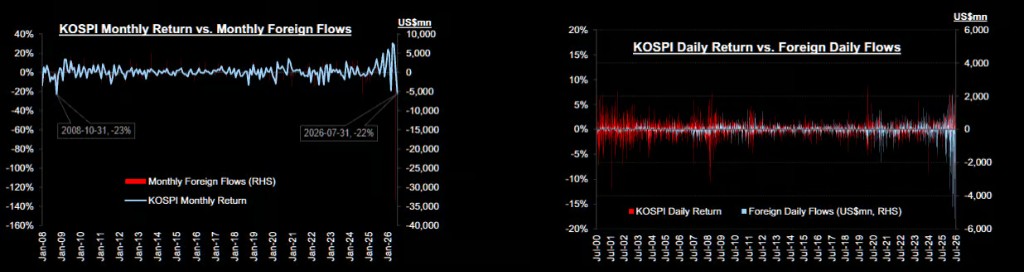 Source: Goldman Sachs
Core AI Assets Fail to Follow the Rally; Confidence in the Supply Chain Still Needs Repair
As a key participant in the global HBM market, SK Hynix has long been regarded as the "thermometer" of the AI cycle.
Recently, however, the stock came under pressure again after rebounding near its downward trend line, showing that the previously accumulated expectations for gains still need time to be digested. Samsung Electronics faces a similar situation, pulling back after touching key technical levels.
Japanese memory company Kioxia has also released similar signals through its price trend. Previously, the stock became a market favorite due to growing demand for AI storage, but after a rapid rise, it has undergone continuous adjustment since late June, encountering resistance again after recently rebounding to a resistance zone.
The commonality among these companies is that they are not merely AI concept stocks, but enterprises truly positioned at the core of the AI infrastructure cycle. Therefore, their prolonged inability to strengthen has become a significant point of doubt in the current market rally.
U.S. Semiconductor Rebound Still Awaits Validation from Asian Assets
Over the past few quarters, the logic of AI capital expenditure has revolved around a core chain: cloud providers increasing investment, driving growth in GPU demand, which in turn boosts demand for HBM, advanced packaging, and semiconductor equipment.
In this chain, Asian memory manufacturers are at the very forefront.
Therefore, if the AI cycle is entering a new upward phase, the stock performance of companies like SK Hynix and Samsung should typically serve as a confirmation signal. The current divergence between U.S. semiconductor indices and Asian AI assets means the market cannot completely rule out another possibility: following the previous sharp decline, capital merely covered positions rather than repricing the AI earnings cycle.
Of course, after adjustments, the valuation attractiveness of some Asian AI assets is improving. However, until market sentiment fully recovers, stock performance remains an important basis for judging trends.
For the AI rally, whether the core assets of the industry chain can regain strength is the key to whether the rebound can continue. At present, the AI canary is still struggling.