
SpaceX Shares Surge Over 6% on $100 Billion Unlock Day! The 14% Plunge on Wednesday Was the Real 'Unlock Sell-Off'
 Complete. Here is the key summary
On August 6, SpaceX saw the lifting of restrictions on its first batch of 911.5 million restricted shares. Instead of falling, the stock price rose 6.14%, with trading volume reaching 251 million shares, hitting a one-and-a-half-month high. The 14% plunge on Wednesday, with 200 million shares traded, had already largely exhausted marginal sellers. Market participants pointed out that some short-selling strategies were not merely betting on deteriorating fundamentals but were targeting the concentrated cashing out after the lifting of restricted shares. If actual selling by insiders falls short of expectations, the pressure for short covering cannot be ignored
On August 6, the first batch of 911.5 million insider restricted shares of SpaceX was officially unlocked, potentially releasing a market value of approximately $100 billion—but the secondary stampede widely priced in by the market did not occur.
The stock price rose about 5% after the opening, with trading volume reaching approximately 93 million shares in the first half-hour, equivalent to about 40% of the full-day volume of the previous trading day. The total number of tradable shares increased from about 639 million to about 1.55 billion, more than doubling in scale, yet the price did not fall.
SpaceX finally closed up 6.14% on Thursday, with a full-day trading volume of 251 million shares, marking a new high since June 18.
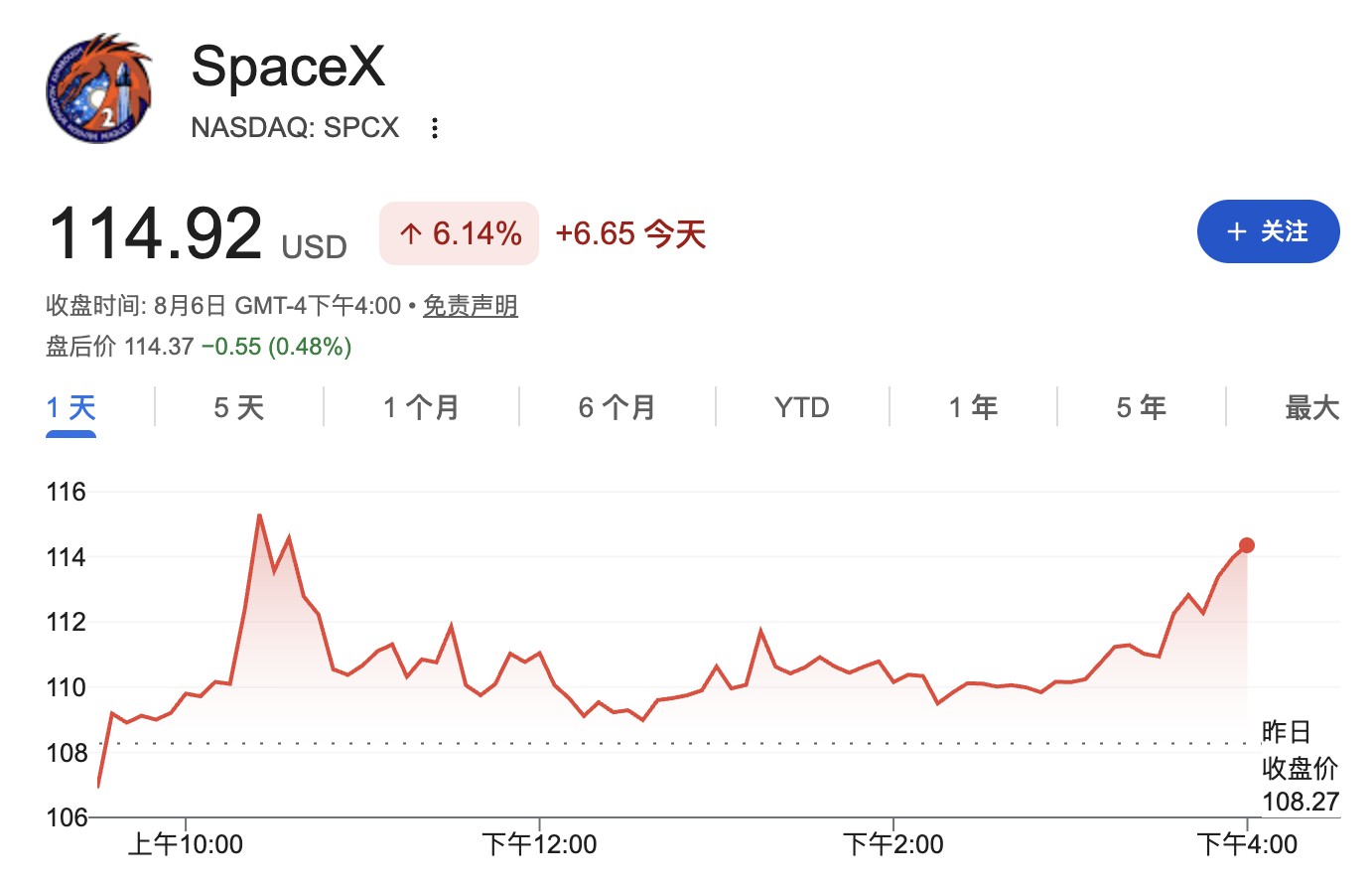
The underlying strength of this "resilience" was the brutal clearing on Wednesday. At that time, SpaceX's stock price plummeted nearly 14% in a single day to $108.27, with trading volume surging to about 200 million shares, driven by AI capital expenditures exceeding $18 billion in its first quarterly report after listing—nearly 40% higher than analysts' expectations.
Market participants pointed out that some short-selling strategies were not merely betting on deteriorating fundamentals but were targeting the potential concentrated cashing out by early investors and employees after the lifting of restricted shares. If actual selling by insiders falls short of expectations, the pressure for short covering cannot be ignored.
However, the unlocking process is far from over. This is only the first step in SpaceX's unique nine-stage phased unlocking mechanism—Bernstein noted that this mechanism is "extremely complex," far from comparable to the traditional one-time unlocking 180 days after an IPO.
In June 2027, the largest release will occur, involving approximately 6.4 billion Class A common shares held by Musk. By Wednesday, short positions in SpaceX had reached about 36% of the float, with paper profits exceeding $9 billion. The price increase on Thursday signals that the short-term alarm has been lifted, but the long-term supply and demand game has just begun.
Thursday's "Counter-Intuitive" Move: Why the $100 Billion Unlock Didn't Create a Pit
After the opening on Thursday, SpaceX's stock price rose about 5%, with trading volume reaching approximately 93 million shares in the first half-hour, equivalent to about 40% of the full-day volume of the previous trading day.
Wall Street investment banks acted quickly after Wednesday's plunge: JPMorgan raised its target price from $225 to $240, Goldman Sachs set it at $220, and Morgan Stanley reiterated its $300 target. At least six brokerages, including Morgan Stanley, maintained their buy ratings.
Coupled with the passive configuration demand brought by the inclusion in the Nasdaq 100 Index, these factors jointly built a cushion for Thursday's unlock.
But the most fundamental cushion came from Wednesday itself. With a single-day plunge of nearly 14% and trading volume surging to a new high since June 18 (Thursday's volume again surpassed Wednesday's), marginal sellers had been largely exhausted.
Early investors still retained paper profits even after the stock price fell below the issue price—unlocking does not necessarily mean inevitable selling.
Retail Investors vs. Institutions: One Quarterly Report, Two Answers
There is another overlooked footnote to Thursday's stability—Wednesday's plunge itself was not a uniform bearish signal.
According to data from Vanda Research, retail investors net bought about $22.7 million worth of SpaceX shares in the first hour of trading on Wednesday, ranking third among the 37 opening sessions since the stock's listing, and more than three times the average net inflow in the first hour.
Institutions were cautious due to soaring AI capital expenditures and short-term earnings pressure, while retail investors viewed the aggressive investment as a signal of increased probability of long-term winners.
Brent Donnelly, founder of Spectra Markets, cited three comparable cases before the unlock, noting that although the sample size was limited and the scale of previous cases was far smaller than SpaceX, the first day of unlocking constituted a tradable phase bottom in all cases.
His judgment was: "Supply shock is more likely a misleading bearish signal rather than a truly effective negative factor."
Nine-Stage Unlock: The Real Test Lies Ahead
This unlock for SpaceX is far from the end. The company adopts a nine-stage phased unlocking mechanism, with subsequent restricted shares to be released sequentially in the coming months.
The largest batch is locked until June 2027—approximately 6.4 billion Class A common shares held by Musk will be unlocked then, significantly expanding the market float again.
Short sellers did not exit due to the stability on the first day of unlocking. According to S3 Partners data, as of Wednesday's close, about 36% of SpaceX's floating shares had been sold short, with cumulative paper profits exceeding $9 billion.
Market participants pointed out that some short-selling strategies were not merely betting on deteriorating fundamentals but were targeting the potential concentrated cashing out by early investors and employees after the lifting of restricted shares. If actual selling by insiders falls short of expectations, the pressure for short covering cannot be ignored.
A More Fundamental Issue Than Unlocking
SpaceX's true challenge lies not on the supply side. During its June IPO, the market priced it with a narrative of "scarce space assets"—the world's only reusable rocket company, Starlink covering tens of millions of users, and near-monopoly in launches.
But the first quarterly report exposed another side: AI capital expenditures exceeded $18 billion, with the shadow of data centers overshadowing rocket exhaust. SpaceX is being redefined by the market from a "space company with AI" to an "AI computing infrastructure provider"—and the market is currently sensitive to the narrative of AI money-burning.
Thursday's calm answered the question "Will it crash?"—No. But it did not answer "How much is it worth?"
The IPO issue price of $135 was broken on Wednesday and has not yet been recovered; this level is the baseline that both bulls and bears are currently recalibrating. Subsequent market trends will depend on whether new funds can continuously absorb the unlocked shares being released, and when SpaceX's AI investments will begin to translate into visible returns.