
 I'm LongbridgeAI, I can summarize articles.
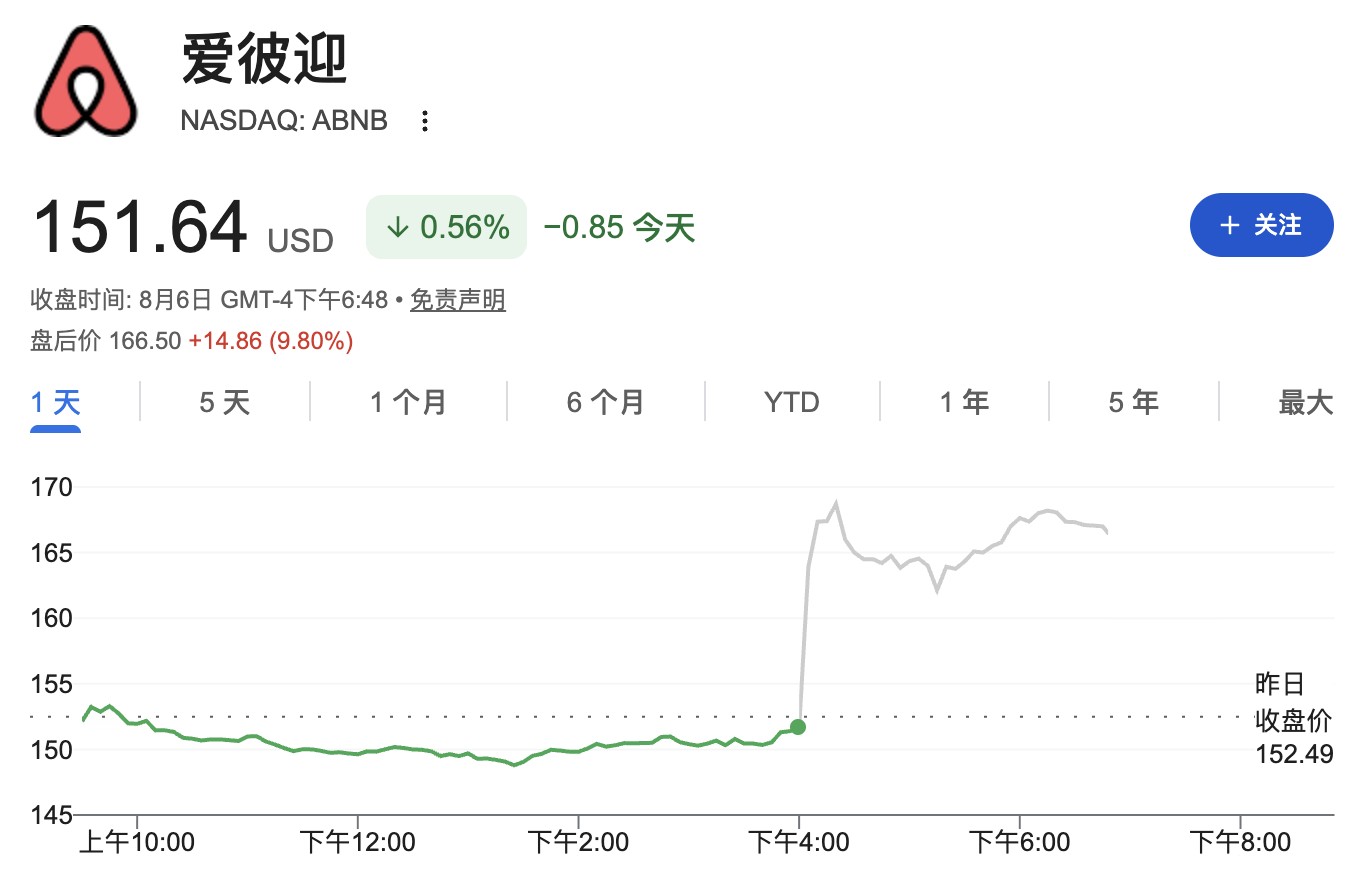
Airbnb reported Q2 revenue of $3.6 billion, a 17% year-over-year increase, with net profit surging 27% and bookings hitting record highs. The number of nights booked in the US market saw its fastest growth in three years, while growth in the European market also accelerated compared to Q1. The company raised its full-year guidance, increasing the 2026 full-year revenue growth forecast from "low-to-mid teens" to "at least mid-teens," whereas the market had previously expected Airbnb's full-year revenue growth to be around 14%. Airbnb's stock rose over 10% in after-hours trading
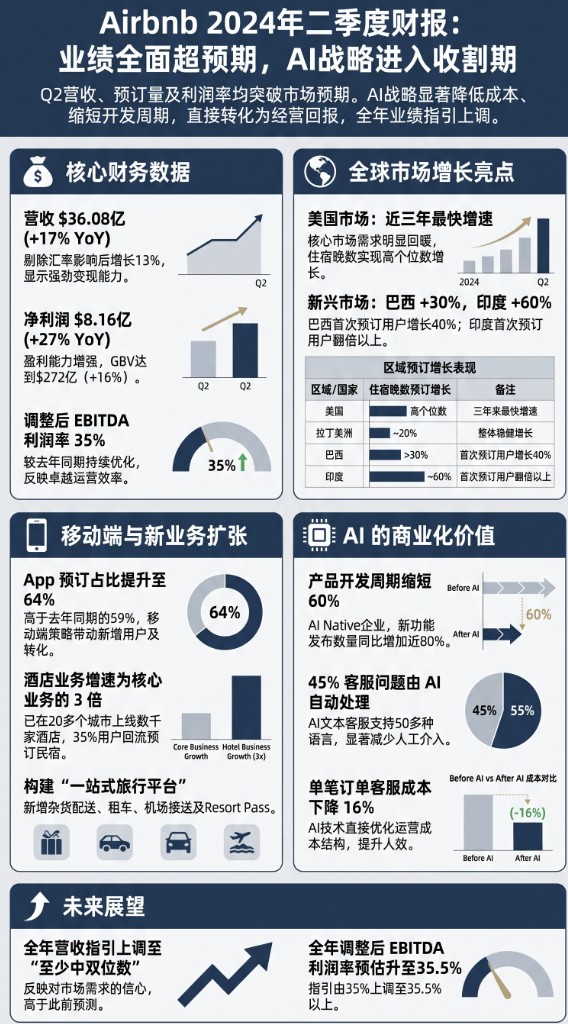
Airbnb delivered a quarterly performance that exceeded expectations. Driven by sustained strong travel demand in the US and Europe, as well as product upgrades, Airbnb's Q2 revenue, booking volume, and profit margins all surpassed market expectations. The company raised its full-year earnings outlook for the second time this year and expects booking volume in Q3 to maintain double-digit growth.
Airbnb's Q2 revenue reached $3.608 billion, a 17% year-over-year increase; excluding the impact of exchange rates, growth was 13%. Net profit amounted to $816 million, up 27% year-over-year. Adjusted EBITDA reached $1.261 billion, a 21% year-over-year increase, with the adjusted EBITDA margin rising to 35%.
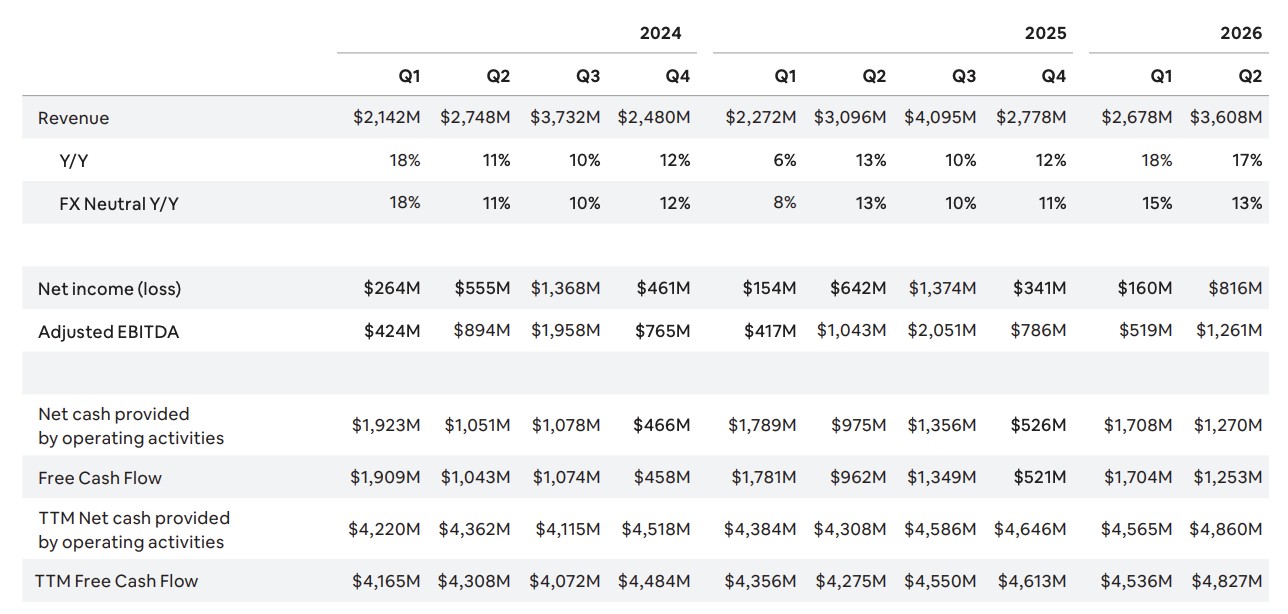
Business metrics also showed strong performance.
In Q2, the platform's nights and experiences booked reached 148.3 million, a 10% year-over-year increase, exceeding market expectations; Gross Booking Value (GBV) reached $27.2 billion, up 16% year-over-year. The Average Daily Rate (ADR) rose 5% year-over-year, indicating that both demand growth and higher rates contributed to the expansion of transaction volume on the platform.
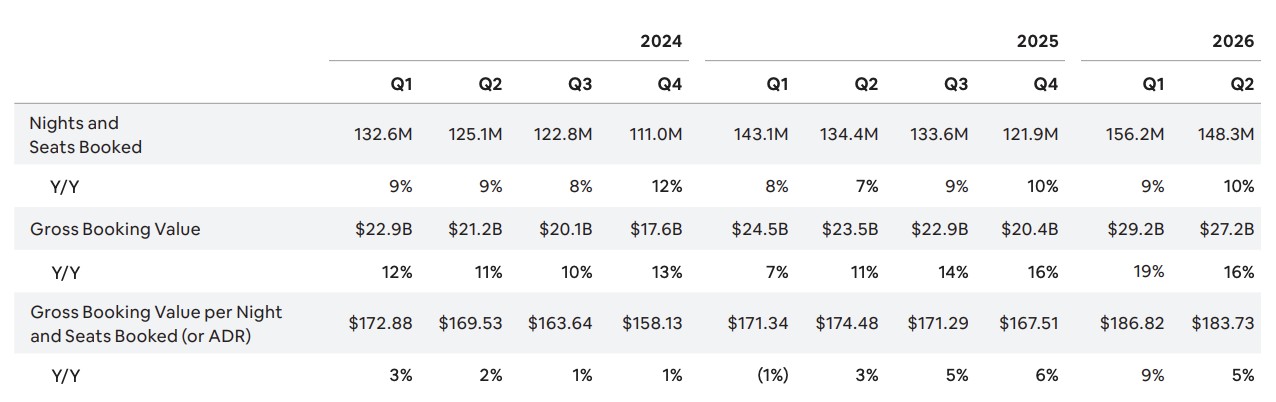
The strong quarterly performance also prompted Airbnb to raise its full-year expectations again.
The company expects that the full-year 2026 revenue growth rate will increase from the previous "low-to-mid teens" to "at least mid-teens"; the full-year adjusted EBITDA margin is expected to be no less than 35.5%, higher than the previous guidance of 35%. The company stated that the raised guidance primarily reflects sustained strong demand on the platform, as well as returns from investments in talent, technology, marketing, and product execution.
The market had previously expected Airbnb's full-year revenue growth to be around 14%, meaning this guidance indicates further strengthened confidence in growth for the coming quarters.
Boosted by this news, Airbnb's stock rose approximately 11% in after-hours trading.
Of even greater interest to the market is that, while travel demand remains resilient, Airbnb is gradually integrating AI into core areas such as search, customer service, and personalized recommendations, and is beginning to see tangible returns like cost reductions and improved conversion rates.
This means AI is evolving from a back-office tool for efficiency improvement into a new engine driving company growth.
Significant Recovery in US and European Demand, Core Markets Re-accelerating
From a regional perspective, Airbnb's biggest surprise came from mature markets.
The company stated that nights booked in the US market achieved high single-digit year-over-year growth, the fastest pace in nearly three years; core markets such as France, the UK, and Australia also further accelerated compared to Q1.
Meanwhile, emerging markets continued to expand at a high speed.
Nights booked in Latin America grew by approximately 20%, with bookings in Brazil increasing by over 30% and first-time booking users growing by 40%; nights booked in the Asia-Pacific region reached high double-digit growth, Japan maintained high double-digit growth, and bookings in India surged approximately 60% year-over-year, with the number of first-time booking users more than doubling year-over-year.
The company believes that product optimization, localized marketing, and mobile strategies are continuously bringing in new users.
Data shows that app-side nights booked in Q2 increased 23% year-over-year, accounting for 64% of total bookings, higher than 59% in the same period last year; first-time booking users increased 11% year-over-year, reaching the highest level in four years.
For the third quarter, the company expects nights and experiences booked to maintain low double-digit growth, continuing to outperform the consensus forecasts on Wall Street.
Hotel Business Accelerates Expansion, Building a "One-Stop Travel Platform"
In addition to its traditional homestay business, Airbnb is continuously expanding its travel ecosystem.
The company stated that it has currently launched thousands of boutique and independent hotels in over 20 popular destinations including New York, Paris, London, Madrid, Rome, and Singapore, and introduced a price match guarantee along with up to 15% cashback in Airbnb credits to attract hotel users to the platform. Approximately 35% of users who book hotels on Airbnb for the first time subsequently return to the platform to book homestays.
Although the hotel business currently accounts for only a single-digit percentage of nights booked on the platform, its growth rate is about three times that of the core homestay business, becoming a new growth point.
At the same time, the company continues to expand its service ecosystem.
In its summer update this year, Airbnb added services such as grocery delivery, car rentals, airport transfers, and luggage storage, and launched the Resort Pass, allowing users to purchase access to hotel amenities separately without staying at the hotel, further enriching travel consumption scenarios.
AI Begins to Deliver Commercial Value: Customer Service Costs Down 16%, Search Experience Upgraded
AI became another major focus this quarter.
Airbnb CEO Brian Chesky stated that the company has restructured Airbnb into an "AI Native" enterprise, with AI helping the company develop products faster. Currently, the development cycle from product concept to launch has been shortened by up to 60%, and the number of new features launched this year increased by nearly 80% year-over-year.
The most direct commercial value of AI is already evident in the customer service system.
The company's AI text-based customer service now supports over 50 languages, and approximately 45% of customer service inquiries can be resolved without human intervention, driving a year-over-year decrease of approximately 16% in customer service costs per order in Q2. Later this year, the company will also launch AI voice customer service, further extending AI capabilities to telephone services.
Furthermore, Airbnb will roll out several AI features later this year, including:
-
An AI listing comparison tool to help users quickly compare multiple listings;
-
An AI search entry point on the homepage, supporting natural language search and returning results in a chatbot-like manner;
-
AI-generated personalized listing titles and recommended content to improve search conversion rates.
Brian Chesky stated that the traditional search box will remain the default entry point. The company will not force users to switch to AI search but will gradually cultivate user habits.
For investors, this means Airbnb's AI strategy is no longer just a concept but is beginning to form quantifiable operational returns in terms of improving operational efficiency, reducing costs, and enhancing user experience.