
Guojin Macro: The Fed's New World Without Forward Guidance
 Complete. Here is the key summary
Guojin Macro points out that under Waller's leadership, the Federal Reserve has abandoned explicit forward guidance in favor of ambiguous monetary policy. This move aims to suppress leverage and asset bubbles by creating uncertainty, rather than stabilizing expectations. As a result, the market treats every economic data release as a "mini FOMC," leading to elevated interest rate volatility and sharp fluctuations in financial conditions, with highly leveraged entities facing greater refinancing risks
US stocks seem to have emerged from the July gloom following the earnings releases of major tech companies, but long-term US Treasuries are still crying out in pain.
In this new world without forward guidance, every economic data release is like a "mini FOMC": a non-farm payrolls report missing expectations or an inflation report meeting expectations can trigger a reversal in trades from "tightening to easing," and vice versa.
However, the absence of forward guidance does not mean the central bank has lost its influence; rather, the mode of influence has shifted from "stabilizing expectations" to "creating uncertainty." Even if the Fed does not raise rates, it can withdraw commitments and restore two-way risk, causing the market to push up real interest rates, term premiums, and associated financing costs.
More ambiguous monetary policy is not without merit: if the central bank does not provide stable commitments to the market, investors cannot be certain that every risk event will be backed by policy support, which may curb leverage and asset bubbles.
However, the short-term costs are significant: every piece of information related to the central bank is amplified, greater volatility requires higher risk compensation, interest rate volatility remains high, financial conditions are more prone to sharp fluctuations with data releases, and highly leveraged entities face greater refinancing risks.
I. Abandoning Explicit Forward Guidance, Strengthening Implicit Data Dependence
Forward guidance generally includes three types: calendar-based guidance, which commits to maintaining policy until a certain point in time; condition-based guidance, which ties policy adjustments to economic data such as inflation and unemployment rates; and path-based guidance, which announces future interest rate trends through forms such as dot plots, forecasts, and officials' speeches.
The Federal Reserve under Waller's leadership is simultaneously weakening all three directions: it does not specify action timelines, set data thresholds, allow forecasts and speeches to form market consensus, or even inform the market of the specific data on which actions depend.
Waller promoted his grand macroeconomic worldview in his FOMC debut in June, while the significance of the July FOMC meeting was to solidify Waller's future style—everything becomes ambiguous. It must be acknowledged that there is a realistic basis for the central bank's exit from forward guidance. Under the successive shocks of public health events, tariffs, geopolitics, energy supply, and AI capital expenditure, the supply side of the real economy is increasingly difficult to outline, naturally allowing monetary policy acting on the demand side to reduce its presence.
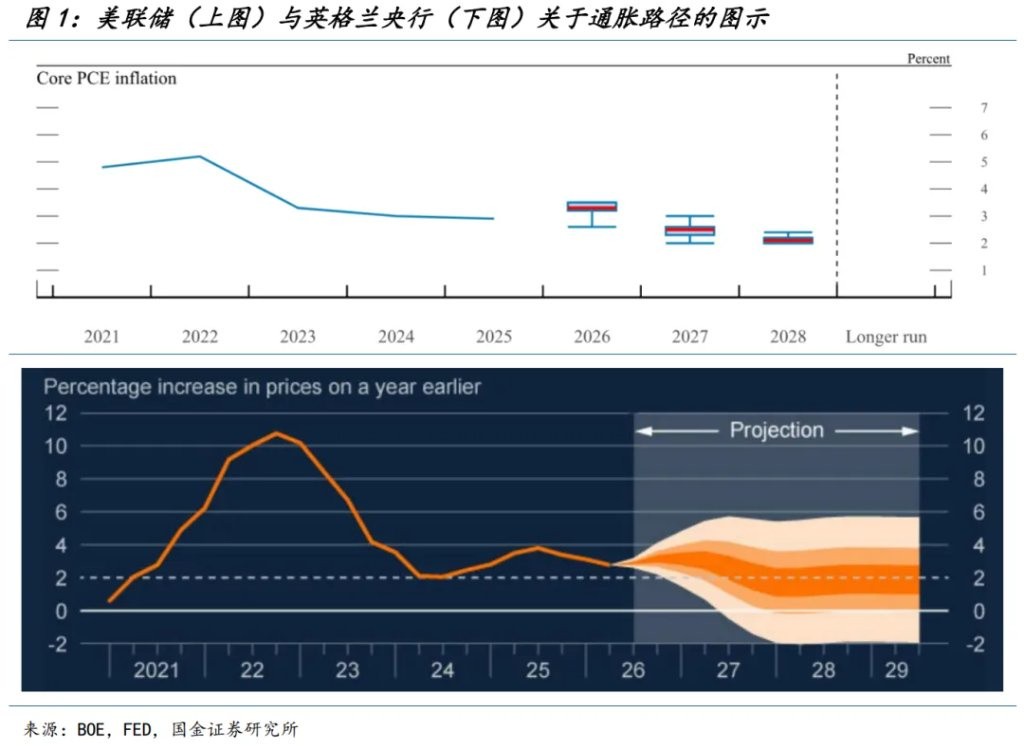
Waller's working group has recruited former Bank of England Governor Mervyn King to improve communication methods. The Fed may choose to refer to the Bank of England's lower-information expression style. Taking the Bank of England's inflation fan chart as an example, the forecast interval widens rapidly with the horizon, with the upper and lower bounds at the far end almost covering everything from deflation to significantly high inflation. Compared with the current Fed's inflation forecasts (Figure 1, top), the Bank of England's fan chart (Figure 1, bottom) provides more "ineffective" information.
The disappearance of forward guidance is not the only anchor the market has lost. Waller has also further blurred for investors which inflation indicator to rely on, how to distinguish supply shocks from broad inflation, under what conditions to act, and how much cost in terms of growth and employment they are willing to bear.
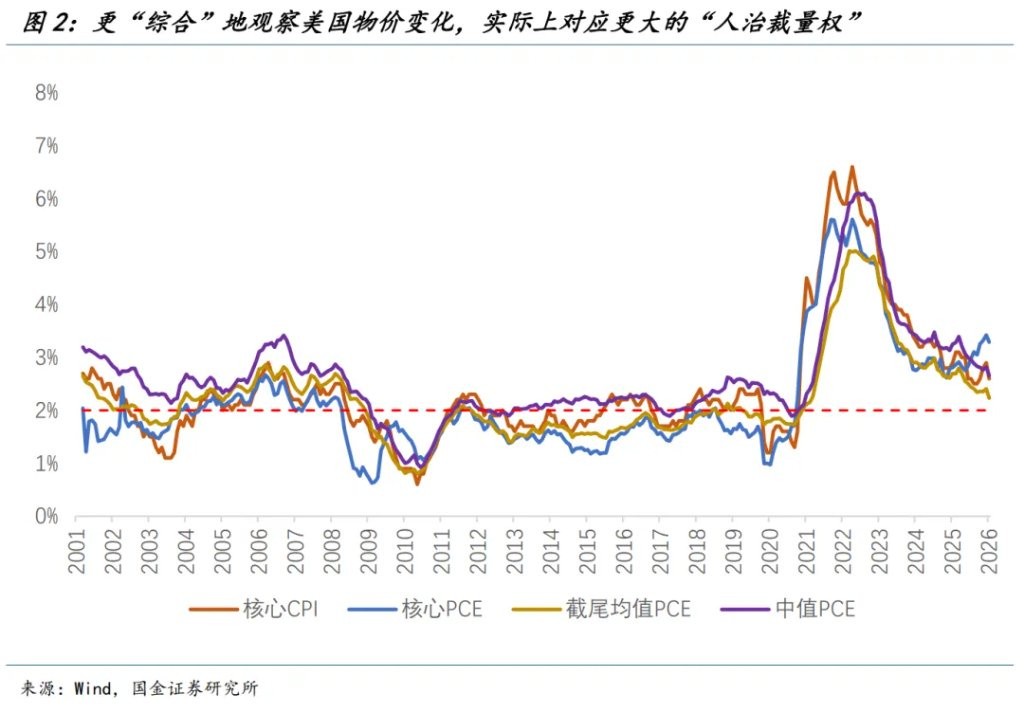
This ambiguity is first reflected in the inflation metric. Waller acknowledges that PCE remains the official target while emphasizing that he will observe CPI and broader "underlying price changes." However, "composite" means it is harder for the market to establish a reproducible reaction function. To some extent, this is like a word game: the real economy does not operate in a parallel universe, and different reference scales correspond to a unique economic reality—"composite" actually implies greater "discretionary power."
Waller hopes the market will form independent views and accepts divergence between market and Fed opinions, but the Fed does not commit to validating or fulfilling market pricing. Consequently, the Fed (and the Treasury) needs to tolerate the current more extreme market combination: the highest 30-year US Treasury yield since 2007 coexisting with record-high US stocks; year-to-date expectations of approximately 35bp in rate hikes coexisting with rising precious metals prices; furthermore, despite long-term US Treasuries struggling to protect their own value, the first joint US-Japan currency intervention in 15 years was conducted.
II. Every Economic Data Release Becomes a "Mini FOMC"
With reduced forward guidance, the market can only infer the Fed's reaction function from high-frequency data. Non-farm payrolls, CPI, PCE, and retail sales data will contribute more significantly to policy decisions at the next FOMC meeting, effectively being treated as a "mini FOMC," forming a shorter transmission chain between "data release—policy pricing—financial conditions."
The problem is that macroeconomic data contains errors, seasonal adjustments, and revisions, but monetary policy cannot be backtested at high frequency. Moreover, recent economic data has hardly provided a clear economic direction. How much weight the market assigns to inflation, employment, consumption, and even geopolitics requires time to explore.
Therefore, so-called data dependence is turning into data noise. Risks for short-term interest rates are no longer concentrated in policy statements but dispersed across every data release point.
Even if the final policy rate remains unchanged, the repeated repricing around the path is naturally unfavorable for financial markets. In a new world lacking monetary policy forward guidance, bonds, as the simplest and purest assets, bear the brunt of crossing the river by feeling the stones, leading to a naturally slower adjustment pace for long-term interest rates.
If we observe the feedback of asset prices after each FOMC meeting that kept interest rates unchanged since September 2024, we can find that the volatility generated after the July 2024 meeting was the largest, which may also be a manifestation of the new era. In the past, central banks suppressed path uncertainty by committing to future actions; now, central banks attempt to suppress leverage, asset bubbles, and reliance on "central bank put options" by refusing to commit and restoring two-way risk.
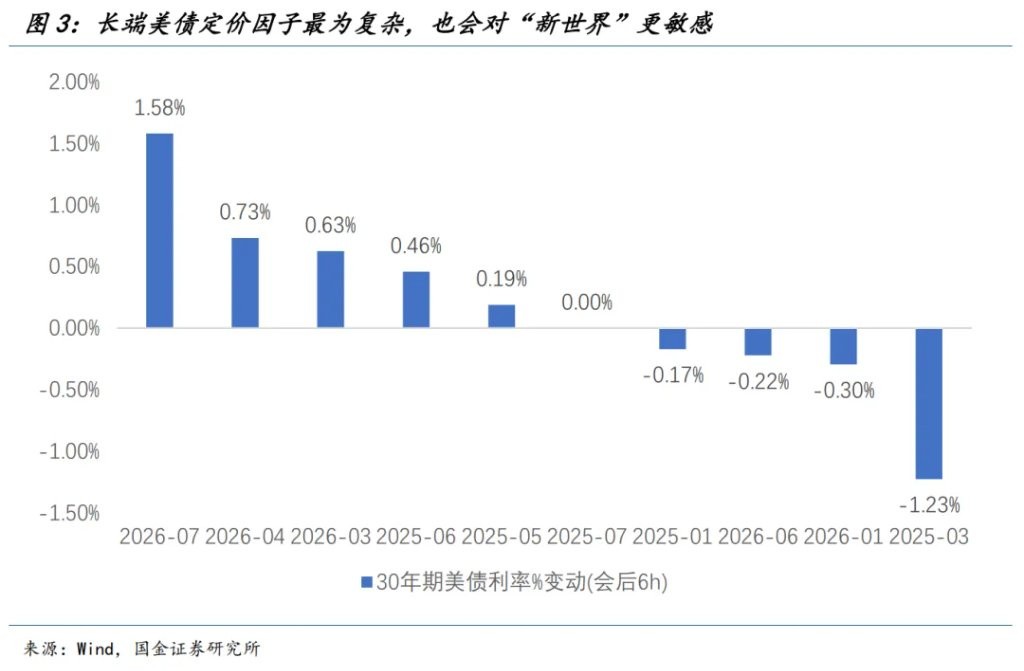
Of course, more ambiguous monetary policy is not without merit: if the central bank does not provide stable commitments to the market, investors cannot be certain that every risk event will be backed by policy support, which may curb leverage and asset bubbles. But the short-term costs are significant: higher risk compensation, interest rate volatility remaining at high levels, financial conditions being more prone to sharp fluctuations with data, and highly leveraged entities facing greater refinancing risks.
Therefore, the absence of forward guidance does not mean the central bank has lost its influence; rather, the mode of influence has shifted from "stabilizing expectations" to "creating uncertainty." Currently, trades reversing from "tightening to easing" are triggered more easily: a non-farm payrolls report missing expectations or an inflation report meeting expectations is sufficient, and vice versa.
Risk Warning and Disclaimer
The market involves risks, and investment should be approached with caution. This article does not constitute personal investment advice, nor does it take into account the specific investment objectives, financial status, or needs of individual users. Users should consider whether any opinions, views, or conclusions in this article align with their specific circumstances. Investment based on this content is at the user's own risk.