
Microsoft Lacks Computing Power, Musk Steps In? SemiAnalysis: SpaceX May Add Over 10GW of Compute in 2027, with ARR Potentially Reaching $300 Billion
 I'm LongbridgeAI, I can summarize articles.
After evaluating all pilot sites, SemiAnalysis believes SpaceX's goal of adding over 10GW of computing power in 2027 is feasible. Due to a significant demand gap, Microsoft is expected to sign a contract with SpaceX for 3GW, valued at approximately $150 billion, becoming its largest computing customer. If half of the new computing power is used for commercial inference, SpaceX's Annual Recurring Revenue (ARR) could reach $300 billion by the end of 2027
SpaceX is transforming into a hyperscale computing provider at a pace exceeding market expectations.
A recent report by research firm SemiAnalysis points out that SpaceX is poised to add over 10GW of computing power by the end of 2027, potentially driving Annual Recurring Revenue (ARR) as high as $300 billion, with Microsoft becoming its largest customer.
Previously, during SpaceX's inaugural earnings call, Musk announced that the company's "conservative" target is to build and deliver an incremental 6 to 8GW of computing power in 2027 alone, with upside potential exceeding 10GW. Based on capital expenditures of $50 billion per GW, this implies capital spending of $300 billion to $500 billion in 2027, comparable to the expected investments by AWS and Google—a figure that shocked the market, given that the company's profitability falls far short of mainstream hyperscale cloud providers.
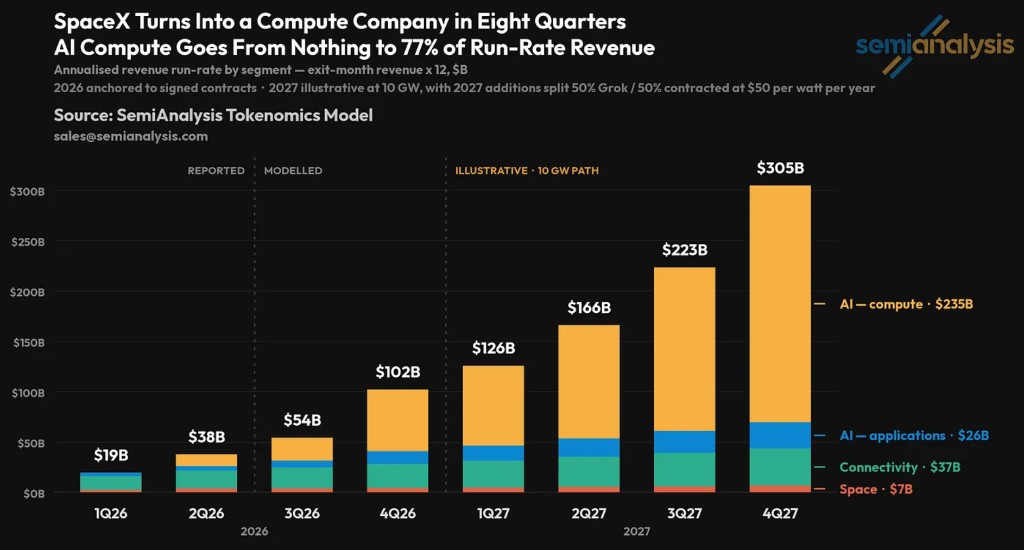
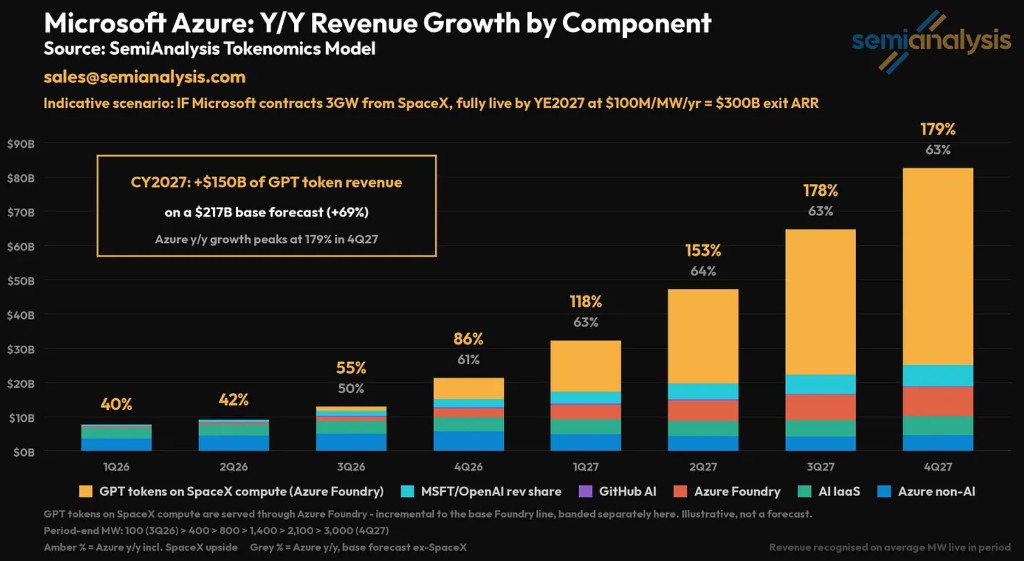
SemiAnalysis stated that it has evaluated all suitable sites for SpaceX and tracked available gas-powered generation equipment on a quarterly basis, believing the aforementioned targets are realistically feasible. The report also noted that Microsoft has signed data center contracts totaling over 10GW year-to-date, with a total contract value exceeding $300 billion. Its potential demand for SpaceX's computing power will be a key variable driving Azure's revenue growth from approximately 42% to over 100%.
Ultra-High Margins in Inference Computing Drive Demand Explosion
SemiAnalysis's core logic is built on the high profit margins of AI inference businesses.
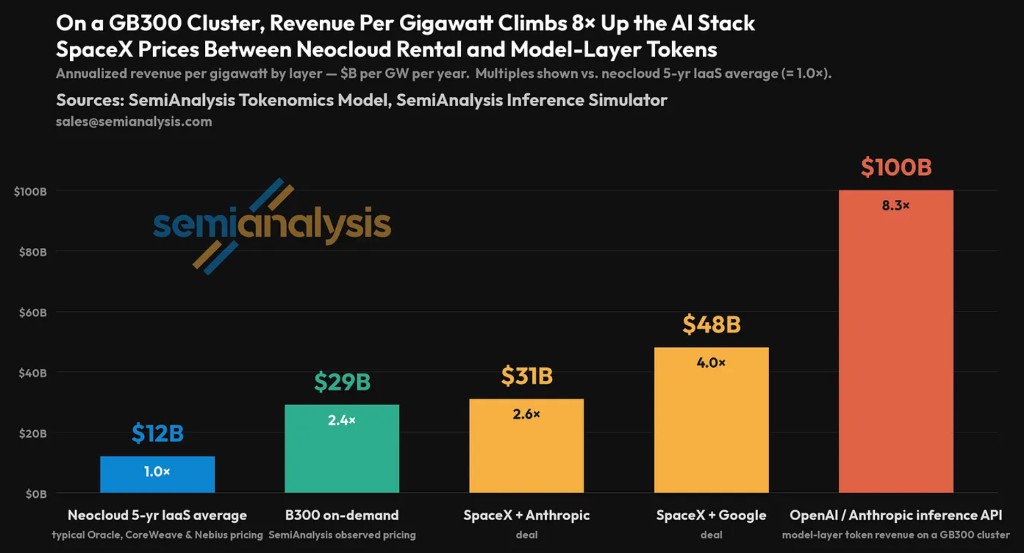
According to the firm's Tokenomics model and inference simulator, when OpenAI and Anthropic provide API inference services on GB300 clusters, each GW can generate over $100 billion in annual revenue. Calculated at a conservative lease price of $3 per GPU per hour, the annual cost per GW is approximately $12 billion, resulting in an inference gross margin exceeding 60%, with some flagship models reaching over 85%.
This economic model applies equally to Microsoft.
SemiAnalysis pointed out that Microsoft canceled the original 20% revenue-sharing clause in the OpenAI agreement renegotiated in April 2026. This means that when Microsoft uses OpenAI models to provide inference services, it can achieve revenue per MW and profit margins similar to those of OpenAI and Anthropic, without bearing any training costs.
The report characterized this situation as a "once-in-a-century opportunity."
Microsoft's Computing Power Gap Opens a Window for SpaceX
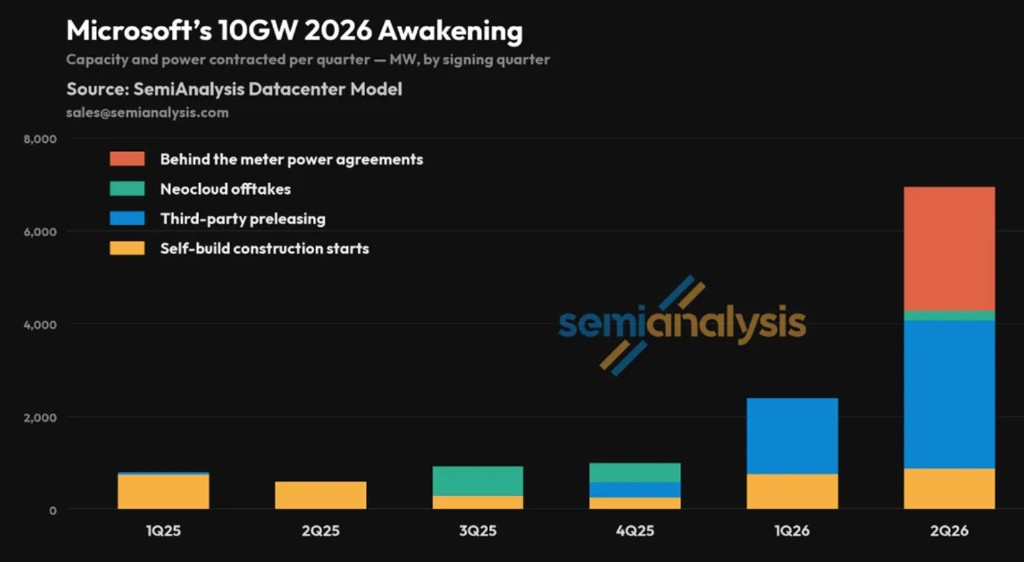
Microsoft had significantly slowed down data center leasing activities in late 2024, but SemiAnalysis stated that this situation completely reversed between 2025 and 2026.
In October 2025, Microsoft signed an Infrastructure-as-a-Service agreement with OpenAI valued at $250 billion. SemiAnalysis estimates this agreement corresponds to approximately 7GW of computing power, severely limiting Microsoft in its Foundry API business and application scenarios such as Copilot.
To fill this gap, Microsoft has signed binding contracts totaling over 10GW year-to-date across multiple dimensions, including leasing, self-construction, and long-term power purchase agreements.
SemiAnalysis believes that the possibility of Microsoft signing a 3GW contract with SpaceX, valued at approximately $150 billion, is "not impossible," for two reasons: First, Microsoft itself is in a cycle of massive computing expansion; second, SpaceX offers a 90-day cancellation clause, consistent with its contract terms with Anthropic and Google, resulting in extremely low financial risk and ease of internal approval.
SpaceX's Construction Speed: Disrupting Industry Norms
SemiAnalysis attributes SpaceX's competitive advantage to a systematic disruption of traditional data center construction logic.
The report cited several specific cases: the 300MW Colossus 1 facility was completed in 122 days; the Southaven plant expanded from 27 gas turbines (approximately 495MW) in February 2026 to 69 turbines (1.7GW) in July 2026; and the "MiniHard" project began vertical construction in March 2026, expected to reach 450 to 500MW within about five months.

To address supply chain bottlenecks, SpaceX adopted a series of unconventional strategies: replacing large power transformers, which had backlogs of over two years, with Chinese-made power modules; procuring gas turbines in the secondary market (including equipment originally scheduled for delivery to Oracle's New Mexico site); and compressing commissioning cycles through highly parallelized construction and pre-assembly. At peak times, Colossus 2 employed approximately 3,000 workers daily, far below the industry average for data centers of similar scale.
SemiAnalysis pointed out that SpaceX's core competitiveness lies in replacing the industry's prevailing "efficiency-first" logic with a "speed-first" approach. In the current context of extreme scarcity of computing power and ultra-high AI inference profit margins, a 500MW cluster that can be delivered within three months and includes a 90-day cancellation clause is one of the scarcest assets in the market. Google's eventual decision to sign with SpaceX serves as strong evidence for this logic.
Financing Path: Nvidia Supplier Financing and Cash Flow Rollover
Addressing external doubts about SpaceX's capital strength, SemiAnalysis proposed two financing paths.
First, Nvidia may reduce SpaceX's upfront cash expenditures through supplier financing—this is also considered a major reason why Musk announced the exclusive adoption of Nvidia chips during the earnings call, although SpaceX had previously evaluated alternative solutions such as TPUs and AMD. Second, leveraging the industry's fastest delivery cycle, SpaceX prices its services at a high premium of $30 million to $50 million per MW annually, allowing capital expenditures to be recovered through operating cash flow in less than a year.
Combining these factors, SemiAnalysis predicts that assuming only 50% of SpaceX's newly added computing power in 2027 is used for commercial inference monetization (with the rest used for training by the Grok and Cursor teams), SpaceX's ARR is expected to reach $300 billion by the end of 2027.